Free the Government’s Plantation
The New York Times, Oct. 6, 1991
Washington, D.C., with a population of 607,000, has more people than Alaska, Wyoming or Vermont. But its elected officials have no real power and the city is denied a voting representative in Congress. The Federal Government treats the District as a colony, controlling local policy on issues ranging from sanitation to abortion and undermining the city’s ability to raise revenues.
Washingtonians deserve self-government no less than other Americans. A bill pending in Congress, H.R. 2482, would admit Washington to the union as New Columbia, the 51st state. The bill deserves attention and a vote of approval in the House. But that won’t happen until languid Democrats schedule hearings. The legislators need to provide more than lip service they’ve given to statehood in recent years. Even if statehood fails, debate could suggest intermediate solutions. The current arrangement is more suited to a dictatorship than a democracy.
Washingtonians have suffered long under second-class citizenship. They were first allowed to vote in Presidential elections in 1964. Permission to elect local officials followed slowly: in 1968, the school board; in 1971, a non-voting delegate to the House of Representatives; and in 1973, the mayor and the city council.
The Home Rule Act of 1973, which granted limited self-rule, contained dictatorial restrictions. The city cannot so much as reschedule garbage collection without groveling before Congress, which has 30 days in which to disapprove. Nor can the city determine its own budget or set independent policies. President George Bush recently forced the District to disallow the use of local tax revenues to furnish abortions for impoverished women. His weapon: vetoing the city budget. Impoverished victims of rape and incest will be denied a choice available to American women elsewhere.
The Federal presence harms the city fiscally. The District is forbidden to tax nonresidents, many of them Federal workers, who comprise about 60 percent of the work force. Federal properties are also exempt from real estate taxes. The city calculates that all taxing restrictions combined cost it $1.9 billion a year in revenues.
An ill-informed Mr. Bush said last year that he opposed statehood because the city’s funds `come almost exclusively from the Government.’ That’s wrong. The Federal contribution at that time was about 14 percent of the city budget, the Government gave a paltry $430 million in lieu of lost tax revenues. The cost of municipal services provided to the Government is difficult to calculate but potentially worrisome.
Those who oppose statehood often claim that the Constitution forbids creation of a state in the District. That claim is without merit. The Constitution says only that Congress will exercise exclusive legislative control over a seat of Government that does not exceed 10 miles square. A state could be created that reduce the size of the Federal enclave but not eliminate it.
The real objections to statehood are political. When Mr. Bush opposes statehood, he is opposing the creation of two additional Democratic Senators, one of whom would surely be Jesse Jackson, now an unpaid lobbyist, or `shadow senator,’ who represents Washington in the Senate. The Democrats also have acted spinelessly, giving statehood little more than token support.
How can the United States champion democracy abroad while it disenfranchises District citizens who die in wars and pay taxes the same way other Americans do? There is every reason for Democrats to gather courage, convene hearings and then bring the issue to the floor. Sooner or later, Congress will realize it has more important tasks than overseeing schedules for garbage collection.
This newspaper article was obtained from the Congressional Record in the Library of Congress related to H.R. 51, The New Columbia Admission Act of 1993. The article is not in the public domain but is being republished here under the fair use doctrine of U.S. copyright law in order to continue my advocacy for full representation for the American citizens of the District of Columbia.

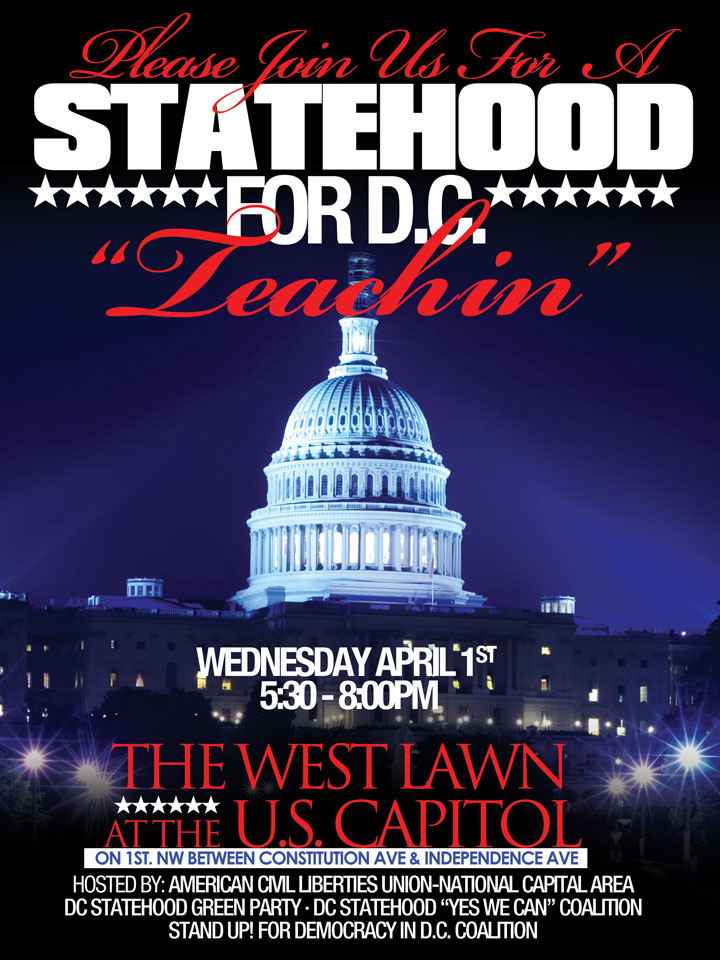
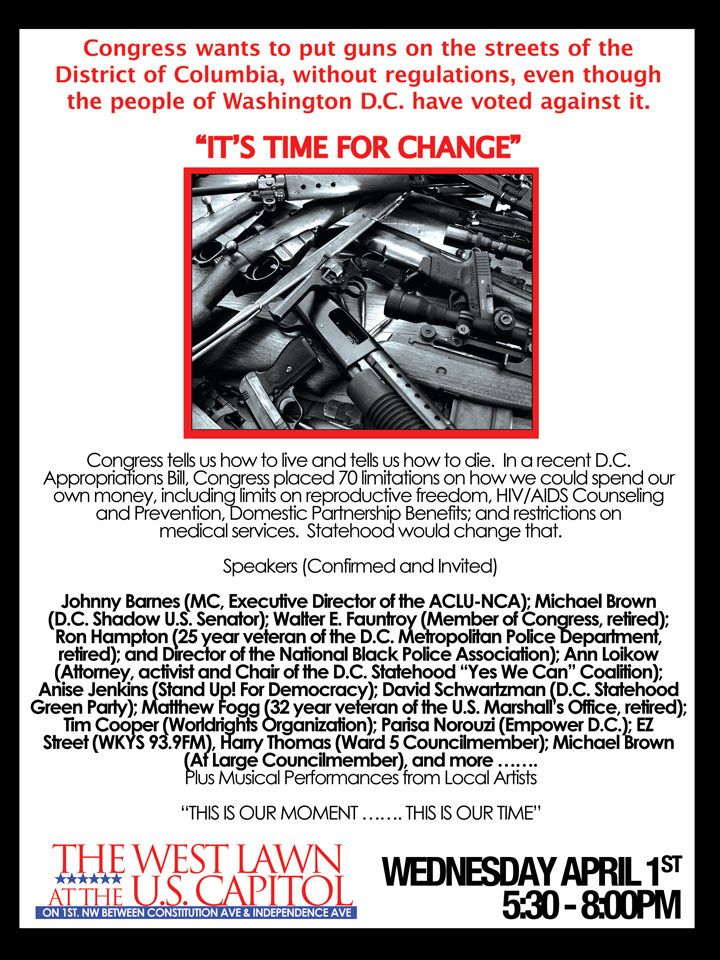
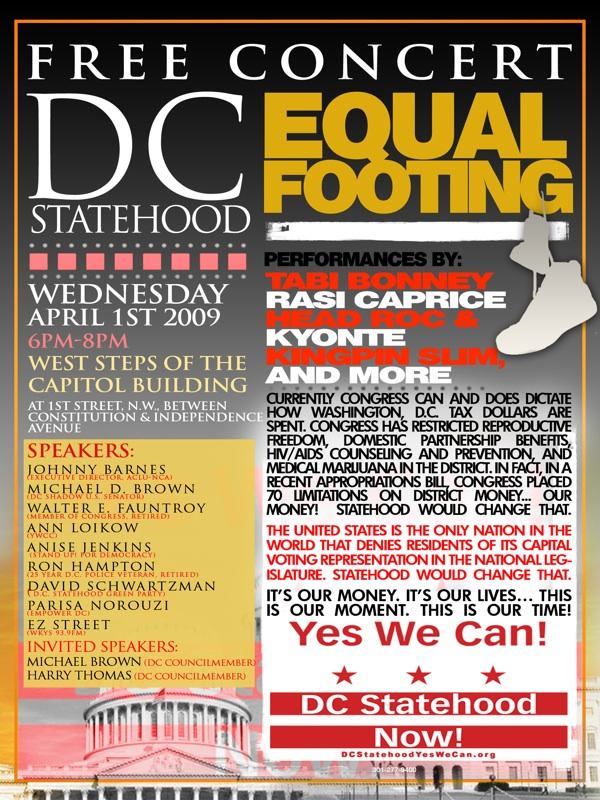


District Representation – The Washington Post, January 22, 1879
|| 10/1/2009 || 8:16 pm || Comments Off on District Representation – The Washington Post, January 22, 1879 || || 137 views
District Representation
The Washington Post, January 22, 1879
With the exception of the Indian tribes, the only community within the territorial jurisdiction of the United States unrepresented in Congress is the District of Columbia.
Territories whose few inhabitants are scattered over a broad expanse like the masts of ships on the ocean, and which neither commerce nor manufactures, send their delegates to Congress to represent their interests, and procure for them such legislation as shall tend to develop their resources and afford encouragement and protection to their people the embryo state advances toward maturity.
States with half the population of this District have their representatives in the House, and have an equal voice in the Senate with the oldest, largest, richest, and most populous members of the family states.
It is only here, at the capital of a country whose government is based on suffrage, that suffrage is unknown.
Holding to the theory that governments derive their just powers only from the consent of the governed, and that the ballot is the proper mode of expressing that consent, our Government denies the ballot to the inhabitants of its capital city.
Believing and teaching that is should be no taxation without representation, and that such taxation is tyranny, our Government levies taxes on the property of this people, and if those taxes are not paid it sells the property under the red flag and the hammer of a Government auctioneer. Thousands of homes have thus been sold here during the last few years.
We cannot see how any man, whatever may have been the result of his observation here in times past, can hold to the Democratic creed, to the great underlying principles of free government, and oppose the representation of this District in the law-making department of our governmental mechanism.
And because out faith in true Democracy is a vital reality, and not a sham, we approve the proposition to have the District of Columbia represented in the House. We see no reason why this community should be an exception to the general rule- why all should have a voice in the Capitol and we be mute.
It may be urged that the horde of negroes who swarm here will be used to elect a delegate who will misrepresent our people. We do not believe it. Intelligence and social influence, if rightly employed, will so direct public opinion that the election will be a fair expression of the wishes of our people.
As the delegate will not vote, and as his influence will depend on his being in accord with the dominant party in Congress, there will be no temptation to resort to any of those schemes and tricks that brought reproach upon popular suffrage here some years ago.
But whatever may be the fears of the timid and doubtful, we see no way in which an honest believer in Democracy can deny representation to this community. The taxpayer has a right to be heard. A delegate can speak for him. Consistency demands that this proposition should not fail for want of the support of Democrats in Congress.
This newspaper article was transcribed from a scan of the original newspaper article. The document was obtained from the Washington Post archives and is in the public domain. It is being republished here in order to continue my advocacy for full representation for the American citizens of the District of Columbia.