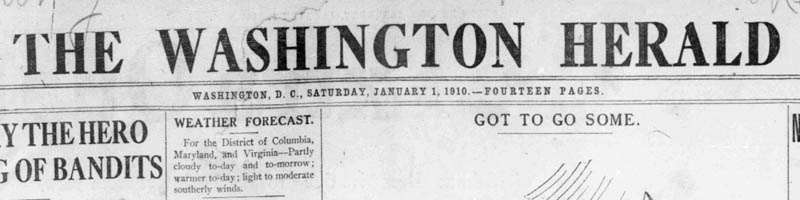
The Washington Herald first appeared on October 8, 1906 with the aim of upholding serious journalism in an era of muckraking. The paper was founded and edited by Scott C. Bone, an eminent newspaperman and former managing editor of the Washington Post from 1888 until his dismissal by new owner John R. McLean in 1905. Bone published the 16-page morning daily to challenge the position of the Post as the foundation of Washington journalism. At its peak, the Herald enjoyed a circulation of roughly 50,000, and surpassed the Post in daily sales. It occupied offices at 734 Fifteenth Street, in close vicinity to newspaper row in the city’s northwest quadrant, and its editorial board included prominent figures such as managing editor William P. Spargeon, the first president of the National Press Club. Bone himself garnered respect in the newspaper world for his work with the Post, and later the Seattle Post-Intelligencer, and went on to become governor of Alaska.
The paper created a niche for itself based on substantive news reporting, displaying the motto “A Paper of Quality” on its masthead. An early advertisement proclaimed the arrival of the Herald as a “clean, compact, newsy newspaper that would appeal to the intelligent and discriminating clientele of Washington.” Its front page most prominently featured discussions of domestic politics, followed by stories of international scope, and the occasional newsworthy crime or personal interest story. The Herald also included a page each on sports, market news, and women’s interest, plus a slew of advertisements and classifieds. Its Sunday edition attempted to rival that of the Post with a 30-page edition featuring special sections on society news, literature, theater, and serialized fiction.
Although the Herald rose to be one of the top three penny dailies in Washington, it underwent a series of transformations after its second decade. In 1913, Clinton T. Brainerd, president of the McClure Syndicate Service, purchased the paper. In 1922, the Herald was taken over by William Randolph Hearst who appointed one of the first female newspaper editors of the era – Eleanor Medill “Cissy” Patterson of the Medill media dynasty. Cissy Patterson revived the paper and its popularity, and in 1939 she merged it with the Washington Times creating the Washington Times-Herald. After her death in 1948, however, the paper declined once again. The Herald died an ironic death in 1954 when the Times-Herald was merged with the Washington Post. Although named the Washington Post and Times Herald, the Post restored its original name in 1973 and the Herald faded into obscurity.
+
1910 Publication Calendar of the Alexandria Gazette
+
1910 Publication Calendar of the Deseret Evening News
+
1910 Publication Calendar of the Los Angeles Herald
+
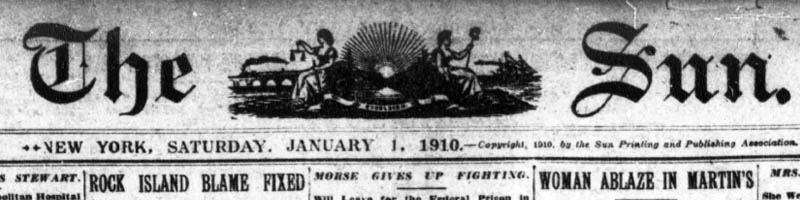
1910 Publication Calendar of the New York Sun
+
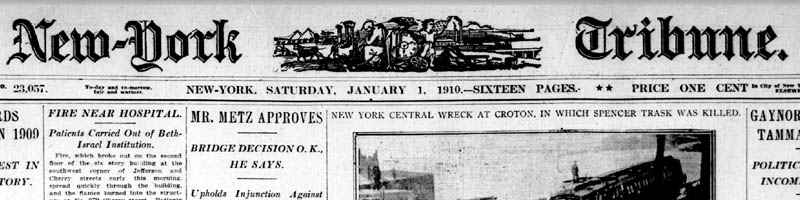
1910 Publication Calendar of the New York Tribune
+
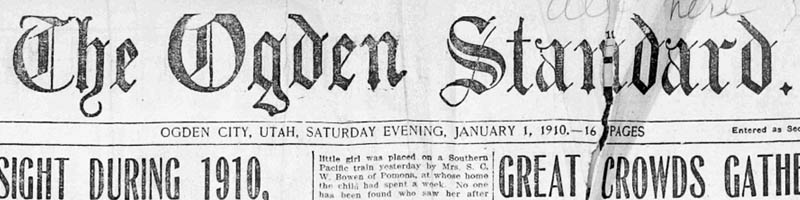
1910 Publication Calendar of the Ogden Standard
+
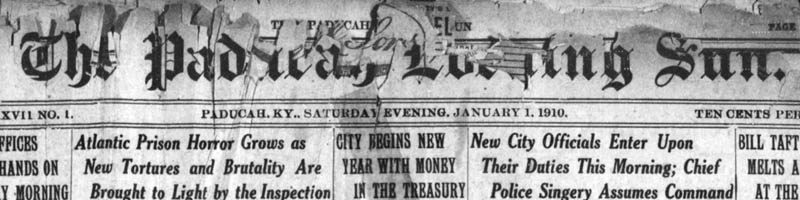
1910 Publication Calendar of the Paducah evening sun
+
1910 Publication Calendar of the Palestine Daily Herald
+
1910 Publication Calendar of the San Francisco Call
+
1910 Publication Calendar of the Washington Herald
+
1910 Publication Calendar of the Washington Times

William M. and H.V. Hamilton Jr. had lived their lives in newspapers prior to establishing the Palestine Daily Herald in 1902. Their father, H.V. Hamilton, Sr., wrote for and edited The Tyler Reporter . Soon after the Civil War, he helped establish The Tyler Democrat and later went on to publish and edit the newly merged Tyler Democrat and Reporter. Consequently, the Hamilton brothers grew up around printing offices, thoroughly learning the newspaper trade. They first attempted newspaper publishing on their own in 1898, leaving Tyler but remaining in East Texas to publish The Palestine Daily Press . They soon sold this paper, and ventured south to Monterrey, Mexico, with plans to establish a newspaper there.
By 1902, however, the Hamiltons had returned to Texas where they inaugurated the Palestine Daily Herald and set to work creating the city’s leading paper. The Daily Herald was a Democratic paper, issued every afternoon except Sunday. Each edition featured eight pages measuring 15 x 22 inches; a weekly subscription cost ten cents, while an annual subscription cost five dollars. The Daily Herald had 900 subscribers in 1903 and 1,200 in 1910, when the population of Palestine stood at 9,773. The paper also covered news in the nearby communities of Nacogdoches and Tyler.
The editorial masthead attributed the paper to “The Hamilton Boys, You Know,” and the front-page nameplate invariably employed, just beneath the dateline, an eye-catching phrase meant to woo citizens and advertisers alike to its pages. Primarily, this line carried circulation boasts, quoting numbers and nicknaming itself “The Growing Paper.” In 1903, such boasts led to a public dispute with the editors of The Daily Visitor, in which the Hamiltons, in a series of editorials, chided The Visitor as a little child and invited their rivals to prove claims that the Herald perpetrated boastful lies about its circulation. The line at the bottom of the Herald’s nameplate not only promoted the paper’s prowess, but also announced community events, such as the 1903 East Texas Carnival and Fruit Show. The Palestine Daily Herald fashioned itself as a serious news outlet, mixing local stories and information (reported by the Herald staff) with national and international items from the wire.
Many local stories ran under various column names and featured headlines such as “Personal Notes,” “Personal Mention” (later re-cast as a “Society” column by Mrs. Caddie Winston Herrington), “Court House Notes,” “Heard at Random,” and “Dissolution Notices.” “Special Correspondents” from throughout Anderson County (and signing off with such monikers as Boll Weevil, Ripples, Pickle, Sweet Roxy, Goo-Goo, and P.P. Funderburk) would report rural happenings in the editorial section. In addition, the paper never neglected to report the results in the new Texas League baseball circuit.
Beside the Palestine Daily Herald, the Hamilton brothers concurrently published the weekly Anderson County Herald. After H.V. Hamilton, Jr., retired in 1935, the sons of William Hamilton kept the Palestine Daily Herald operational until 1949.
1910 Newspapers
Published Everyday Except Sundays, The Month Of April, And A Few Random Days
|
|
|
|
| April, 1910 |
| S |
M |
T |
W |
T |
F |
S |
| |
|
|
|
|
1 |
2 |
| 3 |
4 |
5 |
6 |
7 |
8 |
9 |
| 10 |
11 |
12 |
13 |
14 |
15 |
16 |
| 17 |
18 |
19 |
20 |
21 |
22 |
23 |
| 24 |
25 |
26 |
27 |
28 |
29 |
30 |
| |
|
|
|
|
|
|
|
|
|
|
|
|
|
|
|
|
|
+
1910 Publication Calendar of the Alexandria Gazette
+
1910 Publication Calendar of the Deseret Evening News
+
1910 Publication Calendar of the Los Angeles Herald
+
1910 Publication Calendar of the New York Sun
+
1910 Publication Calendar of the New York Tribune
+
1910 Publication Calendar of the Ogden Standard
+
1910 Publication Calendar of the Paducah evening sun
+
1910 Publication Calendar of the Palestine Daily Herald
+
1910 Publication Calendar of the San Francisco Call
+
1910 Publication Calendar of the Washington Herald
+
1910 Publication Calendar of the Washington Times

Because of frequent name changes, the history of the Paducah Sun, Paducah’s oldest continuously published daily can be confusing. The paper began in 1877 as the Paducah Daily Sun , with a Sunday edition known as the Weekly Sun. It was followed by the Paducah Daily Sun , owned by Frank M. Fisher, who by 1896 had bought the Sun Publishing Company and who two years later consolidated the daily and weekly titles into the Paducah Sun. This singular title was edited briefly by Frank W. Gregory until 1899, when Fisher took hold of the editorial reins. A year later, Fisher was joined by his nephew, Edwin J. Paxton.
In 1901, the Paducah Sun introduced the Sunday Chat for the “quiet of the Sabbath.” By 1902, another version of the paper–the Paducah Sun (Weekly ed.) – appeared on Thursdays, along with the regular daily edition. That same year, the name of the weekly was formally changed to the Paducah Weekly Sun ; it was continuously published until at least 1913. At first, the Weekly Sun was less substantive than its daily sibling, with only four pages compared to the daily’s eight and with national, international, and local news crammed into eight narrow columns of small print. As subscriptions increased and its popularity grew, the Weekly Sun gradually came to resemble its daily counterpart, with six columns of regular type and virtually identical content. In 1906, the Paducah Evening Sun appeared, first under the direction of Paxton and Fisher, and later an associate editor, Elliott C. Mitchell. By 1914, Fisher had retired, selling his share of the paper and the publishing company, leaving Paxton the sole proprietor. The Paducah Evening Sun thrived during these years, with more than 25,000 subscribers in McCracken County and in the surrounding area.
Although the Evening Sun was a more nationally comprehensive paper than most in Kentucky at the time, its reporting nevertheless focused heavily on local developments, many of which involved acts of violence. These included the Black Patch Wars of 1906-1911, when western Kentucky was terrorized by Night Riders, who organized a campaign of intimidation against tobacco farmers unwilling to participate in the pooling of produce. It was not uncommon also to read morbid accounts of racial killings and beatings, written with a flair that would be unacceptable by today’s standards. One typical incident involved a disagreement between a white farmer and his African American tenant, which culminated in a lynching.
The coup de grâce came in 1929, when the staunchly Republican Sun acquired its Democratic rival, the News=Democrat. The two papers were merged into the Sun-Democrat until 1978, when, at the behest of Edwin J. Paxton’s grandson, Jack, it returned to its original title: the Paducah Sun. In 2009, the Paxtons continue to own the Sun, making it one of Kentucky’s oldest familial enterprises.
1910 Newspapers
Published Everyday But Sunday
+
1910 Publication Calendar of the Alexandria Gazette
+
1910 Publication Calendar of the Deseret Evening News
+
1910 Publication Calendar of the Los Angeles Herald
+
1910 Publication Calendar of the New York Sun
+
1910 Publication Calendar of the New York Tribune
+
1910 Publication Calendar of the Ogden Standard
+
1910 Publication Calendar of the Paducah evening sun
+
1910 Publication Calendar of the Palestine Daily Herald
+
1910 Publication Calendar of the San Francisco Call
+
1910 Publication Calendar of the Washington Herald
+
1910 Publication Calendar of the Washington Times

Historians have referred to Ogden, Utah, as the graveyard of western journalism because of the short life expectancy of the dozens of newspapers that sprang up there after 1869. The completion of the transcontinental railroad that year quickly transformed the sleepy agricultural town into a bustling transportation hub. Newspapers came and went, vying for the thousands of potential readers arriving on the nine rail lines with terminals in the city. The Ogden Standard bucked the trend. Founded by Frank J. Cannon, the Standard first appeared on January 1, 1888, with its front page featuring a poem entitled “A Hymn to Progress.” When Cannon was elected to the U.S. Congress four years later, the paper’s business manager, William Glassman, took over day-to-day operations. He acquired the Standard outright in 1894 and quickly molded it into a promotional organ for his own political career- Glassman served three terms as mayor.
The paper also carried world and national news. When the Spanish American War erupted in 1898, the story occupied the Standard’s entire front page. Local news included articles about Utah’s booming mining industry, notes from the local police blotter, and such nuggets as the Christmas Eve 1907 account of a hapless man who accidentally killed his friend in a failed attempt to shoot his cowboy hat off with a pistol.
In 1920, the paper merged with the Morning Examiner, becoming the Ogden Standard-Examiner. Today, the Standard-Examiner is the third-largest daily in the state.
1910 Newspapers
Published Everyday But Sunday
|
|
|
|
|
|
|
|
|
|
| August, 1910 |
| S |
M |
T |
W |
T |
F |
S |
| |
1 |
2 |
3 |
4 |
5 |
6 |
| 7 |
8 |
9 |
10 |
11 |
12 |
13 |
| 14 |
15 |
16 |
17 |
18 |
19 |
20 |
| 21 |
22 |
23 |
24 |
25 |
26 |
27 |
| 28 |
29 |
30 |
31 |
|
|
|
| |
|
|
|
|
|
|
|
| September, 1910 |
| S |
M |
T |
W |
T |
F |
S |
| |
|
|
|
1 |
2 |
3 |
| 4 |
5 |
6 |
7 |
8 |
9 |
10 |
| 11 |
12 |
13 |
14 |
15 |
16 |
17 |
| 18 |
19 |
20 |
21 |
22 |
23 |
24 |
| 25 |
26 |
27 |
28 |
29 |
30 |
|
| |
|
|
|
|
|
|
|
| October, 1910 |
| S |
M |
T |
W |
T |
F |
S |
| |
|
|
|
|
|
1 |
| 2 |
3 |
4 |
5 |
6 |
7 |
8 |
| 9 |
10 |
11 |
12 |
13 |
14 |
15 |
| 16 |
17 |
18 |
19 |
20 |
21 |
22 |
| 23 |
24 |
25 |
26 |
27 |
28 |
29 |
| 30 |
31 |
|
|
|
|
|
|
| November, 1910 |
| S |
M |
T |
W |
T |
F |
S |
| |
|
1 |
2 |
3 |
4 |
5 |
| 6 |
7 |
8 |
9 |
10 |
11 |
12 |
| 13 |
14 |
15 |
16 |
17 |
18 |
19 |
| 20 |
21 |
22 |
23 |
24 |
25 |
26 |
| 27 |
28 |
29 |
30 |
|
|
|
| |
|
|
|
|
|
|
|
| December, 1910 |
| S |
M |
T |
W |
T |
F |
S |
| |
|
|
|
1 |
2 |
3 |
| 4 |
5 |
6 |
7 |
8 |
9 |
10 |
| 11 |
12 |
13 |
14 |
15 |
16 |
17 |
| 18 |
19 |
20 |
21 |
22 |
23 |
24 |
| 25 |
26 |
27 |
28 |
29 |
30 |
31 |
| |
|
|
|
|
|
|
|
+
1910 Publication Calendar of the Alexandria Gazette
+
1910 Publication Calendar of the Deseret Evening News
+
1910 Publication Calendar of the Los Angeles Herald
+
1910 Publication Calendar of the New York Sun
+
1910 Publication Calendar of the New York Tribune
+
1910 Publication Calendar of the Ogden Standard
+
1910 Publication Calendar of the Paducah evening sun
+
1910 Publication Calendar of the Palestine Daily Herald
+
1910 Publication Calendar of the San Francisco Call
+
1910 Publication Calendar of the Washington Herald
+
1910 Publication Calendar of the Washington Times

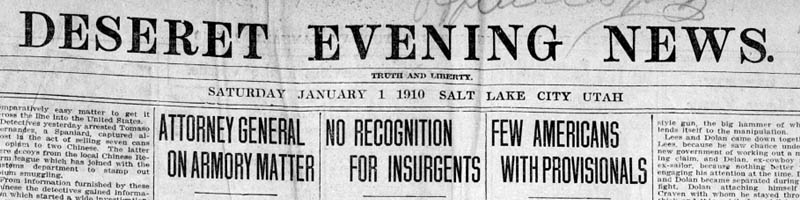
Within three years after Mormon pioneers settled the valley of the Great Salt Lake, Brigham Young established the Deseret News. Taking its name from the old term for the Utah Territory – a “deseret” is a honeybee, according to the Book of Mormon – the newspaper first appeared on June 15, 1850, on a $60 press that had traveled 1,100 miles by ox-cart across the country to Salt Lake City. The News began as a weekly; its first edition masthead proclaiming “Truth and Liberty.” As the official organ of the Church of the Latter-day Saints, the newspaper published gospel-related items and espoused Mormon theology. Yet it also covered national events, for Brigham Young did not want readers to find themselves isolated from the “outside world.”
In 1865, the paper became a semiweekly, appearing on Tuesdays and Saturdays, and two years later it added a daily edition called the Deseret Evening News. The newspaper printed its first “action” photographs on May 12, 1900, when it printed five images of a mine explosion at Scofield, Utah, which killed over 200 men in the nation’s worst mine disaster up to that time. Appearing eleven days after the blast, the grim photos depicted wagons loaded with coffins and stretcher-bearers bringing out the dead.
After the turn of the century, the paper began to attract readers with innovative large-type, banner headlines that extended across the entire front page. One of these appeared on September 7, 1901, the day after President William McKinley was shot, proclaiming, “GOD BLESS OUR PRESIDENT.” A week later, another banner announced McKinley’s death in inch-high letters. At that time, News employed more than 100 reporters, editors, copyboys – even a society-page maven – under the direction of general manager Horace “Bud” Whitney, who had taken over the newspaper three years earlier. Hired to raise circulation numbers, Whitney expanded the coverage of sports, introduced a regular mining, business, and stocks section, and placed a larger emphasis on society and fashion.
By the 1920s, the Deseret News had moved its operation to downtown Salt Lake, installing a 50-horsepower printing press capable of producing 32,000 copies per hour. In 1922, the newspaper discontinued the semiweekly, but branched out into new territory with a radio station. Known today as the Deseret Morning News, the paper boasts the second highest readership of any daily in Utah. It remains the longest running American newspaper west of the Missouri River and continues to operate both as a widely read news source and as an official organ of the Mormon Church.
1910 Newspapers
Published Everyday But Sunday
+
1910 Publication Calendar of the Alexandria Gazette
+
1910 Publication Calendar of the Deseret Evening News
+
1910 Publication Calendar of the Los Angeles Herald
+
1910 Publication Calendar of the New York Sun
+
1910 Publication Calendar of the New York Tribune
+
1910 Publication Calendar of the Ogden Standard
+
1910 Publication Calendar of the Paducah evening sun
+
1910 Publication Calendar of the Palestine Daily Herald
+
1910 Publication Calendar of the San Francisco Call
+
1910 Publication Calendar of the Washington Herald
+
1910 Publication Calendar of the Washington Times

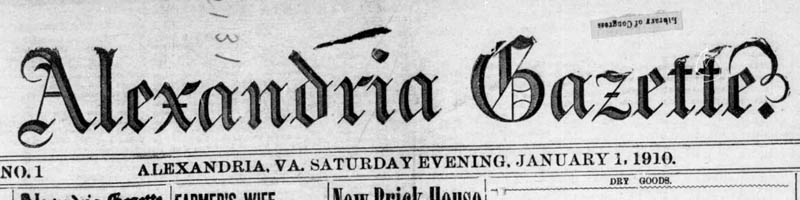
Established in 1834 as a successor to several papers dating back as early as 1800, the Gazette began as a voice of the Whig Party but eventually turned to a Democratic view. For the time, that was hardly an unusual political evolution for a Virginia paper. What did, however, make the paper somewhat unique in nineteenth-century Virginia was its forceful and effective support of industrialization throughout the South. Situated across the Potomac from the Washington Navy Yard, Alexandria was a growing riverfront community that could boast of considerable industry for its size—including brickworks; shoe, furniture, and machinery factories; breweries; ship chandleries and boat yards; and rail lines for both the Baltimore & Ohio and Chesapeake & Ohio Railroads. By 1900, the city had a population of 6,430 and was increasingly affected by—and prospered from—the growth of the federal government and its payroll. Its perspective, then, was unlike most Virginia papers.
Too, the Gazette by 1900 was the dominant daily newspaper and an influential voice in the community. Since 1865, at least 23 papers had begun publication in Alexandria but then disappeared. In the 1890s alone, six shut down. By 1900, then, the Gazette’s competition was reduced primarily to the Alexandria Times, but even that paper would barely survive the decade. Particularly noteworthy is how fertile the Alexandria region had been for the African-American press. But the Clipper had ceased business in 1894, and its successor the Leader and Clipper ended in 1898; the
Home News, established in 1902, and the Industrial Advocate, opened circa 1900, disappeared within several years as well. The point, though, is that the papers reflected a perceived need within a substantial enough minority community that any major paper—whatever its politics, whatever its bias—would be compelled to take its existence into account in reporting on local government and the economy.
Thus, at the beginning of the twentieth century, the Alexandria Gazette could legitimately comment on its considerable significance to the growing northern Virginia community and region. “The files of the paper,” the editor wrote, “are the official and unabridged history of Alexandria, and while numbers of other papers have appeared and disappeared during all the years of its existence, it has weathered all the storms of time. . . .”
1910 Newspapers
Published Everyday But Sunday
+
1910 Publication Calendar of the Alexandria Gazette
+
1910 Publication Calendar of the Deseret Evening News
+
1910 Publication Calendar of the Los Angeles Herald
+
1910 Publication Calendar of the New York Sun
+
1910 Publication Calendar of the New York Tribune
+
1910 Publication Calendar of the Ogden Standard
+
1910 Publication Calendar of the Paducah evening sun
+
1910 Publication Calendar of the Palestine Daily Herald
+
1910 Publication Calendar of the San Francisco Call
+
1910 Publication Calendar of the Washington Herald
+
1910 Publication Calendar of the Washington Times

To-day is the 158th celebration of January 1 as New Year’s Day. Although there was a general popular observance of the 1st of January as the beginning of the year, the ancient Jewish year, which opened with the 25th of March, continued long to have a legal position in Christian countries. In England it was not till 1752, however, that the 1st of January became the initial day of the legal, as it had been for a long time of the popular year. In Scotland this desirable change was made a by a decree of James VI in privy council in the year 1600. It was effected in France in 1546; in Holland, Protestant Germany, and Prussia in 1700, and in Sweden in 1753. The old Dionysian calendar is still retained in the Balkan States and in Greece, while in Russia the new style was adopted in 1902.
The ancient Egyptians had a year determined by the changes of the seasons which contained 365 days, divided into twelve months of thirty days each, with five supplementary days at the end of the year. The Greeks, in the most ancient period, reckoned according to the lunar months, twelve making a year. The Romans are said to have originally had a year of ten months, but in the time of their kings they adopted twelve months, with an occasional intercalary month. Caesar gave the months the number of days they still have.
The month of January was named after Janus, the deity supposed to preside over doors, who might very naturally be presumed also to have something to do with the opening of the year. His name was selected to represent the month Numa Pompilius, the Roman Emperor who decreed that the year should commence at this time, and added two new months to the ten into which the year had previously been divided. The deity Janus was represented by the Romans as a man with two faces, one looking backward and the other forward, implying that he stood between the old and the new year, with regard to both.
Almanacs, which are now so generally issued throughout the world with the beginning of the New Year, have been in existence for several centuries. The first important book of the character to be printed was written in Latin and issued in 1475. Almanacs in one form or another have played an important part in literature and history. In the United States the first almanac is said to have been published in Philadelphia in 1687. In 1731 Benjamin Franklin published the first issue of “Poor Richard’s Almanac,” which was continued for twenty-five years.
The Nautical Almanac, the most valuable of its character, was first published in 1767. In modern times the widely known “Almanach de Gotha,” printed both in German and French, contains much valuable statistical information. Whittaker’s Almanac, the Stateman’s Year Book, Hazell’s Annual, and books of that character are invaluable to-day by reason of the important information they contain.
January 1 is the birthday of
Paul Revere (1735),
Anthony Wayne (1745),
Edmund Burke (1730), and the first American flag was used by Washington on January 1, 1776, at
Cambridge, Mass.
This newspaper article was transcribed from a scan of the original newspaper article. The document was obtained from the Chronicling America newspaper collection and is in the public domain. It is being republished here in order to continue my advocacy for full representation for the American citizens of the District of Columbia.

This editorial is the third in a series of editorials published by the Alexandria Gazette in first week of June 1909. As the editors hinted to at the end of the previous editorial, they reprint a previous opinion that was rendered by Senator George Frisbie Hoar of the judiciary committee shortly before his death.
Printed in full, for the first then, as it is the first time now, are the committee’s findings that the matter between Congress and Alexandria County, the former portion of the District of Columbia, have been resolved by political, not judicial means, and there is nothing stopping the negotiations for the reacquisition from taking place. The Hoar opinion was written 7 years prior in 1902 and concluded that the Federal government can purchase those lands back with the consent of the State of Virginia.
As heretofore stated Mr. Hayes, of California, on May 27 introduced a bill in the House of Representatives to extend the limits of the District of Columbia so as to take in all of Alexandria county, but not Alexandria city or that part of Falls Church which lies within the county. The bill was published in full in the Gazette of June 1. Commenting upon this the Gazette of June 1st suggested that Mr. Hayes should read the report made to the Senate on this subject by the late Senator Hoar. This report reads as follows and has never before been published in full:
Constitutionality of the retrocession of a certain portion of the District of Columbia ceded to the United States by Virginia.
April 11, 1902, — Ordered to be printed.
MR. HOAR, from the committee on the judiciary, submitted the folowing
ADVERSE REPORT.
The committee on the judiciary, to whom was referred the joint resolution (S. R. 50) directing the attorney-general to bring suit to determine the constitutionality of the retrocession of that portion of the original District of Columbia which was ceded to the United States by the state of Virginia, submit the following report:
The territory on the other side of the Potomac river, including the city of Alexandria, which was originally a part of the 10 miles square, was ceded by Virginia for the seat of government. It was retroceded to Virginia by act of Congress in 1846, accepted by Virginia, and thereafter Congress exercised no jurisdiction over it, except so far as it controls the Arlington national cemetery, the experimental farm of the Department of Agriculture, the military school for cavalry, and the signal corps, with the land and building occupied by them.
It seems to the committee that it is not expedient that this act of retrocession should be set aside by Congress, even if Congress have the power so to do, without the consent of Virginia. Virginia accepted the transaction, it being understood that it was at the desire and for the benefit of the national government. She has established in Alexandria the important and intimate relations which every state forms for its own citizens dwelling on her own soil; and the people, on the other hand, we presume, feel the loyal and deep attachment which such a relation excites. Such a tie ought not to be broken at all without the consent of the parties, except in case of some paramount and overwhelming public interest.
As to the suggestion that the retrocession was unconstitutional, it seems to as the answer is that from the nature of the case it is a political question and not a judicial question, and that it has been settled by the political authorities alone competent to decide it. It is like the question, What is the true state government, the true and lawful government of a state?– like the question, What is the true frontier? where any dispute exists as to whether territory belongs to us or so a neighboring foreign country, and many like questions.
These are partly questions of law and partly of fact. The questions of law may be settled by the highest court to whom, in the course of judicial proceedings, they may be taken, unless, and until that court choose to reverse its previous opinions. But the fact must be determined in each case, when it arises, by the jury or other tribunal authorized to find the fact. It would be utterly intolerable that territory should be held in one case to be a part of Virginia, and in another case to be a part of the District of Columbia, according as might be held, in the individual case.
So it seems to the case must be deemed settled by the acquiescence in the act by Virginia and of the United States, as manifested by the conduct of the departments of government for more that half a century. The consequences of holding that this retrocession has been void from the beginning would be very serious.
If it be desirable that Alexandria become a part of the District of Columbia again, the only way to accomplish it will be to open negotiations with Virginia and get her consent (See Luther v. Borden, 7 How., 1.)
The committee, therefore, report adversely, and recommend that the resolution be indefinitely postponed.
This newspaper article was transcribed from a scan of the original newspaper article. The document was obtained from the Chronicling America newspaper collection and is in the public domain. It is being republished here in order to continue my advocacy for full representation for the American citizens of the District of Columbia.