1 / 3123
The Daily Render

by

A Digital Scrapbook for the Past, Present, and Future


| FRONT PAGE | GEOSPATIAL ART | DC HISTORY | NEWS | COLONIST | FOUND MAPS | FRACTALS | PHOTOGRAPHY | ANTIQUE | DESIGN | VIDEO | BLOGROLL | PRICE LIST | RANDOM | CONTACT |

|| 8/8/2010 || 6:53 pm || + Render A Comment || ||
GAMBLERS MAY GET ALEXANDRIA FOR US – The Washington Times, October 16, 1905

The only Supreme Court ruling on the constitutionality of the retrocession of Alexandria was in Phillips v. Payne. The Congressional debate on May 8th, 1846, prominently features William Winter Payne as a Representative who objected to the legislation, and this article is the first I’ve transcribed that includes the lawsuit’s other party, R. A. Phillips.


GAMBLERS MAY GET ALEXANDRIA FOR US


Argue That County Belongs to the District


FAMOUS QUESTION REVIVED


Federal Court Will Decide Whether Congress Legally Returned the County to Virginia


Interest in whether Alexandria county is part of the State of Virginia or of the District of Columbia has been revived through the prosecution of poolrooms in Virginia.

The cases are now before Judge Waddill, judge of the United States court of the eastern district of Virginia. His decision tomorrow may mean the opening of this celebrated question.

Ten years ago the jurisdiction of Alexandria county was questioned. The case was taken before the United States Supreme Court by R. A. Phillips, a well-known capitalist and real estate owner of Alexandria county, with offices in Washington.

The court decided that the issue was one wholly between the United States and the State of Virginia and that a private citizen was not qualified to bring it up for disposition.

Since that decision, which failed to settle the status of the county, the case has been at a standstill and is so now. There are residents of Alexandria county who now are inclined to believe that with the agitation attending the poolroom cases the retrocession of the county will again come up for serious discussion.

Return of County

In the proclamation of President Washington, Alexandria county was part of the “ten mile square” allotted as the seat of the Federal Government. In 1846, Congress voted to retrocede to Virginia “that portion of the ten mile square south of the Potomac.”

It has been contented by eminent lawyers that if Congress has that power in 1846, it has that power today to retrocede to Maryland that portion which is known as the District of Columbia. They argue further that it then has the power to change the seat of Government to Bladensburg, Jackson City, of even to Hawaii.

It is not understood that Congress ever had the power to cede away any part of the “ten mile square” defined as the limits of the District of Columbia in President Washington’s proclamation.

The activity of Mr. Phillips and other is ascribed to the lax methods which now obtain in the government of the county and the benefits to be derived from its restoration to the District.

Would Benefit Town.

The county would have the benefit of the good-roads law, the revenues from Government property, such as Arlington, the three Government bridges, and other property would revert to the District and citizens of what is now Alexandria county would have the protection of a police system and the benefits of sanitary laws which are not now in force in the county.

L. E. Phillips, the Washington attorney, a son of R. A. Phillips, said yesterday that there is practically no sanitation in the county, the police facilities are poor, and that the methods of governing the county are much in line for improvement. Should the court decide that Alexandria county is legally within the District line it would mean practically a general revision of affairs there, and one which would not only mean benefits to the people of the county, but to the county itself, and to the District of Columbia.

New Phase Brought Up.

A letter from Mr. Phillips father to Attorney John A. Lamb, counsel for the two poolroom men who now under arrest, is interesting in that it presents a phase of the matter which has not been brought prominently before the public.

The letter reads as follows:


“It is a pleasure to me to observe that you asser in a case before Judge Waddill, of the United States district court, that Alexandria county is a part of the District of Columbia, and that the act of retrocession was wholly ultra vires.

“In my opinion Congress has less right to relinquish or transfer its exclusive jurisdiction over part of the seat of Federal Government than it would have to cede away or relinquish its legislative power over postoffices and postroads.

“Of course, we all know the Constitution has become a mere political football in there modern days. We find our Federal Government in canal-digging business in foreign territory, and in the missionary business in Asiatic islands, and it is refreshing to observe occasionally a recurrence to safe principles of jurisdiction and Federal authority.

“Section 8, paragraph 17, provides for the establishment and jurisdiction of the District, and a few lines later, Section 9, paragraph 2, puts a guarantee about one good old writ- ‘The privilege of the writ of habeas corpus’ shall not be suspended. It is a striking coincidence that the provision of the Constitution violated dismembering the seat of government and the appropriate procedure for the determination of such infractions of the fundamental law are in close proximity. When, in the course of events, it may appear necessary to dismember the seat of government or remove it permanently to a new location, such a proposal must first be submitted to all the States; and with the approval of three-fourths it will become lawful.

“As for the individual citizens respecting whose rights or liberty the writ of habeas corpus is brought in this particular case. I have no interest. It is an ill wind that blows no one good, and so even the rights and liberties of an unfortunate gambler may correct the grevious error of dismembering our seat of government. It was established by our Revolutionary ancestors. I trust Judge Waddill will do his part as a judge and a patriot to restore it.

“If appealed to the Supreme Court of the United States, that august body may meet the question fully and say that under the high privilege of this particular writ, the court is bound to decide whether the District was dismembered lawfully.

“As for inconvenience that will arise respecting titles and acts of de facto government since 1847, changes of governmental control are frequent respecting territories, counties and cities and nobody has has ever been seriously hurt by them.

“R. A. PHILIPS.”


This newspaper article was transcribed from a scan of the original newspaper article on Chronicling America. It is being republished here in order to continue my advocacy for full representation for the American citizens of the District of Columbia.


|| 4/16/2010 || 9:28 am || 1 Comment Rendered || ||
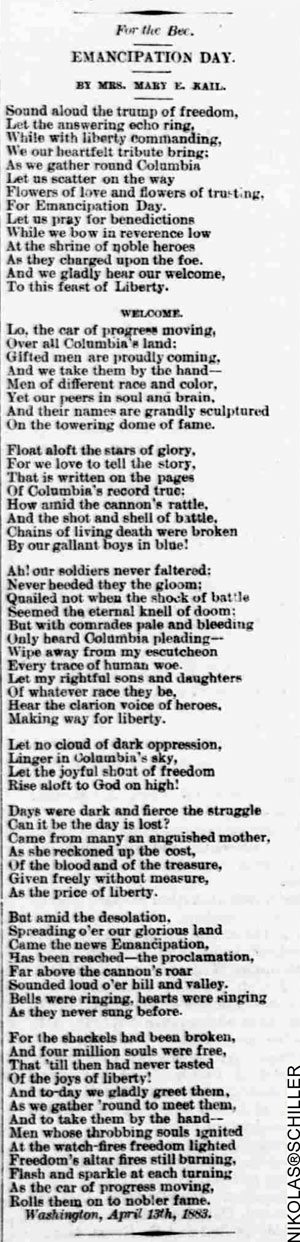
Emancipation Day by Mrs. Mary E. Kail

Below is a poem I found on Chronicling America last week and I’ll be reciting this poem later today at the 148th annual celebration of Emancipation Day.


Emancipation Day by Mrs. Mary E. Kail

EMANCIPATION DAY BY MRS. MARY E. KAIL

Originally read by Milton Holland at the Emancipation Banquet, Washington, DC April 13th, 1883

Sound aloud the trump of freedom,
Let the answering echo ring,
While with liberty commanding,
We our heartfelt tribute bring;
As we gather round Columbia,
Let us scatter on the way
Flowers of love and flowers of trusting,
For Emancipation Day.
Let us pray for benedictions
While we bow in reverence low
At the shrine of noble heroes
Bravely charging on the foe.
Gladly we hear our welcome,
To this feast of Liberty.

Lo, the car of progress moving,
Over all Columbia’s land;
Gifted men are proudly coming
And we take them by the hand–
Men of different race and color,
Yet our peers in soul and brain,
And their names shall soon be sculptured
On the towering dome of fame.

Float aloft the stars of glory,
For we love to tell the story
That is written on the pages
Of Columbia’s record true:
How amid the cannon’s rattle,
And the shot and shell of battle,
Chains of living death were broken
By our gallant boys in blue!

Ah! our soldiers never faltered;
Never heeded they the gloom;
Quailed not when the shock of battle
Seemed the eternal knell of doom;
But with comrades pale and bleeding
Only heard Columbia pleading–
“Wipe away from my escutcheon
Every trace of human woe.
Let my rightful sons and daughters
Of whatever race they be,
Hear the clarion voice of heroes,
Making way for liberty.

Let no cloud of dark oppression,
Linger in Columbia’s sky,
Let the joyful shout of freedom
Rise aloft to God on high!”

Days were dark and fierce the struggle–
Can it be the day is lost?
Came from many an anguished mother,
As she reckoned up the cost,
Of the blood and of the treasure,
Given freely without measure,
As the price of liberty.

But amid the desolation,
Spreading o’er our glorious land
Came the news– Emancipation,
Has been reached– the proclamation,
Far above the cannon’s roar
Sounded loud, o’er hill and valley.
Bells were ringing, hearts were singing
As they never sung before.

For the shackles had been broken,
And four millions souls were free,
That ’till then had never tasted
Of the joys of liberty!
And to-day we gladly greet them,
As we gather ’round to meet them,
And to take them by the hand–
Men whose throbbing souls ignited
At the watch-fires freedom lighted.
Freedom’s altar fires, still burning
Flash and sparkle at each turning,
As the car of progress moving,
Rolls them on to nobler fame.


|| 4/14/2010 || 1:45 pm || 2 Comments Rendered || ||
SENATE TIE ON PROHIBITION – The New York Times, December 20, 1916

This article discusses the Senate’s actions toward implementing Prohibition in the District of Columbia. I found it rather interesting that the Senators were willing to hold a referendum on Prohibition and let District residents vote for the first time since the 1870s. More importantly, the referendum was to include women, who did not earn the right to vote until the passage of the 19th Amendment to the United States Constitution.


SENATE TIE ON PROHIBITION


But Suffrage Wins a Referendum Test Vote, 54 to 15
Special to The New York Times.

WASHINGTON, Dec. 19- The first test of prohibition sentiment in the Senate came today when a vote on Senator Underwood’s amendment to Senator Sheppard’s bill providing for a referendum on the establishment of prohibition in the District of Columbia, resulted in a tie, 38 to 38. Immediately before the Senate had gone on record overwhelmingly for at least a limited degree of women suffrage, but voting 54 to 15 to accept an amendment giving the women of the District the right to vote under the terms of the referendum.

According to the Senate rules the tie vote defeated the referendum proposal, but as the Senate was at the time acting in Committee of the Whole, Senator Underwood announced his intention of bringing the amendment up again tomorrow when the bill will be reported by the committee to the Senate. A vote on the bill itself is also expected tomorrow.

The provision for a referendum was generally supported by the opponents of the prohibition movement, and today’s vote was commonly regarded as an accurate gauge of the strength of the prohibition forces. Both advocates and opponents of national prohibition have watched the course of the District prohibition bill in the Senate with increasing interest since the House Committee on Judiciary voted to report favorably the national prohibition amendment.

The two parties were very evenly divided today in the vote on the referendum. Twenty-three Democrats and fifteen Republicans voted in favor of the referendum and twenty Democrats and eighteen Republicans opposed it.

Before the vote was taken an amendment offered by Senator Williams of Mississippi was accepted, permitting women to vote, and inserting property and educational qualifications in the requirements for suffrage on the referendum vote. Senator Jones’s amendment making it possible for residents of the District who are citizens of other States to vote was also accepted.

The vote came unexpectedly after a long afternoon’s debate. As soon as the fate of the referendum was known Senator Underwood attempted to fix a definite time tomorrow at which his amendment could be voted on again by the whole Senate. The move was defeated, and the advocates of the prohibition measure attempted to force an immediate vote on the bill itself. They were forestalled by Senator Stone of Missouri, who made a motion that the Senate go into executive session to consider some appointments recently made by the President. The motion was carried, and the final decision on the Sheppard bill was postponed until tomorrow.


This newspaper article was transcribed from a scan of the original newspaper article. The document was obtained from the New York Times archives and is in the public domain. It is being republished here in order to continue my advocacy for full representation for the American citizens of the District of Columbia.


|| 4/6/2010 || 11:01 am || + Render A Comment || ||
S280 – A Bill To Repeal an Act Entitled ”An Act to Retrocede the County of Alexandria, in the District of Columbia, to the State of Virginia” – United States Senate, April 23, 1866

Within two years of the end of the Civil War, it was realized that Virginia’s retrocession in 1846 was unconstitutional and Senator Benjamin Wade, a Radical Republican introduced a bill to repeal the act:


Page 1 - S280 - A Bill To Repeal an Act Entitled 'An act to retrocede the county of Alexandria, in the District of Columbia, to the State of Virginia'
Page 2 - S280 - A Bill To Repeal an Act Entitled 'An act to retrocede the county of Alexandria, in the District of Columbia, to the State of Virginia'
Page 3 - S280 - A Bill To Repeal an Act Entitled 'An act to retrocede the county of Alexandria, in the District of Columbia, to the State of Virginia'
Page 4 - S280 - A Bill To Repeal an Act Entitled 'An act to retrocede the county of Alexandria, in the District of Columbia, to the State of Virginia'
[ Source: Library of Congress ]

Bills and Resolutions
Senate
39th Congress, 1st Session:
April 23, 1866

Mr. Wade asked, and by unanimous consent obtained, leave to bring in the following bill; which was read twice, referred to the Committee on the District of Columbia, and ordered to be printed.

A Bill To repeal an act entitled ”An act to retrocede the county of Alexandria, in the District of Columbia, to the State of Virginia,” and for other purposes.

Whereas the Constitution of the United States provides that Congress ”shall exercise exclusive legislation in all cases whatsoever over such District (not exceeding ten miles square) as may, by cession of particular States, and the acceptance of Congress, become the seat of government of the United States;” and whereas by an act of Congress approved July sixteenth, anno Domini seventeen hundred and ninety, ten miles square of territory was accepted from the States of Maryland and Virginia, as the permanent seat of government, constituting what was subsequently known as the District of Columbia, which when so accepted and defined, all jurisdiction over the same was, by the Constitution, forever vested in Congress, whose duty it was then, and forever after, to preserve unviolated and free from all control whatsoever, save that of Congress; and whereas experience derived from the recent rebellion, has demonstrated the wisdom of preserving such ten miles square under the exclusive control of Congress, both for military and civil purposes, and for the defense of the capital; and whereas, by an act of Congress approved July ninth, anno Domini eighteen hundred and forty-six, that portion of said ten miles square lying south of the Potomac was ceded back to the State of Virginia, in violation of the intent and meaning of the Constitution of the United States, and to the great peril of the capital as aforesaid: Therefore,

Be it enacted by the Senate and House of Representatives of the United States of America in Congress assembled, That the act of Congress approved July ninth, anno Domini eighteen hundred and forty-six, retroceding to the State of Virginia that portion of the district ten miles square, as provided by the Constitution, known as the District of Columbia, be, and the same is hereby, henceforth and forever repealed and declared null and void, and that the jurisdiction of Congress, and the laws provided for the District of Columbia be, and the same hereby, put in force, as same as if said act of retrocession had never been passed.

Sec. 2. And be it further enacted, That private and personal property shall not be affected by this act, so far as the rights of parties are concerned; and all public property whereof the United States were possessed at the time of the retrocession of said portion of the District of Columbia to the State of Virginia shall, from and after the passage of this act, be vested in the United States government, any law, act, or conveyance to the contrary notwithstanding, and the government, through its proper officials, is hereby authorized to acquire, by purchase or otherwise, any and all further property, real or personal, in said portion of the District of Columbia, as may be deemed necessary for public use.

Sec. 3. And be it further enacted, That all suits and actions at law, civil or criminal, shall from and after the passage of this act be conducted and determined according to the laws, rules, and regulations enacted and provided by Congress for the District of Columbia, excepting causes wherein final judgment, decree, or sentence shall have been pronounced or passed; in such cases the final satisfaction of such judgments or decrees will be in accordance with the laws in force in the State of Virginia. But all causes wherein final judgment or decree shall not have been passed or pronounced, shall be in future conducted and determined as provided by this act.

Sec. 4. And be it further enacted, That all taxes and revenues assessable and collectible on property, real or personal, in said portion of the District of Columbia south of the Potomac, shall from and after the passage of this act, be rated, collected, and applied according to the existing or future laws of Congress governing the District of Columbia.

Sec. 5. And be it further enacted, That from and after the passage of this act all civil offices in the said portion of the District of Columbia south of the Potomac, in the city of Alexandria and what is known as the county of Alexandria, shall be declared vacant; and the vacancies so created shall be filled by new appointments or elections, to be made and held under the laws, regulations, and qualifications provided by Congress for elections and electors in the District of Columbia.

Sec. 6. And be it further enacted, That this act shall be in force from and after its passage.


|| 4/2/2010 || 4:05 pm || + Render A Comment || ||
How the Scythians Used Hemp – Paragraphs 73-75 from Book 4 of The Histories of Herodotus [circa 440 BC]

The Histories of Herodotus is considered one of the influential works of history in Western literature. Written from the 450s to the 420s BC in the Ionic dialect of classical Greek, The Histories serves as a record of the ancient traditions, politics, geography, and clashes of various cultures that were known around the Mediterranean and Western Asia at that time. These paragraphs are about the Scythians, who were an Ancient Iranian people of horse-riding nomadic pastoralists who throughout Classical Antiquity dominated the Pontic-Caspian steppe in present day Kazakhstan, southern Russia, and Ukraine. Below is how the Scythians used hemp about 2,450 years ago:


73. Thus they bury their kings; but as for the other Scythians, when they die their nearest relations carry them round laid in wagons to their friends in succession; and of them each one when he receives the body entertains those who accompany it, and before the corpse they serve up of all things about the same quantity as before the others. Thus private persons are carried about for forty days, and then they are buried: and after burying them the Scythians cleanse themselves in the following way:–they soap their heads and wash them well, and then, for their body, they set up three stakes leaning towards one another and about them they stretch woolen felt coverings, and when they have closed them as much as possible they throw stones heated red-hot into a basin placed in the middle of the stakes and the felt coverings. 73. [1] οὕτω μὲν τοὺς βασιλέας θάπτουσι· τοὺς δὲ ἄλλους Σκύθας, ἐπεὰν ἀποθάνωσι, περιάγουσι οἱ ἀγχοτάτω προσήκοντες κατὰ τοὺς φίλους ἐν ἀμάξῃσι κειμένους. τῶν δὲ ἕκαστος ὑποδεκόμενος εὐωχέει τοὺς ἑπομένους, καὶ τῷ νεκρῷ ἁπάντων παραπλησίως παρατίθησι ὅσα τοῖσι ἄλλοισι. ἡμέρας δὲ τεσσεράκοντα οὕτω οἱ ἰδιῶται περιάγονται, ἔπειτα θάπτονται. [2] θάψαντες δὲ οἱ Σκύψαι καθαίρονται τρόπῳ τοιῷδε. σμησάμενοι τὰς κεφαλὰς καὶ ἐκπλυνάμενοι ποιεῦσι περὶ τὸ σῶμα τάδε ἐπεὰν ξύλα στήσωσι τρία ἐς ἄλληλα κεκλιμένα, περὶ ταῦτα πίλους εἰρινέους περιτείνουσι, συμφράξαντες δὲ ὡς μάλιστα λίθους ἐκ πυρὸς διαφανέας ἐσβάλλουσι ἐς σκάφην κειμένην ἐν μέσῳ τῶν ξύλων τε καὶ τῶν πίλων.


74. Now they have hemp growing in their land, which is very like flax except in thickness and in height, for in these respects the hemp is much superior. This grows both of itself and with cultivation; and of it the Thracians even make garments, which are very like those made of flaxen thread, so that he who was not specially conversant with it would not be able to decide whether the garments were of flax or of hemp; and he who had not before seen stuff woven of hemp would suppose that the garment was made of flax. 74. [1] ἔστι δέ σφι κάνναβις φυομένη ἐν τῇ χώρῃ πλὴν παχύτητος καὶ μεγάθεος τῷ λίνῳ ἐμφερεστάτη· ταύτῃ δὲ πολλῷ ὑπερφέρει ἡ κάνναβις. αὕτη καὶ αὐτομάτη καὶ σπειρομένη φύεται, καὶ ἐξ αὐτῆς Θρήικες μὲν καὶ εἵματα ποιεῦνται τοῖσι λινέοισι ὁμοιότατα· οὐδ᾽ ἄν, ὅστις μὴ κάρτα τρίβων εἴη αὐτῆς, διαγνοίη λίνου ἢ καννάβιος ἐστί· ὃς δὲ μὴ εἶδε κω τὴν κανναβίδα, λίνεον δοκήσει εἶναι τὸ εἷμα.


75. The Scythians then take the seed of this hemp and creep under the felt coverings, and then they throw the seed upon the stones which have been heated red-hot: and it burns like incense and produces a vapour so think that no vapour-bath in Hellas would surpass it: and the Scythians being delighted with the vapour-bath howl like wolves. This is to them instead of washing, for in fact they do not wash their bodies at all in water. Their women however pound with a rough stone the wood of the cypress and cedar and frankincense tree, pouring in water with it, and then with this pounded stuff, which is thick, they plaster over all their body and also their face; and not only does a sweet smell attach to them by reason of this, but also when they take off the plaster on the next day, their skin is clean and shining.

75. [1] ταύτης ὦν οἱ Σκύθαι τῆς καννάβιος τὸ σπέρμα ἐπεὰν λάβωσι, ὑποδύνουσι ὑπὸ τοὺς πίλους, καὶ ἔπειτα ἐπιβάλλουσι τὸ σπέρμα ἐπὶ τοὺς διαφανέας λίθους τῷ πυρί· τὸ δὲ θυμιᾶται ἐπιβαλλόμενον καὶ ἀτμίδα παρέχεται τοσαύτην ὥστε Ἑλληνικὴ οὐδεμία ἄν μιν πυρίη ἀποκρατήσειε. [2] οἱ δὲ Σκύθαι ἀγάμενοι τῇ πυρίῃ ὠρύονται. τοῦτό σφι ἀντὶ λουτροῦ ἐστι. οὐ γὰρ δὴ λούονται ὕδατι τὸ παράπαν τὸ σῶμα. [3] αἱ δὲ γυναῖκες αὐτῶν ὕδωρ παραχέουσαι κατασώχουσι περὶ λίθον τρηχὺν τῆς κυπαρίσσου καὶ κέδρου καὶ λιβάνου ξύλου, καὶ ἔπειτα τὸ κατασωχόμενον τοῦτο παχὺ ἐὸν καταπλάσσονται πᾶν τὸ σῶμα καὶ τὸ πρόσωπον· καὶ ἅμα μὲν εὐωδίη σφέας ἀπὸ τούτου ἴσχει, ἅμα δὲ ἀπαιρέουσαι τῇ δευτέρη ἡμέρῃ τὴν καταπλαστὺν γίνονται καθαραὶ καὶ λαμπραί. 


[ source ]


|| 2/2/2010 || 11:29 am || + Render A Comment || ||
Vote Victory Result Of Luck, Hard Work, Some Sweat, Tears – The Washington Post, March 30, 1961

This newspaper article highlights some of the work that was undertaken to ratify the 23rd Amendment to the United States Constitution. Two curious items that I learned from transcribing this article was that the Washington Post sent out a team of correspondents to 44 state capitals to cover the ratification process and that Tennessee was the only Southern state to ratify the Constitutional Amendment. As I have noted here & here, Arkansas was the only Southern State to flatly reject the Constitutional Amendment based mostly on the racial makeup of the District of Columbia. Nonetheless, I’ve got to wonder that with all the technological innovations in the last 50 years, would it be easier to pass a Constitutional Amendment nowadays than it was then?


Vote Victory Result Of Luck, Hard Work, Some Sweat, Tears

23d Amendment Had Close Calls, Many Friends

To the Washington resident starved for the vote the Constitution offered cake: He could be elected President of the United States.

Until the adoption of the 23d Amendment yesterday the Constitution denied him bread: the right to vote for the great office to which he always has been eligible to be elected.

Amending the Constitution is extremely difficult. The approval of two thirds of the members of both Houses of Congress must be won, then the approval of three fourths of the states (either their legislatures, as in the case of the 23d Amendment, or of specially called state conventions, as the case with the 21st Amendment repealing prohibition).

Amended 12 Times

And in the 170 years since the Bill of Rights went into effect the job has been done only 12 times. Several attempts have failed.

The 23d Amendment hardly had the intoxicating, thirst-slaking appeal of the prohibition-repeal Amendment. That it went through 39 states faster than the 21st went through 36 is astonishing.

It is astonishing even if you know of the confluence of luck and circumstance- including the dedicated, devoted work of many persons to a democratic principle, of the fortuitous political self-interest of some, even of the desire to use the presidential vote to head off home rule- that lie behind the 23d’s passage.

The whole story can never be told. But there are several examples of luck and lucky dedication that helped bring the vote to Washington:

+ A ratification resolution squeaked by the Illinois Senate with a 2-vote margin.

+ Tennessee almost certainly would not have ratified had it not been for the decision of Gov. Buford Ellington to rescue an Amendment resolution that a House committee had tabled. Tennessee was the only Southern state that ratified.

+ A House-passed resolution was before the Indiana Senate. Adjournment- until 1963- was but a few days away. It was not realized that the bill had not been lost en route from the printer and was, therefore, not on the Senate calendar.

Because of a routine “How are things going?” phone call from Sturgis Warner, presidential vote counsel to the District Democratic and Republican State Committees, the lost bill was found- and ratified in time.

The GOP-controlled Wyoming Senate got a do-not-pass recommendation from its Judiciary Committee. Under ordinary circumstances that would have been the end of the resolution.

Mary Bruner, District GOP Committee secretary and a former clerk in the Wyoming House, was horrified. She felt that the central problem was that Wyoming legislators did not understand that the Amendment would give District residents the presidential vote- period.

The Wyoming Press Association was meeting at the time in Cheyenne. Mrs. Bruner’s younger brother, Jim Griffith Jr., editor of the Lusk (Wyo.) Herald, had just been elected president.

She contacted him and influential Wyoming friends, including Lewis E. Bates, editor of the Wyoming State Tribune in Cheyenne, and State Treasurer C. J. Rogers.

Even before the Judiciary Committee action, the state’s lone Congressman, Rep. William Henry Harrison (R-Wyo.), had wired compelling appeals for support.

The Senate constituted itself as a committee of the whole, took the Amendment from the Judiciary Committee, passed it and sent it to the House, which later ratified it.

Perhaps it was luck, too, that Washington’s newspapers- divided on home rule and many other issues- were wholeheartedly united in trying to win the presidential vote.

Last September, The Washington Post set up a network of legislative correspondents in 44 state capitals. Especially in recent weeks, they provided The Post with the caliber of phone and wire coverage of fast-breaking news that can come only from experienced, on-the-spot reporters.

Beyond that, these correspondents themselves became interested in the Amendment. Their interest stimulated that of their own and other newspapers, of state legislators and of governors.

Slip-up in Vermont

There was one slip-up. The Vermont Senate had passed a ratification resolution. One day, the Vermont correspondent reported that the House had ratified. The report was duly printed.

Next morning, the office of Rep. Robert T. Stafford (R-Vt.) said there must have been a mistake- that the House had approved on a second, not a third and final, reading.

The cleark of the Vermont House, Dale Brooks, confirmed this. He said the House was in session at the moment (the morning of Friday, March 10) but was tied up with a fish and game bill. He doubted that final action could come before the following Tuesday.

The Washington Post reporter, almost speechless at the possibility of having to repeal Vermont, managed to ask Brooks if he would call collect whenever the House did ratify. Brooks said he’d be glad to.

Brooks called back within 10 minutes. He said that he had apprised Speaker Leroy Lawrence of the situation, and that the Speaker had suspended legislative hunting and fishing and called up the Amendment resolution, which was passed- unanimously.

For New Mexico’s ratification much credit is due to the wife of George Dixon, The Washington Post columnist. She is the daughter of Sen. Dennis Chavez (D-N. Mex.) Her name is Ymelda as most Dison’s fans know by this time.


This newspaper article was transcribed from a scan of the original newspaper article. The document was obtained from the Washington Post archives and is not in the public domain. It is being republished here in order to continue my advocacy for full representation for the American citizens of the District of Columbia.


|| 1/13/2010 || 4:32 pm || 1 Comment Rendered || ||
Chronicling One Century Ago – A Listing Of All The Daily American Newspapers Published In 1910 In The Chronicling America Collection

For the year 2010, the Chronicling America historic newspaper collection has a nearly complete collection of 11 American daily newspapers that were published exactly 100 years ago. Click on the masthead to view the newspaper’s 1910 publication calendar:


1910 Publication Calendar of the Alexandria Gazette (Alexandria, Virginia)
Scan of the masthead of the Alexandria Gazette


1910 Publication Calendar of the Deseret Evening News (Salt Lake City, Utah)
Scan of the masthead of the Deseret Evening News


1910 Publication Calendar of the Los Angeles Herald (Los Angeles, California)
Scan of the masthead of the Los Angeles Herald


1910 Publication Calendar of the New York Sun (New York City, New York)
Scan of the masthead of the New York Sun


1910 Publication Calendar of the New York Tribune (New York City, New York)
Scan of the masthead of the New York Tribune


1910 Publication Calendar of the Ogden Standard (Ogden, Utah)
Scan of the masthead of the Ogden Standard


1910 Publication Calendar of the Paducah Evening Sun (Paducah, Kentucky)
Scan of the masthead of the Paducah Evening Sun


1910 Publication Calendar of the Palestine Daily Herald (Palestine, Texas)
Scan of the masthead of the Palestine Daily Herald


1910 Publication Calendar of the San Francisco Call (San Francisco, California)
Scan of the masthead of the San Francisco Call


1910 Publication Calendar of the Washington Herald (Washington, DC)
Scan of the masthead of the Washington Herald


1910 Publication Calendar of the Washington Times (Washington, DC)
Scan of the masthead of the Washington Times


Curious about what happened on your birthday 100 years ago? Try clicking on the day after your birthday :-)


|| 12/1/2009 || 3:11 pm || + Render A Comment || ||
A brief note on the history of the Washington Times

A scan of the original masthead of the Washington Times from 1920

The Washington Times of 100 years ago that I’ve been republishing here recently is not the Washington Times of today. The original Washington Times was founded in 1893 by William Randolph Hearst and eventually merged with the Washington Herald in 1939 to become the Washington Times-Herald. In 1954 the Washington Times-Herald was purchased by the Washington Post and merged into the Washington Post and Times-Herald. The Washington Post eventually dropped the Times-Herald from it’s masthead in 1973. In 1982, less than a year after the the demise of the Washington Post’s rival daily newspaper, The Washington Star, the contemporary version of the Washington Times was created by Unification Church founder Sun Myung Moon. In the archives on this blog, I have not made any attempt to separate the two Washington Times, nor do I plan to. All one needs to do is see the original date of publication and they should automatically know which Washington Times is being written about.


|| 11/24/2009 || 1:02 am || 1 Comment Rendered || ||
The D.C. Colonist Is The Subject Of A Letter To The Editor In Today’s Washington Post

Screen grab from the WashingtonPost.com website showing the Letter to the Editor
“A D.C. statehood activist’s historical breeches”

Text of the Letter:

A D.C. protester garbles the garb
Tuesday, November 24, 2009

Nikolas Schiller seems to lack a clear understanding of the history of the District of Columbia ["Hats off to D.C. statehood," the Reliable Source, Nov. 19]. He wears “Colonial” garb to make the point that, in his words, “the status of D.C. residents has not changed since Colonial times.” But there was, of course, no District of Columbia in colonial times. There was a city of Georgetown, in Maryland.

Mr. Schiller also needs a new costume consultant. His coat is cut incorrectly, and I hope he doesn’t really wear German lederhosen, as he said, but rather correctly cut knee breeches when he isn’t wearing blue jeans.

Ann Wass, Riverdale


I’ll have a reply in the afternoon. In the meantime, the Latin Phrase of the Day is Ad Hominem.


|| 11/1/2009 || 1:21 pm || + Render A Comment || ||
HOME RULE FOR THE DISTRICT! GRAND MASS-MEETING OF CITIZENS AT ODD-FELLOWS’ HALL [The Washington Times, 1/20/1880]

Scan of a Suffrage Meeting notice from the National Republican Newspaper from 1880

HOME RULE FOR THE DISTRICT!

GRAND MASS-MEETING OF CITIZENS AT ODD-FELLOWS’ HALL

“No taxation without representation.”
“All governments derive their just powers from the consent of the governed” – Declaration of Independence
“No man is good enough to govern another without his consent” – President Hayes

A GRAND MASS MEETING OF CITIZENS, IRRESPECTIVE OF PARTY
Will be held at
ODD-FELLOWS’ HALL
Seventh street, between D and E, on
Friday Evening, Jan.23, 1880, at 7:30 o’clock.

Addresses in favor of SUFFRAGE will be made by ROBERT G. INGERSOLL, THOMAS J. DURANT, J.F. KLINGLE and others.

All invited. Reserved seats for ladies. Members of Congress, you who have established this despotic appointive government over us, are respectfully invited to be present.

LOOK ON THIS PICTURE:
Debt of the District of Columbia in 1871, after 70 years under an elected government…….. $3,000,000
THEN ON THIS:
Debt of the District of Columbia in 1880, after 9 years under an appointive government……… $24,000,000

FIVE HUNDRED of our best citizens are houseless and homeless to-day in consequence of excessive taxation imposed upon them by this anti-American government.


This advertisement was obtained from the Library of Congress’ Chronicling America collection and was originally published on January 20th, 1880 in Washington, DC. It is being republished here in order to continue my advocacy for full representation for the American citizens of the District of Columbia.


The Daily Render By
A Digital Scrapbook for the Past, Present, and Future.

©2004-2010 Nikolas R. Schiller - Colonist of the District of Columbia - Privacy Policy - Fair Use - RSS - Contact


1 / 3123


Photo by Charlie McCormick
Nikolas Schiller is a 29-year-old cartographer, consultant, digital artist, researcher, photographer, civil rights activist, and blogger living in America's last continental colony, Washington, DC. If you have any questions or comments, please contact:

+ Facebook
+ Twitter
+ YouTube
+ MySpace
+ Google
+ Vimeo

::SUBSCRIBE::

I am taking a brief break from daily blog postings. Please subscribe to be notified when I resume!

::ARCHIVES BY YEAR::

+ 2010
+ 2009
+ 2008
+ 2007
+ 2006
+ 2005
+ 2004


::RENDERS BY YEAR::

+ 95 in 2008
+ 305 in 2007
+ 213 in 2006
+ 122 in 2005
+ 106 in 2004

::THE QUILT PROJECTION::

Square
Square

Diamond
diamond

Hexagon
hexagon

Octagon
octagon

Dodecagon
Dodecagon

Beyond
beyond

::OTHER PROJECTIONS::

The Lenz Project
Lenz

Mandala Project
Mandala

The Star Series


Abstract Series
abstract

Memory Series
Memory

Mother Earth Series
Mother Earth

Misc Renderings
Misc

::SORTA POPULAR MAPS::

- The Los Angeles Interchanges Series
- The Lost Series
- Terra Fermi
- Antique Map Mashups
- Google StreetView I.E.D.
- LOLmaps
- The Inaugural Map
- The Shanghai Map
- Ball of Destruction
- The Lenz Project - Maps at the Library of Congress
- Winner of the Everywhere Man Award

::MONTHLY ARCHIVES::

::LOCATIONS & CATEGORIES::

::LAST 51 POSTS::

Fair Use


15 queries. 2.080 seconds.
Powered by WordPress

::SUPPORT::

pay with paypal

:: LAST VISITORS ::