1 / 212
The Daily Render

by

A Digital Scrapbook for the Past, Present, and Future


| FRONT PAGE | GEOSPATIAL ART | DC HISTORY | NEWS | COLONIST | FOUND MAPS | FRACTALS | PHOTOGRAPHY | ANTIQUE | DESIGN | VIDEO | BLOGROLL | PRICE LIST | RANDOM | CONTACT |

|| 8/8/2010 || 6:53 pm || + Render A Comment || ||
GAMBLERS MAY GET ALEXANDRIA FOR US – The Washington Times, October 16, 1905

The only Supreme Court ruling on the constitutionality of the retrocession of Alexandria was in Phillips v. Payne. The Congressional debate on May 8th, 1846, prominently features William Winter Payne as a Representative who objected to the legislation, and this article is the first I’ve transcribed that includes the lawsuit’s other party, R. A. Phillips.


GAMBLERS MAY GET ALEXANDRIA FOR US


Argue That County Belongs to the District


FAMOUS QUESTION REVIVED


Federal Court Will Decide Whether Congress Legally Returned the County to Virginia


Interest in whether Alexandria county is part of the State of Virginia or of the District of Columbia has been revived through the prosecution of poolrooms in Virginia.

The cases are now before Judge Waddill, judge of the United States court of the eastern district of Virginia. His decision tomorrow may mean the opening of this celebrated question.

Ten years ago the jurisdiction of Alexandria county was questioned. The case was taken before the United States Supreme Court by R. A. Phillips, a well-known capitalist and real estate owner of Alexandria county, with offices in Washington.

The court decided that the issue was one wholly between the United States and the State of Virginia and that a private citizen was not qualified to bring it up for disposition.

Since that decision, which failed to settle the status of the county, the case has been at a standstill and is so now. There are residents of Alexandria county who now are inclined to believe that with the agitation attending the poolroom cases the retrocession of the county will again come up for serious discussion.

Return of County

In the proclamation of President Washington, Alexandria county was part of the “ten mile square” allotted as the seat of the Federal Government. In 1846, Congress voted to retrocede to Virginia “that portion of the ten mile square south of the Potomac.”

It has been contented by eminent lawyers that if Congress has that power in 1846, it has that power today to retrocede to Maryland that portion which is known as the District of Columbia. They argue further that it then has the power to change the seat of Government to Bladensburg, Jackson City, of even to Hawaii.

It is not understood that Congress ever had the power to cede away any part of the “ten mile square” defined as the limits of the District of Columbia in President Washington’s proclamation.

The activity of Mr. Phillips and other is ascribed to the lax methods which now obtain in the government of the county and the benefits to be derived from its restoration to the District.

Would Benefit Town.

The county would have the benefit of the good-roads law, the revenues from Government property, such as Arlington, the three Government bridges, and other property would revert to the District and citizens of what is now Alexandria county would have the protection of a police system and the benefits of sanitary laws which are not now in force in the county.

L. E. Phillips, the Washington attorney, a son of R. A. Phillips, said yesterday that there is practically no sanitation in the county, the police facilities are poor, and that the methods of governing the county are much in line for improvement. Should the court decide that Alexandria county is legally within the District line it would mean practically a general revision of affairs there, and one which would not only mean benefits to the people of the county, but to the county itself, and to the District of Columbia.

New Phase Brought Up.

A letter from Mr. Phillips father to Attorney John A. Lamb, counsel for the two poolroom men who now under arrest, is interesting in that it presents a phase of the matter which has not been brought prominently before the public.

The letter reads as follows:


“It is a pleasure to me to observe that you assert in a case before Judge Waddill, of the United States district court, that Alexandria county is a part of the District of Columbia, and that the act of retrocession was wholly ultra vires.

“In my opinion Congress has less right to relinquish or transfer its exclusive jurisdiction over part of the seat of Federal Government than it would have to cede away or relinquish its legislative power over postoffices and postroads.

“Of course, we all know the Constitution has become a mere political football in there modern days. We find our Federal Government in canal-digging business in foreign territory, and in the missionary business in Asiatic islands, and it is refreshing to observe occasionally a recurrence to safe principles of jurisdiction and Federal authority.

“Section 8, paragraph 17, provides for the establishment and jurisdiction of the District, and a few lines later, Section 9, paragraph 2, puts a guarantee about one good old writ- ‘The privilege of the writ of habeas corpus’ shall not be suspended. It is a striking coincidence that the provision of the Constitution violated dismembering the seat of government and the appropriate procedure for the determination of such infractions of the fundamental law are in close proximity. When, in the course of events, it may appear necessary to dismember the seat of government or remove it permanently to a new location, such a proposal must first be submitted to all the States; and with the approval of three-fourths it will become lawful.

“As for the individual citizens respecting whose rights or liberty the writ of habeas corpus is brought in this particular case. I have no interest. It is an ill wind that blows no one good, and so even the rights and liberties of an unfortunate gambler may correct the grevious error of dismembering our seat of government. It was established by our Revolutionary ancestors. I trust Judge Waddill will do his part as a judge and a patriot to restore it.

“If appealed to the Supreme Court of the United States, that august body may meet the question fully and say that under the high privilege of this particular writ, the court is bound to decide whether the District was dismembered lawfully.

“As for inconvenience that will arise respecting titles and acts of de facto government since 1847, changes of governmental control are frequent respecting territories, counties and cities and nobody has has ever been seriously hurt by them.

“R. A. PHILIPS.”


This newspaper article was transcribed from a scan of the original newspaper article on Chronicling America. It is being republished here in order to continue my advocacy for full representation for the American citizens of the District of Columbia.


|| 7/22/2010 || 2:53 pm || + Render A Comment || ||
EARLY SECESSION DAYS – The Washington Times, August 12, 1900

EARLY SECESSION DAYS - The Washington Times, August 12, 1900


The Sentiment Had No Bearing on the National Union.


Efforts of Alexandria and Georgetown to Be Release From Their Association With the City of Washington- Appeals to the Maryland and Virginia Legislatures.


The exclusive jurisdiction of the United States was extended over the District of Columbia on the 27th of February, 1801, and almost immediately plans were proposed for a change in the District bounds, or for its entire abolition. The act of March 3, 1791, which provided that nothing therein should authorize the erection of public buildings on the Virginia side of the river had created dissatisfaction there before the United States took control, and at the third session which Congress held in Washington Mr. Bacon, of New York [actually Massachusetts], introduced a bill to cede back to Maryland and Virginia the land and jurisdiction which made the District of Columbia. On the 9th of February, 1803, the vote was taken on this proposal, and it was found to have only twenty-two supporters in the House of Representatives. In 1804 the attempt to disestablish the District of Columbia was again made by Mr. Bacon [actually it was made by John Dawson, of Virginia]. This time his proposal to re-cede to Maryland and Virginia all the territory except the city of Washington. These attempts seem, from the records, to have been abandoned after 1806 for many years. On both these occasions Mr. G. W. P. Custis of Arlington was an active opponent of retrocession.

However, talk on the subject did not cease. It was claimed on the one hand that the constitution of Maryland had been violated by the cession without a vote upon the act having been taken at two successive sessions of the Maryland Legislature. In Virginia some talkers alleged that the prohibition on the Virginia side of the river was a violation of the terms of cession, and made it void. Mr. Bacon and those of his opinion asserted that Congress was authorized to be “the seat of government,” and that, inasmuch as Georgetown, Alexandria, and the other territory outside the city of Washington were not the seat of government, the retention of that territory was unconstitutional.

In 1818 another proposal for the disintegration of the District of Columbia came to the front, and a town meeting in Alexandria was called by the mayor. Dr. E. C. Dick presided and Jacob Hoffman was secretary. At this meeting a protest against retrocession was adopted. It was not, however, until 1834 that a general movement outside of Washington was made for retrocession. It had been proposed in Congress to establish a Legislature for the District of Columbia. The two little cities, Georgetown and Alexandria, feared the overwhelming influence of the continually growing city of Washington, which might deprive them of the home rule which existed in their municipalities. Georgetown this time took the lead, and made a strong appeal to the State of Maryland for help, while Alexandria made an appeal to the Congressional delegation from Virginia.

In the House of Representatives, on the 19th of February [1838], Mr. Wise of Virginia introduced a resolution that the committee on the District of Columbia be instructed to inquire into the expediency of receding, under proper restrictions and reservations, and with the consent of the people this District and the States of Maryland and Virginia, the said District to the said States.

In Georgetown a series of popular movements in favor of a return to Maryland were initiated, and, after some preliminary proceedings, a mass meeting of the voters of Georgetown was called. The meeting was held on the 12th of February at the North Lancasterian school room, and the “Potomac Advocate” states that it was “one of the largest and most respectable ever held within our town.” Mr. John Kuntz occupied the chair and Thomas Turner was the secretary. Mr. S. McKenney introduced a resolution that “without reference to the political advantages to accrue to that portion of the county of Washington which lies west of Rock Creek, including Georgetown, from a retrocession thereof to Maryland, provided that it can be effected on such terms as shall secure from Congress the reimbursement from Congress of the debt created in the improvement of the harbor and the construction of the Chesapeake and Ohio Canal, will, in the opinion of the his meeting, promote the pecuniary interests and general prosperity of the citizens.” The meeting requested the mayor to order a vote of the citizens of the territory affected on the 14th of February, and if such vote was favorable to retrocession to unite with the common council of Georgetown in bringing the subject before the Maryland Legislature.

The Georgetown committee went to Annapolis to seek help from the Legislature of Maryland, and action on the subject was begun in April, just before the time fixed for adjournment. A committee reported a series of resolutions on the subject, the most important being this one:

“Resolved, That the General Assembly of Maryland do assent to the recession of Georgetown and that portion of the county of Washington, in the District of Columbia, lying west of Rock Creek formerly included within the limits of Montgomery County; provided the Congress of the United States do agree to yield its exclusive jurisdiction over the same; and in such event the said territory shall thereupon be held and deemed a portion of the domain of Maryland, and that the citizens thereof be entitled to all the immunities and privileges of citizens of the State, and the corporate powers which may have been granted by the Congress of the United States.”

On that occasion Mr. Cottman, of Somerset, submitted an additional resolution, as follows:

“And whereas the Constitution of the United States has provided that Congress shall have power to exercise exclusive legislation in all cases over such district as may by the cession of particular States and the acceptance of Congress become the seat of the United States; and

“Whereas the territory north of the Potomac, a portion of the domain of Maryland, has been apparently and ostensibly ceded to the United States by an act of the Legislature of Maryland which was not ratified and confirmed by a succeeding Legislature, and this ostensible cession of the domain being such a modification of the Constitution as requires the action of two successive Legislatures in the mode provided by the constitution of Maryland; therefore

“Resolved, That the territory aforesaid was not ceded in conformity with the constitution of this State, and now is, and of right ought to be, part of the territory of Maryland.”

The Legislature of Maryland, however, adjourned too soon for final action on the subject, and the recession of Georgetown never again assumed formidable proportions.

The assistance given by Congress in securing the release of the Holland loan when it was said that the District cities “were sold to the Dutch” quieted for a while the popular unrest at the “want of a vote” that long galled the young men of the District; but the entente cordiale between the District cities was at an end forever when the corporation of Georgetown passed resolutions protesting against Congress giving aid in the construction of the Aqueduct and the Alexandria Canal, which continued to Alexandria the Chesapeake and Ohio Canal. And although Congress gave Alexandria $300,000 for that work, yet the desire to be with Virginia was not allayed, and when a Democratic Congress refused to re-charter the Alexandria banks the moneyed interests fell in with and even led the people, and then began an agitation which finally severed the District which Washington had made. Then, too, the Van Buren Administration was Democratic, or “loco-foco,” as was the Alexandrian term, and the town of Alexandria was intensely Whig. The Harrison banner of 1840 bore on its reverse the picture of the “Sic semper” woman bending over a shackled maiden in tears, and the legend read: “Our Revolutionary fathers intended us to be free. Sons of Virginia, will you see us slaves?”

At first as the retrocession was so vehemently championed by the Whigs, the “loco-focos” opposed it. The partisans of Van Buren were few in town, but very numerous in the county, and during Tyler’s Administration the Democratic leaders began to see that if Alexandria was turned over to Democratic Virginia it would give the Democrats a more extensive influence; and so, when Polk came in, the Congress which completed the annexation of Texas divided the District of Columbia, and Congress passed a law, which President Polk approved, declaring that “all that portion of the District of Columbia ceded to the United States by Virginia, and all right and jurisdiction, be hereby ceded and forever relinquished to the State of Virginia, in full and absolute right and jurisdiction, as well of soil as of persons residing or to reside therein.” So by this act of July 9, 1846, the District of Columbia, which came into being February 27, 1801, ceased to exist south of the river Potomac.


This newspaper article was transcribed from a scan of the original newspaper article on Chronicling America. It is being republished here in order to continue my advocacy for full representation for the American citizens of the District of Columbia.


|| 5/2/2010 || 6:38 pm || 4 Comments Rendered || ||
Phillips v. Payne, 92 US 130 – Supreme Court 1876

As I mentioned previously, the New York Times published an article that highlighted how residents of Washington and Alexandria were planning on challenging the constitutionality of the Retrocession of Alexandria. Less than 4 years later they brought the challenge all the way up to the Supreme Court, but as you can read below, their challenge failed.

The error in the plan was the concept of ‘continued sovereignty’, as in, just because the government changes, it does not mean one can choose to not follow the rules of the new government, including taxation. The Supreme Court did not touch on the legality of the Retrocession of Alexandria, but instead merely said that “[Virginia] She does not complain of the retrocession,” and “No murmur of discontent has been heard from them: on the contrary, Congress, by more than one act, has recognized the transfer as a settled and valid fact.”

By saying such, the Supreme Court did not look deeper at the constitutional considerations of Article 1, Section 8, Clause 17 in regards to the retrocession, but only at the merits of the suit itself- the payment of taxes to a sovereign government. I believe, if they would have chosen a different path, one that included the State of Maryland as a plaintiff, the constitutional considerations of the retrocession would have been discussed further. Instead of as Justice Swayne concluded, “The plaintiff in error is estopped from raising the point which he seeks to have decided [the Constitutionality of the Retrocession of Alexandria]. He cannot, under the circumstances, vicariously raise a question, nor force upon the parties to the compact an issue which neither of them desires to make.”


92 U.S. 130 (____)

PHILLIPS
v.
PAYNE.

Supreme Court of United States.

Mr. W. Willoughby and Mr. S. Shellabarger for the plaintiff in error.

Mr. R.T. Daniel, contra.

MR. JUSTICE SWAYNE delivered the opinion of the court.

This suit was brought to determine the validity of the retrocession by Congress to the State of Virginia of that part of the District of Columbia, as originally constituted, which was ceded by Virginia to the United States. The plaintiff in error was the plaintiff in the court below. The case upon which he relies is thus set forth in his declaration:—

In pursuance of the Constitution of the United States, Virginia, by an act of her legislature of Dec. 3, 1789, ceded to the United States that part of her territory subsequently known as the county of Alexandria. Congress passed an act accepting the cession. Maryland ceded to the United States the county of Washington, and Congress accepted that cession also. The two counties constituted a territory ten miles square, which Congress set apart as the seat of the government of the United States, and organized as the District of Columbia, over which the Constitution of the United States required that Congress should exercise exclusive legislation in all cases whatsoever. Thereafter, on the 9th of July, 1846, Congress, in violation of the Constitution, passed an act purporting to authorize a vote to be taken by the people of Alexandria County to determine whether the county should be retroceded to the State of Virginia, and declaring, that, in case a majority of the votes should be cast in favor of retrocession, the county should be retroceded and for ever relinquished in full and absolute right and jurisdiction. A majority of the votes were cast for retrocession: whereupon, without any further action by Congress, the State of Virginia passed an act declaring that the county was reannexed, and formed a part of the State. Since that time the State has assumed to exercise full jurisdiction and control over the county, and to authorize the election of officers for the county, among whom is one known as the collector for the township of Washington. The defendant was elected such collector, and assumed to exercise the duties of his office. The State has also assumed to enforce the assessment and collection of taxes upon persons and property in the county. The plaintiff resides in the county, and owns a large amount of real estate and other property there. The defendant alleged that an assessment had been made upon this property; that there was payable to him as such collector, upon the assessment, the sum of $165.18; and he demanded payment. In the event of refusal to pay, he would have sold the property pursuant to the law of the State. To prevent the sacrifice which this would have involved, the plaintiff paid the money under protest; notifying the defendant at the time that he regarded the exaction as illegal and unauthorized, upon the ground that the county of Alexandria was not within the jurisdiction of the State of Virginia, but that it was within the District of Columbia. He avers that the act of Congress of 1846, before mentioned, every thing done under it, and the law of Virginia reannexing the county to the State and extending her jurisdiction over it, are contrary to the Constitution of the United States, and illegal and void.

He therefore claims to recover the amount so paid to the collector.

+ MORE


|| 4/28/2010 || 10:03 pm || 5 Comments Rendered || ||
RETROCESSION OF ALEXANDRIA – The New York Times, August 17, 1873

Does the New York Times issue corrections after 137 years? Because this article has two errors. First, William Winter Payne, of Fauquier, was then a member of Congress from Alabama, not South Carolina. I decided to look in the Congressional Globe myself and find their error. Second, the article uses both Judge Underhill and Judge Underwood, when it should have been only using Judge John Curtiss Underwood (sadly, he died less than 4 months after this article was published.)

I decided to repost this article here because it provides the setting for the Supreme Court case of Phillips vs. Payne. I was not expecting to find an article that essentially provides a road map for how the unconstitutionality of Alexandria’s retrocession was to be legally challenged.


RETROCESSION OF ALEXANDRIA

The New York Times, August 17, 1873

At a recent meeting of the Common Council of Alexandria, Va., a proposition to establish a new hospital being under consideration, Judge Underhill spoke of the renewed effort by citizens of Washington to procure retrocession of Alexandria to the District of Columbia. He then related an interview he had with Gov. Cooke and Chief Justice Cartter, from which he had learned that they had determined on the move. Judge Cartter had pronounced the act of retrocession of 1846 unconstitutional and void, and they would make a test case by getting some citizen of Alexandria to refuse to pay his taxes, and file a bill for an injunction against their collection by the State of Virginia. They preferred that mode to proceeding criminal case by habeas corpus. The Board of Public Works thought it necessary to have both sides of the river, as the Board of Health had concluded the swamps on the Virginia side were the cause of much of the malarious sickness in Washington. The effort will probably be made in the Fall. Judge Underwood also remarked that the change, if made, would very seriously affect him, and necessitate his resignation of the judgeship or removal, and he said he had looked at the Globe of the date of the act of retrocession, and found that Col. Winter Payne, of Fauquier, then a member of Congress from South Carolina Alabama, had opposed it as unconstitutional, and many Democratic statesmen, but no Whigs.


This newspaper article was transcribed from a scan of the original newspaper article. The document was obtained from the New York Times archives and is in the public domain. It is being republished here in order to continue my advocacy for full representation for the American citizens of the District of Columbia.


|| 4/6/2010 || 11:01 am || + Render A Comment || ||
S280 – A Bill To Repeal an Act Entitled ”An Act to Retrocede the County of Alexandria, in the District of Columbia, to the State of Virginia” – United States Senate, April 23, 1866

Within two years of the end of the Civil War, it was realized that Virginia’s retrocession in 1846 was unconstitutional and Senator Benjamin Wade, a Radical Republican introduced a bill to repeal the act:


Page 1 - S280 - A Bill To Repeal an Act Entitled 'An act to retrocede the county of Alexandria, in the District of Columbia, to the State of Virginia'
Page 2 - S280 - A Bill To Repeal an Act Entitled 'An act to retrocede the county of Alexandria, in the District of Columbia, to the State of Virginia'
Page 3 - S280 - A Bill To Repeal an Act Entitled 'An act to retrocede the county of Alexandria, in the District of Columbia, to the State of Virginia'
Page 4 - S280 - A Bill To Repeal an Act Entitled 'An act to retrocede the county of Alexandria, in the District of Columbia, to the State of Virginia'
[ Source: Library of Congress ]

Bills and Resolutions
Senate
39th Congress, 1st Session:
April 23, 1866

Mr. Wade asked, and by unanimous consent obtained, leave to bring in the following bill; which was read twice, referred to the Committee on the District of Columbia, and ordered to be printed.

A Bill To repeal an act entitled ”An act to retrocede the county of Alexandria, in the District of Columbia, to the State of Virginia,” and for other purposes.

Whereas the Constitution of the United States provides that Congress ”shall exercise exclusive legislation in all cases whatsoever over such District (not exceeding ten miles square) as may, by cession of particular States, and the acceptance of Congress, become the seat of government of the United States;” and whereas by an act of Congress approved July sixteenth, anno Domini seventeen hundred and ninety, ten miles square of territory was accepted from the States of Maryland and Virginia, as the permanent seat of government, constituting what was subsequently known as the District of Columbia, which when so accepted and defined, all jurisdiction over the same was, by the Constitution, forever vested in Congress, whose duty it was then, and forever after, to preserve unviolated and free from all control whatsoever, save that of Congress; and whereas experience derived from the recent rebellion, has demonstrated the wisdom of preserving such ten miles square under the exclusive control of Congress, both for military and civil purposes, and for the defense of the capital; and whereas, by an act of Congress approved July ninth, anno Domini eighteen hundred and forty-six, that portion of said ten miles square lying south of the Potomac was ceded back to the State of Virginia, in violation of the intent and meaning of the Constitution of the United States, and to the great peril of the capital as aforesaid: Therefore,

Be it enacted by the Senate and House of Representatives of the United States of America in Congress assembled, That the act of Congress approved July ninth, anno Domini eighteen hundred and forty-six, retroceding to the State of Virginia that portion of the district ten miles square, as provided by the Constitution, known as the District of Columbia, be, and the same is hereby, henceforth and forever repealed and declared null and void, and that the jurisdiction of Congress, and the laws provided for the District of Columbia be, and the same hereby, put in force, as same as if said act of retrocession had never been passed.

Sec. 2. And be it further enacted, That private and personal property shall not be affected by this act, so far as the rights of parties are concerned; and all public property whereof the United States were possessed at the time of the retrocession of said portion of the District of Columbia to the State of Virginia shall, from and after the passage of this act, be vested in the United States government, any law, act, or conveyance to the contrary notwithstanding, and the government, through its proper officials, is hereby authorized to acquire, by purchase or otherwise, any and all further property, real or personal, in said portion of the District of Columbia, as may be deemed necessary for public use.

Sec. 3. And be it further enacted, That all suits and actions at law, civil or criminal, shall from and after the passage of this act be conducted and determined according to the laws, rules, and regulations enacted and provided by Congress for the District of Columbia, excepting causes wherein final judgment, decree, or sentence shall have been pronounced or passed; in such cases the final satisfaction of such judgments or decrees will be in accordance with the laws in force in the State of Virginia. But all causes wherein final judgment or decree shall not have been passed or pronounced, shall be in future conducted and determined as provided by this act.

Sec. 4. And be it further enacted, That all taxes and revenues assessable and collectible on property, real or personal, in said portion of the District of Columbia south of the Potomac, shall from and after the passage of this act, be rated, collected, and applied according to the existing or future laws of Congress governing the District of Columbia.

Sec. 5. And be it further enacted, That from and after the passage of this act all civil offices in the said portion of the District of Columbia south of the Potomac, in the city of Alexandria and what is known as the county of Alexandria, shall be declared vacant; and the vacancies so created shall be filled by new appointments or elections, to be made and held under the laws, regulations, and qualifications provided by Congress for elections and electors in the District of Columbia.

Sec. 6. And be it further enacted, That this act shall be in force from and after its passage.


|| 12/25/2009 || 2:06 pm || + Render A Comment || ||
ALEXANDRIA AND THE DISTRICT OF COLUMBIA – The Alexandria Gazette, June 9, 1909

This editorial is the third in a series of editorials published by the Alexandria Gazette in first week of June 1909. As the editors hinted to at the end of the previous editorial, they reprint a previous opinion that was rendered by Senator George Frisbie Hoar of the judiciary committee shortly before his death.

Printed in full, for the first then, as it is the first time now, are the committee’s findings that the matter between Congress and Alexandria County, the former portion of the District of Columbia, have been resolved by political, not judicial means, and there is nothing stopping the negotiations for the reacquisition from taking place. The Hoar opinion was written 7 years prior in 1902 and concluded that the Federal government can purchase those lands back with the consent of the State of Virginia.


Click to view the newspaper clipping

ALEXANDRIA AND THE DISTRICT OF COLUMBIA – The Alexandria Gazette, June 9, 1909

As heretofore stated Mr. Hayes, of California, on May 27 introduced a bill in the House of Representatives to extend the limits of the District of Columbia so as to take in all of Alexandria county, but not Alexandria city or that part of Falls Church which lies within the county. The bill was published in full in the Gazette of June 1. Commenting upon this the Gazette of June 1st suggested that Mr. Hayes should read the report made to the Senate on this subject by the late Senator Hoar. This report reads as follows and has never before been published in full:


Constitutionality of the retrocession of a certain portion of the District of Columbia ceded to the United States by Virginia.
April 11, 1902, — Ordered to be printed.
MR. HOAR, from the committee on the judiciary, submitted the folowing

ADVERSE REPORT.

The committee on the judiciary, to whom was referred the joint resolution (S. R. 50) directing the attorney-general to bring suit to determine the constitutionality of the retrocession of that portion of the original District of Columbia which was ceded to the United States by the state of Virginia, submit the following report:

The territory on the other side of the Potomac river, including the city of Alexandria, which was originally a part of the 10 miles square, was ceded by Virginia for the seat of government. It was retroceded to Virginia by act of Congress in 1846, accepted by Virginia, and thereafter Congress exercised no jurisdiction over it, except so far as it controls the Arlington national cemetery, the experimental farm of the Department of Agriculture, the military school for cavalry, and the signal corps, with the land and building occupied by them.

It seems to the committee that it is not expedient that this act of retrocession should be set aside by Congress, even if Congress have the power so to do, without the consent of Virginia. Virginia accepted the transaction, it being understood that it was at the desire and for the benefit of the national government. She has established in Alexandria the important and intimate relations which every state forms for its own citizens dwelling on her own soil; and the people, on the other hand, we presume, feel the loyal and deep attachment which such a relation excites. Such a tie ought not to be broken at all without the consent of the parties, except in case of some paramount and overwhelming public interest.

As to the suggestion that the retrocession was unconstitutional, it seems to as the answer is that from the nature of the case it is a political question and not a judicial question, and that it has been settled by the political authorities alone competent to decide it. It is like the question, What is the true state government, the true and lawful government of a state?– like the question, What is the true frontier? where any dispute exists as to whether territory belongs to us or so a neighboring foreign country, and many like questions.

These are partly questions of law and partly of fact. The questions of law may be settled by the highest court to whom, in the course of judicial proceedings, they may be taken, unless, and until that court choose to reverse its previous opinions. But the fact must be determined in each case, when it arises, by the jury or other tribunal authorized to find the fact. It would be utterly intolerable that territory should be held in one case to be a part of Virginia, and in another case to be a part of the District of Columbia, according as might be held, in the individual case.

So it seems to the case must be deemed settled by the acquiescence in the act by Virginia and of the United States, as manifested by the conduct of the departments of government for more that half a century. The consequences of holding that this retrocession has been void from the beginning would be very serious.

If it be desirable that Alexandria become a part of the District of Columbia again, the only way to accomplish it will be to open negotiations with Virginia and get her consent (See Luther v. Borden, 7 How., 1.)

The committee, therefore, report adversely, and recommend that the resolution be indefinitely postponed.


This newspaper article was transcribed from a scan of the original newspaper article. The document was obtained from the Chronicling America newspaper collection and is in the public domain. It is being republished here in order to continue my advocacy for full representation for the American citizens of the District of Columbia.


|| 12/24/2009 || 10:25 am || 1 Comment Rendered || ||
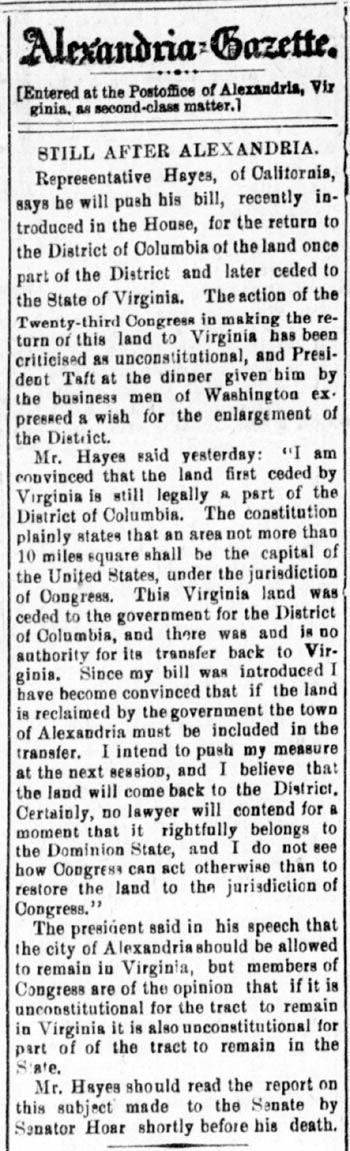
STILL AFTER ALEXANDRIA – The Alexandria Gazette, June 5th, 1909

This editorial is a follow-up to a previous editorial that included the full text of a bill that Representative Hayes, of California, had introduced in Congress the previous week to expand the size of the District of Columbia. Representative Hayes goes on record in this article saying that his bill is imperfect and that in the next session he would like to also include Alexandria City, which was left out. The editor of the Alexandria Gazette concludes with a hint at what the next editorial will be….


STILL AFTER ALEXANDRIA – The Alexandria Gazette, June 5th, 1909

Representative Hayes, of California, says he will push his bill, recently introduced in the House, for the return to the District of Columbia of the land once part of the District and later ceded to the State of Virginia. The action of the Twenty-third Congress in making the return of this land to Virginia has been criticised as unconstitutional, and President Taft at the dinner given him by the business men of Washington expressed a wish for the enlargement of the District.

Mr. Hayes said yesterday: “I am convinced that the land first ceded by Virginia is still legally a part of the District of Columbia. The constitution plainly states that an area not more than 10 miles square shall be the capital of the United States, under the jurisdiction of Congress. This Virginia land was ceded to the government for the District of Columbia, and there was and is no authority for its transfer back to Virginia. Since my bill was introduced I have become convinced that if the land is reclaimed by the government the town of Alexandria must be included in the transfer. I intend to push my measure at the next session, and I believe that the land will come back to the District. Certainly, no lawyer will contend for a moment that it rightfully belongs to the Dominion State, and I do not see how Congress can act otherwise than to restore the land to the jurisdiction of Congress.”

The president said in his speech that the city of Alexandria should be allowed to remain in Virginia, but members of Congress are of the opinion that if it is unconstitutional for the tract to remain in Virginia it is also unconstitutional for part of of the tract to remain in the State.

Mr. Hayes should read the report on this subject made to the Senate by Senator Hoar shortly before his death.


This newspaper article was transcribed from a scan of the original newspaper article. The document was obtained from the Chronicling America newspaper collection and is in the public domain. It is being republished here in order to continue my advocacy for full representation for the American citizens of the District of Columbia.


|| 12/23/2009 || 11:54 am || + Render A Comment || ||
A Bill To Extend The Limits of the District of Columbia – The Alexandria Gazette, June 1, 1909

It appears that some of my recent work uncovering the history of the District of Columbia has been somewhat popular as of late. I could not be happier. History brings joy only to those willing to learn it.

This entry was transcribed from the June 1st, 1909 edition of the Alexandria Gazette. The newspaper printed the entire text of a bill introduced by Representative Everis A. Hayes of California.

In this bill he outlines the expansion of the District of Columbia back to it’s original boundary, with the exceptions of Alexandria City and Falls Church, and gives the President authority to negotiate with the governor of the State of Virginia a price of no more than $100,000 for the land. [that is between 2 million and 40 million 2009 dollars depending on how you calculate it]

There is a portion of the text that is illegible due to the use of tape when the newspaper was archived. However, I was able to adjust the contrast to be able to make out about 90% of the missing text.

I have a couple more subsequent articles to be transcribed that follow up on what exactly happened to this bill.


A BILL TO EXTEND DISTRICT OF COLUMBIA LIMITS.

The following is the full text of the bill introduced in the House of Representatives on May 27, 1909 by Mr. Hayes, of California, which was referred to the committee on the District of Columbia:

A bill extending the limits of the District of Columbia.

Whereas more territory ought to be held under the exclusive legislation given Congress over the District which is the seat of the general government for purposes of such a seat; and

Whereas that portion of Alexandria county, in the State of Virginia, which was originally ceded to the United States by the State if Virginia and receded to the State of Virginia by the twenty-ninth Congress by an act approved July ninth, eighteen hundred and forty-six, is now necessary for the public uses of the District of Columbia; Therefore,

Be it enacted by the [lost] House of Representatives of the United States in Congress assembled, [lost] that portion of the original District of Columbia ceded to the United States of America by the State of Virginia and which was receded to the State of Virginia by the twenty-ninth Congress by an act approved July ninth, eighteen hundred and forty-six, except that portion lying within the boundary lines or corporate limits of the towns of Alexandria and Falls Church, be held under the exclusive legislation given Congress over the District of Columbia, which is the seat of the general government, for the purposes os such a seat, and all the rights and jurisdiction therewith be, and the same are hereby, forever bound unto the District in full and absolute right and jurisdiction as well as of soil as of persons residing or to reside therein.

Sec. 2. That the right of jurisdiction and sovereignty shall be exercised by the United States government for the purposes of the District of Columbia over that portion of said Alexandria county, State of Virginia, except that portion lying within the corporate limits of the towns of Alexandria and Falls Church on and after the first day of July, nineteen hundred and ten.

Sec. 3. That the President is hereby authorized and empowered to open negotiations with the State of Virginia, through the Secretary of War or such other officer or commissioner as he may deem necessary and proper, to comply with the provisions of this act; and, further, the President is authorized to pay over into the treasury of the State of Virginia such sum of money as may be mutually agreed upon by the President of the United States and the governor of the State of Virginia for relinquishing her sovereignty or jurisdictions over the said portion of Alexandria county to the District of Columbia.

Sec. 4. That if it be not possible to conclude negotiations with the State of Virginia prior to July first, nineteen hundred and ten, the sovereignty of the District of Columbia and the exclusive legislation by Congress, together with all the rights and jurisdiction of the same, as well as of persons as of soil, shall extend over Alexandria county as aforesaid, except that portion included within the corporate limits of the town of Alexandria and the town of Falls Church, on and after the first day of July, nineteen hundred and ten, and the negotiations fixing the amount of the award to be awarded to the State of Virginia may be completed and the money paid over into the treasury of the State of Virginia at some future time as may be agreed upon by the President of the United States and the governor of the State of Virginia.

Sec. 5. That in addition to any sum of money which may be paid into the treasury of the State of Virginia by the President of the United States as provided by this act Congress will assume and pay all the debts or any part thereof now due or outstanding against that portion of Alexandria county no included within the corporate limits of the towns of Alexandria and Falls Church at the time of the passage of this act.

Sec. 6. That so much money as may be needed to pay in full said outstanding debts or obligations against that portion of Alexandria county, Virginia, as aforesaid, is hereby appropriated our the United States treasury, out of any money not otherwise appropriated, to be paid when and as the same may become due and payable.

Sec. 7. That so much money as may be needed is hereby appropriated out of the United States treasury no otherwise appropriated, to carry out the provisions of this act, not exceeding one hundred thousand dollars.


This newspaper article was transcribed from a scan of the original newspaper article. The document was obtained from the Chronicling America newspaper collection and is in the public domain. It is being republished here in order to continue my advocacy for full representation for the American citizens of the District of Columbia.


|| 12/17/2009 || 11:36 pm || + Render A Comment || ||
Anxious To Come Back – The Washington Post, July 24, 1890

Map of Alexandria County from 1878

ANXIOUS TO COME BACK


The District Hath Charms for the People of Alexandria


A MOVEMENT OF THE CITIZENS


Ninety Per Cent of the Population of Alexandria City and County Ready and Willing to Leave the Old State and Become Part of the National Capital.


The question of the repeal of the law retroceding Alexandria county to Virginia is the uppermost topic in the ancient city now. The advocates and opponents of repeal are having it back and forth good naturedly. “When are you going into the District?” one asks banteringly of the other. The latest step that has been taken toward securing a crystallization into action of all the discussion on the subject for the past twenty-five years was the presentation in the Senate, as stated in The Post yesterday, of a petition by Mr. Edmunds, signed by about 400 citizens of Alexandria county, praying for the repeal of the act of 1846, giving back to Virginia that portion of the ten miles square which Virginia had ceded for the seat of government. A Post reporter circulated among the business men of Alexandria yesterday with a view of learning the public sentiment in the matter. He found an almost unanimous sentiment in favor of it, at least those whom he met favored it and claimed that there was little opposition to the movement.

Mr. Amos Slaymaker, the King-street drygoods merchant, carried the petition among the business men. He said that he found very few who were opposed to it. There were some who thought that it was a slap at old Virginia, and they thought that it was not right to “go back” on the old State. The opposition was based entirely on sentiment. Those who favored repeal were animated by practical movements.

“We do not regard it as a slap at old Virginia,” Mr. Slaymaker said to the Post reporter. “We believe that it would benefit Virginia as well as Alexandria. See how Maryland has benefited by the proximity of the District. This would put a slice of the District right into Virginia, and could not but benefit all the surrounding country. I was a Confederate soldier myself, and I would not do anything that would be a blow to Virginia. Alexandria should be the port of entry for Washington. The navy yard and the ordnance foundery should be located here, where there is plenty of deep water instead of government spending thousands of dollars every year dredging out the Eastern Branch.”

“What started this movement?”

“It was started out in the county, and the paper was sent to me by Mr. Lacey, the patent attorney of Washington, who own considerable property in Alexandria county. The people in the county are all strongly in favor of it.”

“How is it proposed to proceed?”

“We hope to get Congress to repeal the law of retrocession. The Virginia legislature will bring the case before the Supreme Court, where we hope to get a decision. It is said, I believe, that Daniel Webster claimed when the law of retrocession was passed that it was unconstitutional, but a test has never been made of the law. Why, at the present time when you want to run any lines in the District you have to start from our corner of the ten miles square. It would be quite as constitutional for Maryland to take back that portion which she ceded to the Government. Then where would your District be?”

Mr. Joseph Broders, the grocer, on King street, near Union, heads the list of those who signed the petition. “I have thought for years that the act of retrocession was unconstitutional,” he said, “and when the paper was brought to me I said that I would willingly sign it– I would put my name at the top if they wanted. Daniel Webster said when it was proposed to let Virginia take back what it had given the Government, ‘Why, gentlemen, you can’t do that.’ But the South was in a majority in Congress, and it was rushed through. It was put through largely through railroad influence. Alexandria wanted to subscribe for the Orange and Alexandria Railway, and as part of the District it couldn’t do it. So it was decided to have the city go back into the State, and then it could be authorized to subscribe, and it was done. But it was wholly unconstitutional. Why, suppose a bill were to be brought up into Congress retroceding to Maryland that part which that State gave to the Government? The thing wouldn’t be heard of. It would be declared unconstitutional at the start. But if it was constitutional to let go of the part of the District on this side of the river it certainly is to retrocede that part of the District on the other side. That is plain enough.”

Mr. D.W. Whiting, the publisher of the Daily Progress, said that he had long favored repeal and had written for it for years. “Here we are paying out between $80,000 and $100,000 a year to the State,” said he, “and are getting nothing in return for it. All our license fees, the fines in State cases, and 40 cents on the $1 goes into the State, and we get nothing in return for it. Look at our streets; cobblestones overgrown by grass. If we had this $100,000 to spend on home improvements we could pave our streets better. As it is we spend about $10,000 a year on our streets. The benefit to Alexandria by coming into the District would be immense. There is an overwhelming sentiment here in favor of it. I believe that 90 out of 100 favor it. The laboring people favor it almost to a man, and the business men of Alexandria are largely in favor of it.”

Mr. Whiting yesterday published in his paper the following editorial on the subject:

RETROCESSION — A petition was presented to the United States Senate yesterday signed by a number of leading citizens of this city, asking Congress to pass an enabling act so that the constitutionality of the act annexing that portion of the District of Columbia, south of the Potomac, to Virginia. There are many very strong reasons why the people of Alexandria should desire to get back into the District. One of the reasons is that Alexandria is paying annually into the State treasury nearly, if not quite $100,000, which if spent in the city would give us good streets instead of miserable cobblestone wagon-destroyers that we have. The only reason for desiring to remain with the State is a sentimental one. The reasons for going back to the District are practical ones and appeal to common sense and business interest. If a vote was taken on the subject, nine-tenths of the people would vote to go back.

George Fisher, of Fisher Bros., on Royal street, said that he favored repeal because he believed that it would be a great benefit to the city to be in the District. It would rid the city of an undesirable political element. They could get city councils that would improve the streets. The city debt was being rapidly paid off without any increase in taxation, instead of improvements being made to the city. The politicians were, of course, opposed to repeal. It would take away the franchise.

Mr. John Harlow, of Harlow Bros., Royal and Cameron streets, said that he believed 95 persons out of 100 favored it. His brother, George Harlow, is strongly in favor of it.

Mr. M. B. Harlow, the city treasurer, said that one great reason for complaint was that so much money was paid into the State and nothing received in return. The circuit judge, the city sergeant, and other State officials were paid by the city. He, however, was not convinced of the wisdom of taking the step of separation.

Mr. Peter Aitchison, of Aitchison Bros., lumber dealers, on Union street, near Prince, is strongly in favor of repeal. He is a member of the city council, and has given considerable thought to the subject. He was not in his office when the reporter called, but his brother George was. He agreed with the other speakers that Virginia got a good deal more out of Alexandria than Alexandria did out of Virginia. He believed that a large majority of the people favored the repeal.

N. Lindsey, an extensive wholesale grocer at King and Union streets, also member of the city council, strongly favors the movement and signed the petition.

Mr. William F. Creighton, proprietor of the extensive drugstore on King and Royal streets, said that the subject had been considerably discussed in his store by members of the council and others. He had heard it stated that the city had paid in 1889 $88,00 toward the State, for which nothing had been received. His store is quite an assembling place for members of the council before and after meetings, and he had heard a good deal of discussion. He had signed the petition on it being represented to him that in the District the taxes would be lower and the local improvements would be greater.

French Smoot, the lumber dealer, on Union street, near King, a member of the city council, had also signed the petition. Other who believe in repeal are:
Helmuth Bros., butchers, corner King and Columbus streets; Summers & Bros., Pitt, near King; Thomas Leadbeater, North Fairfax, near King; R. C. Acton, the King street jeweler; William H. May, agricultural implements; Thomas Lannon, grocer; B. F. Peake, carpenter and builder; George Wise, insurance; L. E. Corbett, customs collector; C. A. Yohe, Old Dominion cigar factory; R. Bell, L. Bendhelm, C. W. Howell, Isaac M. Bell, R. M. Latham, Issac Eichberg, drygoods; J. H. D. Lunt, Worth Hulfish, V. M. Power, Perry & Son, T. A. Robinson, E. S. Fawcett, D. A. Windsor, whose son assisted in circulating the petition; Frederick Paff, G. E. French, W. N. Berkley, R. T. Lucas, A. W. Armstrong, J. C. Creighton, Thomas Hoy, C. T. Helmuth, H. Kirk, A. A. Warfield, C. B. Marshall, Henry Strauss, J. A. Marshall, R. W. French, G. P. Hill, L. Stabler & Co., R. F. Lee, B. Wheatley, R. J. Thomas, J. R. Edelin, Louis Brill, William Demaine, George Wise, A. H. Smythe.


Anxious To Come Back – The Washington Post, July 24, 1890


This newspaper article was transcribed from a scan of the original newspaper article. The document was obtained from the Washington Post archives and is in the public domain. It is being republished here in order to continue my advocacy for full representation for the American citizens of the District of Columbia.


|| 12/11/2009 || 11:56 am || 2 Comments Rendered || ||
Does Virginia Own Alexandria County? – The Washington Herald, January 18, 1910

I found this article absolutely fascinating. I’ve blogged about the two acts of Congress that are referenced throughout this article [H.R. 259 - An act to retrocede the county of Alexandria, in the District of Columbia, to the State of Virginia & An Act for establishing the Temporary and Permanent seat of the Government of the United States], but until today I had not thoroughly read a legal opinion on the topic of Virginia’s retrocession of Alexandria County (now present-day Arlington County). My original contention was that the Act of 1846 was illegal because the text of the Act specified that retrocession was possible only with the approval of both the city *and* the county of Alexandria, and only the city voted in favor retrocession. The argument presented in this article below speaks to the larger issue of how the “permanent” seat of government was created out of a legal covenant that involved four parties: the Federal Government, Virginia, Maryland, and the original 19 property owners of the District. A very compelling case is made that through the passage of the Act of 1846 the original covenant was unconstitutionally broken. 99 years later, I thoroughly agree with the logic outlined in the article below and would like to have the District of Columbia return to its original size. While I don’t see it happening any time soon, history shows that change is constant.

Map of the portion of the District of Columbia ceded back to Virginia

The Washington Herald, January 18th, 1910

DOES VIRGINIA OWN ALEXANDRIA COUNTY?


Hon. Harris Taylor, in Elaborate Opinion, Holds the Retrocession Was Clearly Illegal and Unconstitutional.


Was the act of July 9, 1846, under which the County of Alexandria, then in the District of Columbia, was re-ceded to the State of Virginia unconstitutional?

Hon. Hannis Taylor, former Minister to Spain, and a constitutional lawyer of distinction, has prepared an elaborae opinon on this subject, which was presented to the Senate yesterday, in which he holds that the retrocession was clearly illegal and unconstitutional.

“If retrocession to Virginia is to stand,” he says, “then the land underlying the Capitol, the White House, and the Treasury belongs either to Maryland or the local proprietors whom it was granted. The nation can only be protected against that result by a judgement of the Supreme Court of the United States declaring the act of retrocession of 1846 to be null and void.”

Complete Answer Found.

What is the remedy?
“The complete answer,” he says, “is to be found in the opinion of the Supreme Court in the case of The United States vs. Texas (143 U.S.,621-649), in which it was held that the Supreme Court can, under the Constitution, take cognizance of an original suit brought by the United States against a State to determine the boundary between one of the Territories and such State; that the Supreme Court has jurisdiction to determine a disputed question of boundary between the United States and a State; that a suit in equity begun in the Supreme Court is appropriate for determining a boundary between the United States and one of the States.”

He quotes the opinion rendered in this case, and says it solves every problem that can possibly arise in an original suit between the United States and Virginia as to the boundaries of the District of Columbia.
Act of 1846.

His opinion as to the unconstitutionality of the retrocession is based upon the contention that the act of 1846 broke a quadrilateral contract entered into on the one hand by the United States and on the other by Virginia, Maryland, and the nineteen local property-owners in Washington.

The United States, through the act of Congress of July 10, 1790, passed under the constitutional mandate, agreed that “the District so defined, limited, and located, shall be deemed the District accepted by this act, for the permanent seat of the government of the United States.”

Each of the three grantors, in consideration of that stipulation, made for the benefit of each, through which alone title to the whole could be made perfect, entered into the quadrilateral contract in question.

“It is elementary in the law of contracts,” he says, “that when two or more instruments are recorded at the same time or at different times which relate to the same subject matter, and one refers to the other, either tacitly or expressly, they will be taken together and construed as one instrument.

Maryland’s Right.

“Maryland,” he says, “has a perfect right to claim of the United States, by reason of the recision of the original quadrilateral agreement, the return of every foot of land ceded by her and now embraced within the present limits of the District.

“That right Maryland can enforce in an original suit against the United States in the Supreme Court under the authority laid down in the case of the United States vs. Texas.

“That great case,” he says, “refuted most emphatically the contention made by Senator Hoar in the Senate on April 11, 1902, that retrocession was a political and not a judicial question, and was settled by the political authorities, alone competent to decide it.

“The Supreme Court in the case in question decided that ‘it cannot with propriety be said that a question of boundary between a Territory of the United States and one of the States of the Union is of a political nature and non susceptible of judicial determination by a court having jurisdiction of such a controversy.

Constitutional Mandate.

“The constitutional mandate that requires the President to ‘take care that the laws be faithfully executed’ compels him to ascertain and determine the limits of territory over which they are to be enforced.”

And in conclusion he says:
In determining all question all questions of boundary, whether foreign or domestic, the initiative in this country is vested in the Executive acting alone. While he may advise with Congress as to the steps he may take in ascertaining boundaries, while executing the laws within the same, the President cannot surrender his exclusive power to ascertain what they are.

As a practical illustration, if in this matter the President believes that Virginia is in lawful possession of that portion of the District described in the act of 1846, it is his constitutional duty to “take care that the laws be faithfully executed” in that area, regardless of any contrary opinion the legislative department of the government might entertain on the subject. He could hold no other view without abdicating the independence of the executive power in the execution of the laws. It is, however, in my humble judgment, a case in which there should be friendly consultation between the executive and legislative departments, because in the event of a recovery in the Supreme Court Congress would no doubt be called upon to pass such a bill of indemnity as would relieve Virginia of any accountability for revenues derived from the area in question during her de facto occupation.

Goes in the Record.

Senator Carter, in presenting the elaborate brief written at his request by Mr. Taylor, asked and was granted unanimous consent to have it printed in the Record, and also as a Senate document. He said:

The subject is of absorbing interest to the people of the District and will surely challenge the attention of the country with constantly increasing force as the growth of the Federal city and the expanding needs of the government demonstrate more fully the wisdom of President Washington and his co-laborers in fixing the District lines as originally marked.

To the United States government the subject is of
Continued on Page 3, Column 4


DOES VIRGINIA OWN ALEXANDRIA COUNTY


Continued from Page One.

grave concern, for it involves in a technical sense title to the ground upon which this Capitol, the White House, and many other important public buildings stand. If the recession to Virginia stands in law it would seem possible that the Federal government retains jurisdiction over the portion north of the Potomac in derogation of the rights and at the sufferance of the State of Maryland.

Fever-breeding Marsh.

When artistic taste and solicitude for sanitary conditions combined to inspire the movement to reclaim the Potomac Flats, the progress of the work soon revealed the fact that proper treatment of the narrow river and adjacent marshes would always be limited and unsatisfactory while confined to the northern bank alone. A fever-breeding marsh within 7,000 or 8,000 feet of the White House cannot be regarded with indifference, nor can any one fail to observe that the improvement on the north sets forth the unsightliness of the south bank of the river in bold relief. In short, each year more amply justifies the wisdom of Washington and his commission in embracing both sides of the river within the limits of the Federal District.

The Capitol, the White House, and all the public buildings were located near the center in the beginning, but the act of retrocession moved the southern line of the District to within a short distance of the White House grounds. This was not intended by Washington, under whose masterful direction the constitutional design regarding a seat for the Federal government was executed.

Defeat of Intention.

“The act receding two-fifths of the District to Virginia so obviously defeats the intention of the framers of the Constitution in this behalf and so ruthlessly disregards the rights of other parties that I have for years regarded it as null and void on general principles; not withstanding the interesting and important nature of the question, I have not found time to investigate the law and the historical facts bearing upon it. Last year, however, I had the good fortune to mention the matter to Mr. Harris Taylor, known to the bar of the country as one of our leading constitutional lawyers, and the gentleman volunteered to examine the question and to write me his view upon it.

Mr. Taylor’s letter sets forth the constitutional provision in question and all legislation, State and national, in relation to the subject, together with a review of all executive action and contract obligations in pursuance thereof. In fact, the letter is a brief of such rare clearness and ability that I believe it should be made permanently available for reference, and so believing, I renew my request and ask that when printed the commincation be referred to the Committee on the District of Columbia for consideration.

An Exhaustive Opinion.

Mr. Taylor’s opinion, buttressed by historical references and legal citations, is exhaustive and comprehensive. He says, in beginning:

The contemporaneous evidence puts the fact beyond all question that the final definition of a district ten miles square as the seat of our Federal government was in a special sense the personal work of President Washington, whose task involved the acquisition of the title to the tract from three sources- the State of Virginia, the State of Maryland, and the nineteen local proprietors who owned that part at the heart of the present city which underlies the Capitol, the White House, and the Treasury. Washington’s task was to induce the three parties who held the title to cede to the Federal government, without any direct pecuniary consideration, the entire area under a quadrilateral contract in which that government was the grantee and beneficiary, and Virginia, Maryland, and nineteen local proprietors the grantors. The real consideration moving to such grantors was the incidental benefits to accrue to them from their joint cession, which, in the language of the act of July 16, 1790, “is hereby accepted for the permanent seat of the government of The United States.” That covenant represented the only consideration moving directly from the Federal government, while the three grantors were bound to each other by the mutual considerations moving from the one to the other under interdependent grants.

Maryland, the last to grant, expressed the idea of mutual benefits to be derived from a common enterprise when her legislature declared that “it appears to this general assembly highly just and expedient that all the lands within the said city should contribute, in due proportion, in the mean which have already greatly enhanced the value of the whole.” Under that quadrilateral contract, supported by the foregoing considerations, the Federal government entered into possession with a perfect title, after the final cession made by Maryland December 19, 1791.

Government in Control.

No one, perhaps, will deny that after the title to the entire area had thus passed from the three grantors into the corporate person of the nation neither the State of Virginia nor the State of Maryland could have, either in law or in equity, any claim to the common heritage superior to that of any other State. Under such considerations the Federal government remained in peaceful possession of the entire area ten miles square, and governed the same under the Constitution for a period of fifty-five years. During that time the original boundaries as designed by Washington were marked by massive stone monuments, while still abide unimpaired.

By the act of retrocession of July 9, 1846, the District was dismembered by a conveyance to Virginia of nearly one-half of the entire area for no pecuniary or property consideration whatever. What was the real motive of the retrocession it is at this time difficult to ascertain.

From a legal standpoint, the fact that the portion reconveyed to Virginia had originally been contributed by her is of no significance whatever. Therefore, before argument begins, the mind wonders upon what constitutional principle such retrocession could have been made. Two distinct parts of the Constitution are involved. First, that part of section 8, Article 1, which provides that Congress shall have power “to exercise exclusive legislation in all cases whatever, over such District (not exceeding ten miles square) as may, by cession of particular States and the acceptance of Congress, become the seat of government of the United States;” second, that part of section 10, article 1, which provides that “no State shall pass any bill of attainder, ex post facto law or law impairing the obligation of contracts.”

During the memorable Senate debate led by Senator Haywood, of North Carolina, who, as chairmen of the District Committee, bitterly assailed the constitutionality of the act of retrocession, the meaning and effect of section 8, Article 1, was fully explored.

I cannot doubt the soundness of the conclusion then reached by many leading statesmen of that day to the effect that, considered in reference to that part of the Constitution alone, the act of retrocession is null and void. What I cannot understand is the fact that any debate, however hastily conducted, the deeper and more obvious argument based on the contract clause of the Constitution (Article 1, section 10), should have been entirely overlooked. And yet the record shows that such was the fact.

It never occurred to any one in 1846, or since that time, to look to the sources of the title in the quadrilateral contract upon which the ownership of the area ten miles square really depends. What is said herein as to that branch of the subject is my personal contribution to the controversy.

Acquirement of Site.

He goes into history to show how the site of the National Capital was discussed and finally acquired, and says:

After prolonged discussion the act of July 16, 1790, was passed, and the site of the District finally located, partly in Prince George and Montgomery counties, in the State of Maryland, and partly in Fairfax County, in the State of Virginia, by proclamation of President George Washington, March 30, 1971, within the following bounds:

“Beginning at Jones Point, being the upper cape of Hunting Creek, in Virginia, and at an angle in the outset of 45 degrees west of the north, and running in a direct line ten miles for the first line; then beginning again at the same Jones Point and running another direct line at a right angle with the ffirst across the Potomac ten miles.”

From the diagram it appears that the “Portion derived from and receded to Virginia” constitutes nearly one-half of the territory of the District as originally defined in the proclamation of March 30, 1791. If the act of July 9, 1846 (9 Stats. 35), entitled “An act to retrocede the County of Alexandria, in the District of Columbia, to the State of Virginia,” is unconstitutional and void, the laws of the United States should now be executed by the President thourghout the “Portion derived from and receded to Virginia.”

Continuing, he says:
After the power to elect the seat of government had been once exercised by Congress, after the cession had been made for that purpose by “particular States,” after the area so ceded had been accepted by Congress under the act of July 16, 1790, declaring “the same is hereby accepted for the permanent seat of government of the United States,” the power of Congress over the subject matter was exhausted. Or, if it was not exhausted, could not again be exercised, because no power remained to transfer the District, as originally created and accepted, of any portion of it to any State. In other words, after a district of ten miles square had once been established and accepted as a permanent seat of government, Congress possessed no power to acquire another territory for another seat of government, without violating the constitutional limitation which confined it to the ten miles square. The Congress, an agent of limited authority, was expressly authorized to receive cessions from States of a limited amount of territory to be held as a permanent seat of government; but it was not authorized, expressly or implicitly, to give any part of such cessions away to any one. Such was the constitutional difficulty which the Hon. R. M. T. Hunter attempted to overcome when the bill in question was up for debate in the House of Representatives May 8, 1846.

Section 8 of Article 1 of the Constitution when taken as a whole, provides that “the Congress shall have power * * * to exercise exclusive legislation in all cases whatsoever over such District (not exceeding ten miles square) as may, by cession of particular States and the acceptance of Congress become the seat of the government of the United States; and to exercise like authority over all places purchased by the consent of the legislature of the State in which the same shall be for the erection of forts, magazines, arsenals, dockyards, and other needful things.” The delegation of power thus made Congress to acquire a seat of government for the United States, through formal acceptance of cessions to the be made by particular States is a distinct subject matter, entirely separate and apart from the succeeding delegation of power to govern “all places purchased by the consent of the legislature of the State in which the same shall be.” Did the grant of an express power formally to accept cessions from particular States, which were to constitute and “become the seat of government of the United States,” carry with it, as a necessary implication, the right to use the means necessary for the execution of the power? In other words, did the implied power to use such necessary means flow from the express to accomplish the end? In construing that clause which provides that Congress shall have power “to make all laws which shall be necessary and proper for carrying into execution the foregoing powers and all other powers vested by the Constitution in the government of the United States, or in any department or officer thereof,” it was held at an early day that the clause in question “confers on Congress the choice of means and does not confine it to what is indispensably necessary.”

Constitutional Mandate.

The express mandate was given by the Constitution to Congress to acquire a seat of government by cessions from particular States, and in no other manner. Congress was powerless to force any State to make a cession; it could not go beyond the limits of the States. It could only persuade; it could not command. Congress did not offer to the ceding States any money consideration whatever for their cessions. The means, and the only means, Congress saw fit to employ to accomplish a vitally important end was the promise, made in the of July 16th, 1790, that the seat of government to be located on the cessions should be “permanent.”

The act expressly declared that “the district so defined, limited, and located shall be deemed the district accepted by this act for the permanent seat of government of the United States.” When Mr. Madison moved in the House of Representatives to strike out the word “permanent” from the act he was voted down, and thus we have a legislative interpretation, practically contemporaneous, to the effect that the Constitution intended to confer upon Congress the power make the seat of government permanent. Contemporary interpretation of the Constitution, practiced and acquiesced in for years, conclusively fixes its construction.

Some years go, when a movement was on foot to remove the Capital to the Valley of the Mississippi, the effect of the action of Congress under section 8, Article 1, was fully discussed. I am informed that it was then universally admitted that by the selection of the present seat of government the power of Congress, under the section in question, had been exhausted.

Virginia made her grant, which was the first grant, December 3 1789. The nineteen local proprietors perfected their grants on or about the 29th of June, 1791. Maryland did not make grant until December 19, 1791. In that grant, embodied in a very elaborate act of thirteen sections, Maryland put the fact beyond all question that the prior grants made by Virginia and the nineteen proprietors were conditions precedent to her grant.

Quotes from Opinions.

He quotes from many opinions rendered by the Supreme Court of the United States to show that a grant is a contract, and this quadrilateral contract entered into by the United States on the one hand and Virginia, Maryland, and the nineteen local proprietors on the other, was binding in its operation and effect, and could not be modified without abrogating the contract as a whole.


Related Legislation Entries:


The Daily Render By
A Digital Scrapbook for the Past, Present, and Future.

©2004-2010 Nikolas R. Schiller - Colonist of the District of Columbia - Privacy Policy - Fair Use - RSS - Contact


1 / 212


Photo by Charlie McCormick
Nikolas Schiller is a 29-year-old cartographer, consultant, digital artist, researcher, photographer, civil rights activist, and blogger living in America's last continental colony, Washington, DC. If you have any questions or comments, please contact:

+ Facebook
+ Twitter
+ YouTube
+ MySpace
+ Google
+ Vimeo

::SUBSCRIBE::

I am taking a brief break from daily blog postings. Please subscribe to be notified when I resume!

::ARCHIVES BY YEAR::

+ 2010
+ 2009
+ 2008
+ 2007
+ 2006
+ 2005
+ 2004


::RENDERS BY YEAR::

+ 95 in 2008
+ 305 in 2007
+ 213 in 2006
+ 122 in 2005
+ 106 in 2004

::THE QUILT PROJECTION::

Square
Square

Diamond
diamond

Hexagon
hexagon

Octagon
octagon

Dodecagon
Dodecagon

Beyond
beyond

::OTHER PROJECTIONS::

The Lenz Project
Lenz

Mandala Project
Mandala

The Star Series


Abstract Series
abstract

Memory Series
Memory

Mother Earth Series
Mother Earth

Misc Renderings
Misc

::SORTA POPULAR MAPS::

- The Los Angeles Interchanges Series
- The Lost Series
- Terra Fermi
- Antique Map Mashups
- Google StreetView I.E.D.
- LOLmaps
- The Inaugural Map
- The Shanghai Map
- Ball of Destruction
- The Lenz Project - Maps at the Library of Congress
- Winner of the Everywhere Man Award

::MONTHLY ARCHIVES::

::LOCATIONS & CATEGORIES::

::LAST 51 POSTS::

Fair Use


19 queries. 5.182 seconds.
Powered by WordPress

::SUPPORT::

pay with paypal

:: LAST VISITORS ::