The D.C. Plantation: Freedom Soon?
New York Times, Nov. 25, 1991
The effort to grant statehood to Washington, D.C., could well become a campaign issue in 1992.
A bill that would admit the District to the Union as New Columbia, the 51st state, was introduced in the Senate on Thursday. And hearings on the House version of the bill saw a welcome burst of enthusiasm. Three Democratic Presidential candidates testified in favor of statehood and others sent messages of support.
That’s as it should be. The District’s treatment is a scandal, albeit one with a long history. The Federal Government runs the city like a plantation, denying it a voting representative in Congress, forbidding it even rudimentary self-rule and limiting severely its ability to raise revenue.
President Bush favors keeping the District on its knees. But Gov. Bill Clinton of Arkansas, Gov. Douglas Wilder of Virginia and Senator Tom Harkin of Iowa testified before Congress that the District deserved to become a full partner in the Union. The three were on the mark.
Washingtonians have long been denied rights that the rest of us take for granted. They weren’t allowed to vote in Presidential elections until 1964. And it was not until the Home Rule Act of 1973 that they could elect a mayor and city council; both had previously been appointed.
The Home Rule Act left the Federal Government’s dictatorial powers intact. Congress can overturn any law the District council passes. A powerful senator can throw some cash to friends by attaching amendments to the city’s budget bill. And one meddlesome Congressman can by himself trigger bearings on any law by simply raising an objection to it.
The Federal Government is not above extortion. Mr. Bush recently vetoed the city budget, forcing the District to ban the use of locally raised tax revenues to furnish abortions for impoverished women. And Congress used similar blackmail to force repeal of a law that made gun dealers and manufacturers liable for injuries from assault weapons. The citizens have reinstated the measure; gun-lobbying senators may yet thwart it. The District’s non-voting representative, Eleanor Holmes Norton, spends much of her time fending off odious infringements like these.
Fiscal restrictions abound. The Federal Government’s real estate is exempt from taxation; the city is forbidden to tax the earnings of commuters, most of whom are Federal employees. District officials say these restrictions cause the city to forgo $1.9 billion in revenues per year. Last year the Federal Government paid a paltry $430 million in return. Denied sources of revenue, the city levies some of the highest taxes in the nation.
Those who oppose statehood typically offer weak constitutional arguments against it. It seems fairly clear, however, that Republicans who oppose statehood do so because the District would send two more Democrats to the Senate.
But most Americans understand democracy well. The issue of statehood for the District raises an obvious question: How can we justify championing democracy abroad while inflicting second-class citizenship in the nation’s capital? The answer is obvious, too: We can’t.
This newspaper article was obtained from the Congressional Record in the Library of Congress related to H.R. 51, The New Columbia Admission Act of 1993. The article is not in the public domain but is being republished here under the fair use doctrine of U.S. copyright law in order to continue my advocacy for full representation for the American citizens of the District of Columbia.

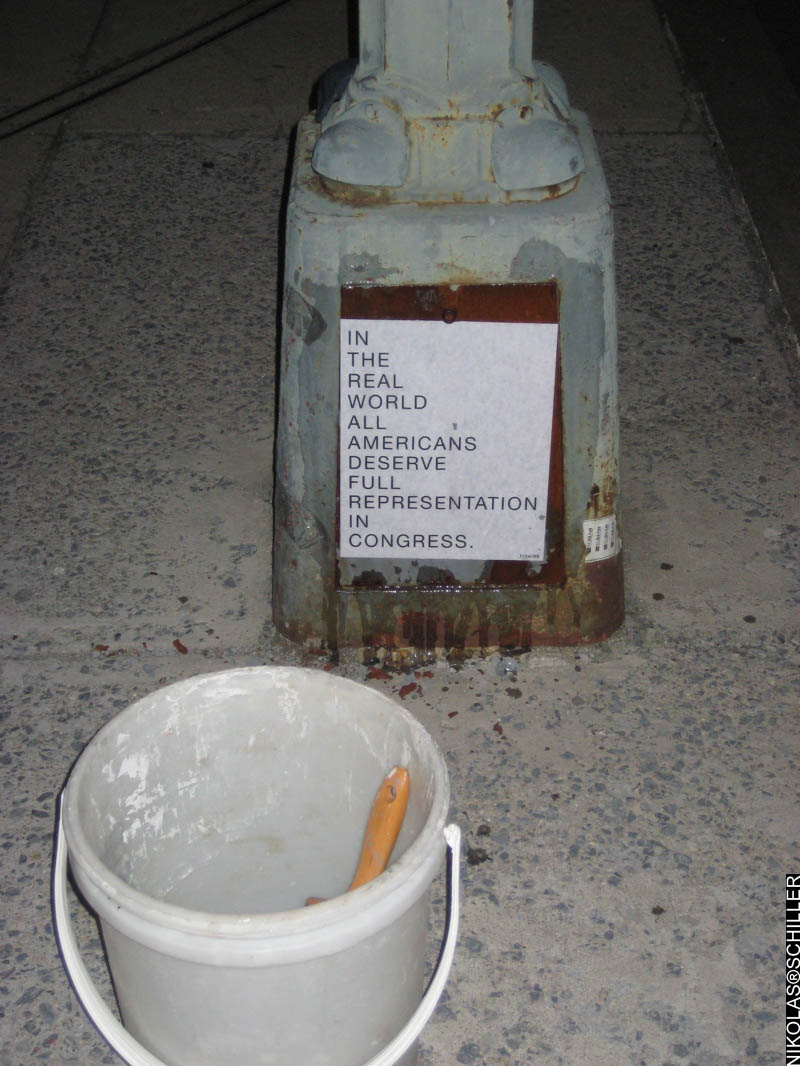
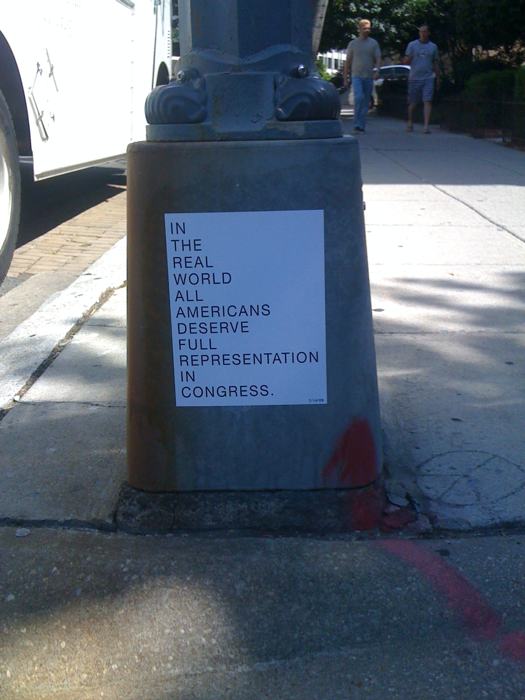




The sign I posted outside of MTV’s Real World DC house is transcribed in today’s Washington Post
|| 8/16/2009 || 3:01 pm || Comments Off on The sign I posted outside of MTV’s Real World DC house is transcribed in today’s Washington Post || ||
Last month I posted the photograph above in my entry about adding some political commentary to the area around the Real World DC house in the Dupont Circle neighborhood of Washington, DC. This morning a friend of mine left a somewhat cryptic comment on my Facebook page telling me to check section E6 in today’s Washington Post. I ran downstairs, opened the paper up, and let out out a hearty laugh.
Transcribed near the end of Dan Zak’s article, Neighborhood Watch: MTV Is in the House, and Everyone Else Just Wants to Be, is the text of my sign:
In the next section of the article there is choice quote from some teenagers from Maryland:
(underline added for emphasis of the Congressional lack thereof)
While I was not identified as the creator of the sign, even though a simple Google Search would have brought the author to my website, and the author only mentioned that there was one sign (there are 8 still up last time I counted), I’m very pleased that my sign was mentioned in today’s article. In that respect, the ten dollars spent making those signs & purchasing the wheatpaste was completely validated— my message made it into the Washington Post. But the real question is if the message will make the cut and be mentioned in any of the episodes set to air on MTV in 2010?
Since the sign(s) has been up now for just about a month, I figure its time to remove them and put up something new. I already have the next flyer made, but I’m debating if I should put them up or not. The flyer is a bit over the top, but well, umm, so are most of the people mentioned in the article. But unlike the ones who actually give two shits about the show, my aim is not to get in the house or hang out with the cast (I really could care less about that), but to use their presence in Washington, DC as a vehicle to get out the larger message of DC residents being second class citizens denied representation in Congress.
Click on the screen grab below to read the last page of the article:
What’s interesting about the text on-line versus the text in the printed article is that there is extra space between lines of the poster in the on-line version captured above. These extra line breaks actually make the point of the poster appear more important on-line than it does in the print edition, which does not feature extra line breaks. But since the print edition of the Washington Post is not delivered outside of the Washington, DC area, this typographical difference carries significantly more weight on-line than in print. In that respect, I must thank the web editor at the Washington Post for giving the text of my sign a little bit more emphasis than it would otherwise have received if it were identical to the print edition.
UPDATE – After I posted this entry, I went back to the Washington Post website and found that the poster was briefly shown at the beginning of the video portion of the article: