The Daily Render

by

A Digital Scrapbook for the Past, Present, and Future

| FRONT PAGE | GEOSPATIAL ART | DC HISTORY / TIMELINE | NEWS | COLONIST | FOUND MAPS | FRACTALS |
| PHOTOGRAPHY | ANTIQUE | DESIGN | VIDEO | | CONTACT |

The Full Text Of An Act for the Release of certain Persons held to Service or Labor in the District of Columbia
|| 3/5/2010 || 2:58 pm || 1 Comment Rendered || ||

Washington, DC celebrates April 16 as Emancipation Day. On that day in 1862, President Abraham Lincoln signed the Compensated Emancipation Act for the release of certain persons held to service or labor in the District of Columbia. The Act freed about 3,000 slaves in the District of Columbia nine months before President Lincoln issued his famous Emancipation Proclamation. The District of Columbia Compensated Emancipation Act represents the only example of compensation by the federal government to former owners of emancipated slaves. While the slaves of DC were the first to be freed in America, through the continued denial of congressional representation, their decedents are the last to be fully equal.

Text and Image Courtesy of the National Archives


An Act for the Release of certain Persons held to Service or Labor in the District of Columbia

Be it enacted by the Senate and House of Representatives of the United States of America in Congress assembled, That all persons held to service or labor within the District of Columbia by reason of African descent are hereby discharged and freed of and from all claim to such service or labor; and from and after the passage of this act neither slavery nor involuntary servitude, except for crime, whereof the party shall be duly convicted, shall hereafter exist in said District.

Sec. 2. And be it further enacted, That all persons loyal to the United States, holding claims to service or labor against persons discharged therefrom by this act, may, within ninety days from the passage thereof, but not thereafter, present to the commissioners hereinafter mentioned their respective statements or petitions in writing, verified by oath or affirmation, setting forth the names, ages, and personal description of such persons, the manner in which said petitioners acquired such claim, and any facts touching the value thereof, and declaring his allegiance to the Government of the United States, and that he has not borne arms against the United States during the present rebellion, nor in any way given aid or comfort thereto: Provided, That the oath of the party to the petition shall not be evidence of the facts therein stated.

Sec. 3. And be it further enacted, That the President of the United States, with the advice and consent of the Senate, shall appoint three commissioners, residents of the District of Columbia, any two of whom shall have power to act, who shall receive the petitions above mentioned, and who shall investigate and determine the validity and value of the claims therein presented, as aforesaid, and appraise and apportion, under the proviso hereto annexed, the value in money of the several claims by them found to be valid: Provided, however, That the entire sum so appraised and apportioned shall not exceed in the aggregate an amount equal to three hundred dollars for each person shown to have been so held by lawful claim: And provided, further, That no claim shall be allowed for any slave or slaves brought into said District after the passage of this act, nor for any slave claimed by any person who has borne arms against the Government of the United States in the present rebellion, or in any way given aid or comfort thereto, or which originates in or by virtue of any transfer heretofore made, or which shall hereafter be made by any person who has in any manner aided or sustained the rebellion against the Government of the United States.

Sec. 4. And be it further enacted, That said commissioners shall, within nine months from the passage of this act, make a full and final report of their proceedings, findings, and appraisement, and shall deliver the same to the Secretary of the Treasury, which report shall be deemed and taken to be conclusive in all respects, except as hereinafter provided; and the Secretary of the Treasury shall, with like exception, cause the amounts so apportioned to said claims to be paid from the Treasury of the United States to the parties found by said report to be entitled thereto as aforesaid, and the same shall be received in full and complete compensation: Provided, That in cases where petitions may be filed presenting conflicting claims, or setting up liens, said commissioners shall so specify in said report, and payment shall not be made according to the award of said commissioners until a period of sixty days shall have elapsed, during which time any petitioner claiming an interest in the particular amount may file a bill in equity in the Circuit Court of the District of Columbia, making all other claimants defendants thereto, setting forth the proceedings in such case before said commissioners and their actions therein, and praying that the party to whom payment has been awarded may be enjoined form receiving the same; and if said court shall grant such provisional order, a copy thereof may, on motion of said complainant, be served upon the Secretary of the Treasury, who shall thereupon cause the said amount of money to be paid into said court, subject to its orders and final decree, which payment shall be in full and complete compensation, as in other cases.

Sec. 5. And be it further enacted, That said commissioners shall hold their sessions in the city of Washington, at such place and times as the President of the United States may direct, of which they shall give due and public notice. They shall have power to subpoena and compel the attendance of witnesses, and to receive testimony and enforce its production, as in civil cases before courts of justice, without the exclusion of any witness on account of color; and they may summon before them the persons making claim to service or labor, and examine them under oath; and they may also, for purposes of identification and appraisement, call before them the persons so claimed. Said commissioners shall appoint a clerk, who shall keep files and [a] complete record of all proceedings before them, who shall have power to administer oaths and affirmations in said proceedings, and who shall issue all lawful process by them ordered. The Marshal of the District of Columbia shall personally, or by deputy, attend upon the sessions of said commissioners, and shall execute the process issued by said clerk.

Sec.6. And be it further enacted, That said commissioners shall receive in compensation for their services the sum of two thousand dollars each, to be paid upon the filing of their report; that said clerk shall receive for his services the sum of two hundred dollars per month; that said marshal shall receive such fees as are allowed by law for similar services performed by him in the Circuit Court of the District of Columbia; that the Secretary of the Treasury shall cause all other reasonable expenses of said commission to be audited and allowed, and that said compensation, fees, and expenses shall be paid from the Treasury of the United States.

Sec. 7. And be it further enacted, That for the purpose of carrying this act into effect there is hereby appropriated, out of any money in the Treasury not otherwise appropriated, a sum not exceeding one million of dollars.

Sec. 8. And be it further enacted, That any person or persons who shall kidnap, or in any manner transport or procure to be taken out of said District, any person or persons discharged and freed by the provisions of this act, or any free person or persons with intent to re-enslave or sell such person or person into slavery, or shall re-enslave any of said freed persons, the person of persons so offending shall be deemed guilty of a felony, and on conviction thereof in any court of competent jurisdiction in said District, shall be imprisoned in the penitentiary not less than five nor more that twenty years.

Sec. 9. And be it further enacted, That within twenty days, or within such further time as the commissioners herein provided for shall limit, after the passage of this act, a statement in writing or schedule shall be filed with the clerk of the Circuit court for the District of Columbia, by the several owners or claimants to the services of the persons made free or manumitted by this act, setting forth the names, ages, sex, and particular description of such persons, severally; and the said clerk shall receive and record, in a book by him to be provided and kept for that purpose, the said statements or schedules on receiving fifty cents each therefor, and no claim shall be allowed to any claimant or owner who shall neglect this requirement.

Sec. 10. And be it further enacted, That the said clerk and his successors in office shall, from time to time, on demand, and on receiving twenty-five cents therefor, prepare, sign, and deliver to each person made free or manumitted by this act, a certificate under the seal of said court, setting out the name, age, and description of such person, and stating that such person was duly manumitted and set free by this act.

Sec. 11. And be it further enacted, That the sum of one hundred thousand dollars, out of any money in the Treasury not otherwise appropriated, is hereby appropriated, to be expended under the direction of the President of the United States, to aid in the colonization and settlement of such free persons of African descent now residing in said District, including those to be liberated by this act, as may desire to emigrate to the Republics of Hayti or Liberia, or such other country beyond the limits of the United States as the President may determine: Provided, The expenditure for this purpose shall not exceed one hundred dollars for each emigrant.

Sec. 12. And be it further enacted, That all acts of Congress and all laws of the State of Maryland in force in said District, and all ordinances of the cities of Washington and Georgetown, inconsistent with the provisions of this act, are hereby repealed.

Approved, April 16, 1862.
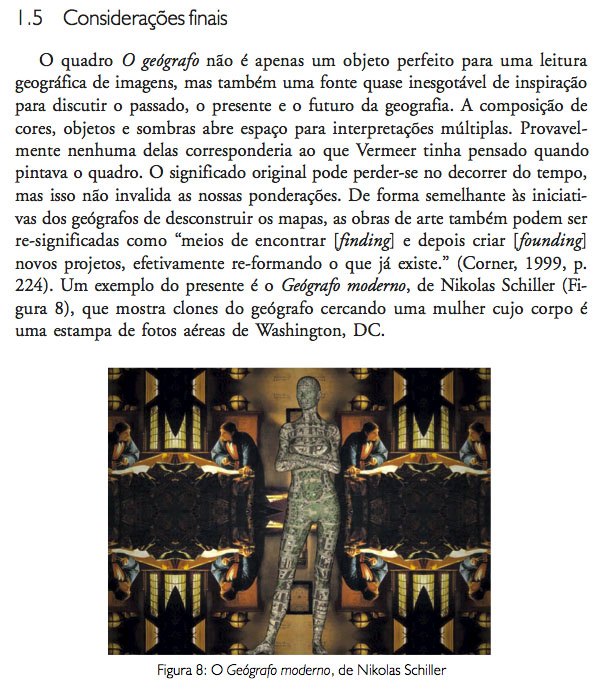


The Modern Geographer is featured in Pro-Prosições vol.20 no.3 Campinas Sept./Dec. 2009
|| 2/25/2010 || 2:18 pm || + Render A Comment || ||

On April 1st, 2009 I received an e-mail the author Jorn Seemann, a graduate student at Lousiana State University, requesting to use my piece “The Modern Geographer” in an upcoming peer-reviewed article for the 10-year-anniversary issue of the Brazilian journal Pre-Posicoes (Universidade Estadual de Campinas, UNICAMP). I was expecting to have to send him a larger version of the work, but to my chagrin the on-line version was able to work for publication.


O quadro O geógrafo não é apenas um objeto perfeito para uma leitura geográfica de imagens, mas também uma fonte quase inesgotável de inspiração para discutir o passado, o presente e o futuro da geografia. A composição de cores, objetos e sombras abre espaço para interpretações múltiplas. Provavelmente nenhuma delas corresponderia ao que Vermeer tinha pensado quando pintava o quadro. O significado original pode perder-se no decorrer do tempo, mas isso não invalida as nossas ponderações. De forma semelhante às iniciativas dos geógrafos de desconstruir os mapas, as obras de arte também podem ser re-significadas como “meios de encontrar [finding] e depois criar [founding] novos projetos, efetivamente re-formando o que já existe.” (Corner, 1999, p. 224). Um exemplo do presente é o Geógrafo moderno, de Nikolas Schiller (Figura 8), que mostra clones do geógrafo cercando uma mulher cujo corpo é uma estampa de fotos aéreas de Washington, DC.


I will have an English translation on-line shortly…..


Today In History: St. Valentine’s Day – The Washington Herald, February 14th, 1910
|| 2/14/2010 || 10:28 am || + Render A Comment || ||

Scan of the newspaper article Today In History from the Washington Herald, 100 years ago

St. Valentine’s Day has degenerated somewhat in recent years, and is now generally observed by the sending of jocular pictures with suitable verses attached, or an equally ridiculous sentimental picture card. Formerly the proper ceremony of the day was the drawing of a kind of lottery, followed by ceremonies not much unlike what is generally called the game of forfeits.

In Pepy’s Diary we find some notable illustrations of this old custom. It appears that married and single were then alike liable to be chosen as a valentine, and that a present was invariably necessarily given to the choosing party. “Noticing the jewels of the celebrated Miss Stuart, who became Duchess of Richmond,” he records, “the Duke of York, being once her valentine, did give her a jewel of about £800; and my Lord Mandeville, her valentine this year, a ring of about £300. These presents were undoubtedly given in roder to relieve the obligations under which the being drawn as valentines places the donors.”

Notwithstanding the practice of “relieving,” there seems to have been a disposition to believe that the person drawn as a valentine had some considerable likelihood of becoming the associate of the party in wedlock.

It was supposed, for instance, that the first unmarried person of the other sex whom you met on St. Valentine’s morning in walking abroad was a destined wife or a destined husband. Thus Gay makes a rural dame remark:

“Last Valentine, the when birds of kind,
Their paramours with mutual chirpings find,
I early rose just at the break of day,
Before the sun had chased the stars away;
A-field I went, amid the morning dew,
To milk my kine (for so should housewives do).
Thet first I spied- and the first swain we see.
In spite of fortune shall our true love be.”

St. Valentine’s Day is alluded to by Shakespeare and by Chaucer, and also by the poet Lydgate, who died in 1440. One of the earliest known writers of valentines, or poetical amative address for this day, was Charles, Duke of Orleans, who was taken at the battle of Agencourt.

The origin of these peculiar observances of St. Valentine’s Day is a subject of some obscurity. The saint himself, who was a priest of Rome, martyred in the third century, seems to have had nothing to do with the matter beyond the accident of this day being used for the purpose.

Just why St. Valentine was chosen the patron of love seems a little obscure. Wheatly says: “He was a man of admirable parts and so famous for his love and charity that the custom of choosing valentines upon his festival, which is still practiced, too rise from thence.” While Dr. Butler, in his “Lives of the Saints,” says: “To abolish the heathens’ lewd custom of boys drawing the names of girls in honor of their goddess, Februata Juno, on the fourteenth of this month, several zealous pastors substituted the names of saints on the billets that were drawn.” and thus in the mutation of time the custom has grown which now takes the form of “valentines.”


February 14 is the date which Gray and Bell each received a patent for the first telephone in 1876; it is the birthday of Gen. Winfield Scott Hancock (1824); Charles L. Sholes, father of the typewriter (1819); Samuel Osgood, the first Postmaster General (1748); the day on which the United States flag was first seen in foreign lands and saluted in 1778, and upon which the battle of St. Vincent, in 1797.


This newspaper article was transcribed from the scan of the February 14th, 1910 edition of the Washington Herald from the Chronicling America newspaper collection and is in the public domain.


The Noyes Armillary Sphere Described In The Historic American Buildngs Survey #532
|| 2/9/2010 || 2:00 pm || + Render A Comment || ||

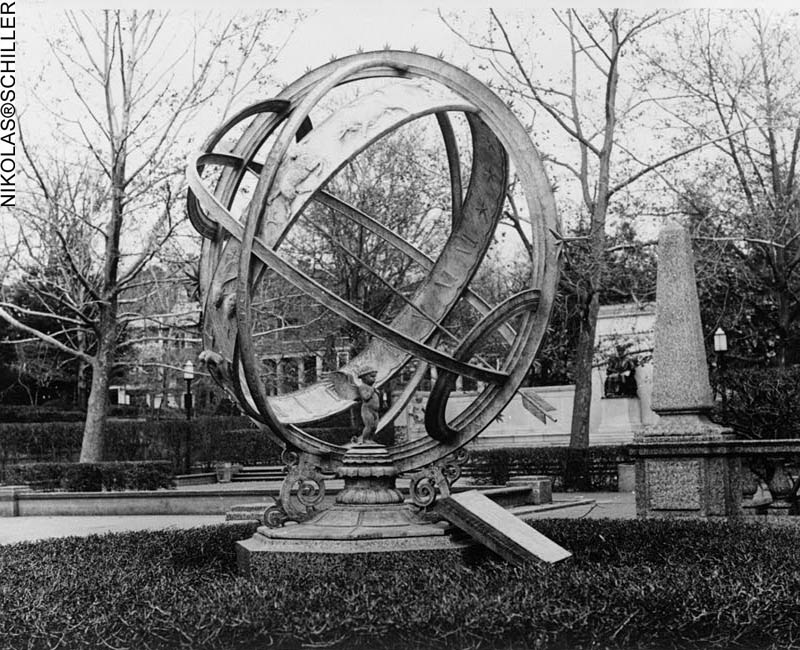
National Park Service Photograph of the Noyes Armillary Sphere in Meridian Hill Park in the District of Columbia taken in the 1965

National Park Service Photograph Courtesy of the Library of Congress

According to page 39 of the Historic American Buildngs Survey #532 published in 1987 [PDF via the Library of Congress]:

The sculpture which contributed most sucessfully to the architectural design [of Meridian Hill Park] was the 6′ high armillary sphere. Money for the construction of the sphere was donated by Bertha Noyes, a well-known Washington artist and founder of the Washington Arts Club, in memory of her father and her sister. Paul Manship had constructed a model for an earlier proposal for an armillary sphere. For lack of funds, that sphere was not realized, later when the Noyes Armillary Sphere was constructed by Carl Paul Jennewein, he based his design on the earlier Manship model. The sphere was located in the exedra on axis with the cascade, south of the reflecting pool. This location was proposed by Ferruccio Vitale, and the foundation was designed by Horace W. Peaslee. Congress approved the location within Meridian Hill Park on June 10, 1932, subject to the final approval of its location within the park by the Commission. The sphere, which was of great interest conceptually as well as visually, was described by historian James Goode as follows:

In spite of its seemingly contemporary design, the armillary sphere is, in face, an ancient astrological instrument. The armillary sphere was frequently used in Europe in the seventeenth century to illustrate the Ptolemaic theory of a central earth; it used metal rings which illustrated the nine spheres of the universe. The usual device, a skeleton of the celestial globe with circles arranged into degrees for angle measurement, represents the great circles of the heavens. The latter includes the horizon, meridian, equator, tropics, and polar circle. The Noyes Armillary Sphere includes a series of bronze rings on which are also found the symbols of the zodiac and the hours, given in Roman numerals. A bronze arrow forms the axis, and, in the center, a small winged genie greets the sun. (James M. Goode, The Outdoor Sculpture of Washington, D.C., The Smithsonian Institution Press, 1974)

The armillary sphere suffered serious damage during the late 1960s and was removed for repair. Its whereabouts is presently unknown. The armillary sphere was worked in bronze, and placed on a green granite pedestal. Other significant park embellishments were wrought in iron. For example, at the north end of the park, a wrought-iron fence is decorated with small armillary spheres, reflecting the significance of the Noyes Armillary Sphere.


This article and photograph was obtained from the Library of Congress and is in the public domain. They are being republished here under the fair use doctrine of U.S. copyright law in order to advocate for a replacement armillary sphere in Meridian Hill Park.


Armillary Sphere Donated to ‘Federal City’ by Author; Ancient Astronomical Device Links Early Chinese to Modern Americans – The Washington Post, November 10, 1936
|| 2/7/2010 || 1:37 pm || + Render A Comment || ||

No one knows where the Noyes Armillary Sphere is today. Over the last few years I have personally called the Smithsonian & the National Park Service inquiring about the sculpture’s existence, but all have said it is lost. I genuinely find that difficult to believe because its not a small sculpture, but a rather large one. Some day in the future I would like to see this sculpture replaced and over time I hope to post more photographs and articles about this lost sculpture of Washington, DC.

According to the Smithsonian Institution Research Information System:

The sculpture originally consisted of two equal rings representing the Meridian and Equator, intersecting to form a sphere. Each intersecting ring was divided into areas representing the equinoxes and the Arctic and Antarctic regions. A wide bronze ring was adorned with the signs of the zodiac…. The base of sphere designed by Horace Peaslee, the architect of Meridian Park. The sphere was accepted by the U.S. Commission of Fine Arts in 1929, and was purchased with funds donated by Bertha Noyes, founder of the Washington Arts Club, in memory of her sister Edith. The sphere was vandalized during the 1960s and was removed from the park for repair. During this time, the sphere disappeared, with only the small winged figure of a child remaining.


National Park Service Photograph of the Noyes Armillary Sphere in Meridian Hill Park in the District of Columbia taken in the 1930's

National Park Service Photograph Courtesy of the Library of Congress

Armillary Sphere Donated to ‘Federal City’ by Author; Ancient Astronomical Device Links Early Chinese to Modern Americans.


The bronze sphere, 16 feet in circumference, bears the words: “Given to the Federal City, MCMXXXVI, for Edith Noyes.” It is the gift of Bertha Noyes, noted Washington artist, in memory of her sister.

Although the origin of the armillary sphere as an astronomical instrument is shrouded in mystery, its invention is usually credited to China, where it was first in use in approximately 200 B. C.

The Noyes memorial was designed by C. Paul Jennewein, New York sculptor, whose other works in Washington include the statue of a nude with fawn in Judiciary Square which was erected in memory of Joseph James Darlington, a District Supreme Court justice. Its placement in 1922 stirred a heated controversy.

Mounted on a granite pedestal three feet in height, the sphere has the signs of the Zodiac in relief on the outside of the great circle, within which are cleverly contrived the hours of the day marked in Roman numerals. In the center is a winged figure of a child greeting the sun.

At the base is a tablet, also of bronze, which corrects minor variations of the dial at different times of the year. Adjustments were made by a Columbia University astronomer in order that the instrument might be scientifically exact.


This newspaper article was obtained from the Washington Post historical newspaper archives. This article is not in the public domain but is being republished here under the fair use doctrine of U.S. copyright law in order to advocate for a replacement armillary sphere in Meridian Hill Park.


Related Armillary Sphere Entries:


Vote Victory Result Of Luck, Hard Work, Some Sweat, Tears – The Washington Post, March 30, 1961
|| 2/2/2010 || 11:29 am || + Render A Comment || ||

This newspaper article highlights some of the work that was undertaken to ratify the 23rd Amendment to the United States Constitution. Two curious items that I learned from transcribing this article was that the Washington Post sent out a team of correspondents to 44 state capitals to cover the ratification process and that Tennessee was the only Southern state to ratify the Constitutional Amendment. As I have noted here & here, Arkansas was the only Southern State to flatly reject the Constitutional Amendment based mostly on the racial makeup of the District of Columbia. Nonetheless, I’ve got to wonder that with all the technological innovations in the last 50 years, would it be easier to pass a Constitutional Amendment nowadays than it was then?


Vote Victory Result Of Luck, Hard Work, Some Sweat, Tears

23d Amendment Had Close Calls, Many Friends

To the Washington resident starved for the vote the Constitution offered cake: He could be elected President of the United States.

Until the adoption of the 23d Amendment yesterday the Constitution denied him bread: the right to vote for the great office to which he always has been eligible to be elected.

Amending the Constitution is extremely difficult. The approval of two thirds of the members of both Houses of Congress must be won, then the approval of three fourths of the states (either their legislatures, as in the case of the 23d Amendment, or of specially called state conventions, as the case with the 21st Amendment repealing prohibition).

Amended 12 Times

And in the 170 years since the Bill of Rights went into effect the job has been done only 12 times. Several attempts have failed.

The 23d Amendment hardly had the intoxicating, thirst-slaking appeal of the prohibition-repeal Amendment. That it went through 39 states faster than the 21st went through 36 is astonishing.

It is astonishing even if you know of the confluence of luck and circumstance- including the dedicated, devoted work of many persons to a democratic principle, of the fortuitous political self-interest of some, even of the desire to use the presidential vote to head off home rule- that lie behind the 23d’s passage.

The whole story can never be told. But there are several examples of luck and lucky dedication that helped bring the vote to Washington:

+ A ratification resolution squeaked by the Illinois Senate with a 2-vote margin.

+ Tennessee almost certainly would not have ratified had it not been for the decision of Gov. Buford Ellington to rescue an Amendment resolution that a House committee had tabled. Tennessee was the only Southern state that ratified.

+ A House-passed resolution was before the Indiana Senate. Adjournment- until 1963- was but a few days away. It was not realized that the bill had not been lost en route from the printer and was, therefore, not on the Senate calendar.

Because of a routine “How are things going?” phone call from Sturgis Warner, presidential vote counsel to the District Democratic and Republican State Committees, the lost bill was found- and ratified in time.

The GOP-controlled Wyoming Senate got a do-not-pass recommendation from its Judiciary Committee. Under ordinary circumstances that would have been the end of the resolution.

Mary Bruner, District GOP Committee secretary and a former clerk in the Wyoming House, was horrified. She felt that the central problem was that Wyoming legislators did not understand that the Amendment would give District residents the presidential vote- period.

The Wyoming Press Association was meeting at the time in Cheyenne. Mrs. Bruner’s younger brother, Jim Griffith Jr., editor of the Lusk (Wyo.) Herald, had just been elected president.

She contacted him and influential Wyoming friends, including Lewis E. Bates, editor of the Wyoming State Tribune in Cheyenne, and State Treasurer C. J. Rogers.

Even before the Judiciary Committee action, the state’s lone Congressman, Rep. William Henry Harrison (R-Wyo.), had wired compelling appeals for support.

The Senate constituted itself as a committee of the whole, took the Amendment from the Judiciary Committee, passed it and sent it to the House, which later ratified it.

Perhaps it was luck, too, that Washington’s newspapers- divided on home rule and many other issues- were wholeheartedly united in trying to win the presidential vote.

Last September, The Washington Post set up a network of legislative correspondents in 44 state capitals. Especially in recent weeks, they provided The Post with the caliber of phone and wire coverage of fast-breaking news that can come only from experienced, on-the-spot reporters.

Beyond that, these correspondents themselves became interested in the Amendment. Their interest stimulated that of their own and other newspapers, of state legislators and of governors.

Slip-up in Vermont

There was one slip-up. The Vermont Senate had passed a ratification resolution. One day, the Vermont correspondent reported that the House had ratified. The report was duly printed.

Next morning, the office of Rep. Robert T. Stafford (R-Vt.) said there must have been a mistake- that the House had approved on a second, not a third and final, reading.

The cleark of the Vermont House, Dale Brooks, confirmed this. He said the House was in session at the moment (the morning of Friday, March 10) but was tied up with a fish and game bill. He doubted that final action could come before the following Tuesday.

The Washington Post reporter, almost speechless at the possibility of having to repeal Vermont, managed to ask Brooks if he would call collect whenever the House did ratify. Brooks said he’d be glad to.

Brooks called back within 10 minutes. He said that he had apprised Speaker Leroy Lawrence of the situation, and that the Speaker had suspended legislative hunting and fishing and called up the Amendment resolution, which was passed- unanimously.

For New Mexico’s ratification much credit is due to the wife of George Dixon, The Washington Post columnist. She is the daughter of Sen. Dennis Chavez (D-N. Mex.) Her name is Ymelda as most Dison’s fans know by this time.


This newspaper article was transcribed from a scan of the original newspaper article. The document was obtained from the Washington Post archives and is not in the public domain. It is being republished here in order to continue my advocacy for full representation for the American citizens of the District of Columbia.


VOTE PLEA TO CONGRESS – Americanize 400,000, Urges D.C. Joint Citizens’ Committee – The Washington Post, February 13, 1918
|| 1/29/2010 || 12:45 pm || + Render A Comment || ||

The Constitutional Amendment contained in this transcribed newspaper article is quite beautiful. It shows nearly 100 years of compromise and the remains of a civil rights struggle that affects 600,000 American citizens. Only a shred of this original Constitutional Amendment exists today and its in the form of the 23rd Amendment to the United States Constitution, which was ratified 43 years after the publication of this newspaper article in 1961. Unfortunately, the 23rd Amendment only allows the residents of the District of Columbia to obtain Presidential Electors (to be able to vote for the President) on par with the least populous state and provides no representation in Congress. The portion of the Constitutional Amendment below that was not ratified remained unfinished business for another 17 years when in 1978 the District of Columbia Voting Rights Amendment was passed by Congress. After seven years only 16 states of the needed 38 had ratified the amendment and the time window of ratification expired, leaving the residents of the District of Columbia without representation in Congress. There has not been a Constitutional Amendment passed by Congress since and I urge my delegate Eleanor Holmes Norton to introduce Constitutional Amendment similar to the one below. If not now, when?


VOTE PLEA TO CONGRESS


Americanize 400,000, Urges D.C. Joint Citizens’ Committee.


NO VOICE ON WAR OR TAXES


Proposed Amendment Would Give Power to Congress to Grant Franchise on President and Fix Representation in Both Houses– Statehood Not Contemplated.


Renewed appeal to Congress to Americanize the 400,000 inhabitants of the Capital by granting them a voice in the national government was made yesterday by the citizens’ joint committee on national representation for the District of Columbia. Every senator and representative was urged to support the constitutional amendment which will empower Congress to give the disfranchised citizens of Washington the right to representation in Congress, and to vote for President and Vice President.

The citizens’ committee mailed to the members of both houses of Congress a copy of the joint resolution providing for amendment of the Federal Constitution as the preliminary step to conferring the vote and representation on the District populace. With the resolution now pending before Congress went two circulars outlining the rights and privileges which its adoption would make possible to the long disfranchised citizens of the nation’s Capital.

Voice in Electoral College.

One circular explains what the proposed District suffrage amendment would do, and also what it would not do. This leaflet sets forth that by enabling Congress to give the District voting representation in Congress and the electoral college, it will become possible to–

Make Americans of 400,000 people– soon to be 1,000,000- whose present political prospects are less than those of aliens elsewhere in America.

Put in force the principle of “no taxation without representation” at the center of the American republic.

Add representative participation in government to the duty, always borne, of paying taxes and bearing arms.

Remove the present stigma resulting from permanent political impotence of a people more numerous than the population in each of six American States (1910 Census).

Statehood Not Proposed.

Make the heart of our own nation “safe for democracy” while engaged in the world crusade to that end.

Make it possible for the District boys fighting in France to look forward on their return to a voting right in the government they have fought to defend.

Make it no longer possible to say that the American Capital city the only national capital that has no voice in its national government.

Showing the other side of the shield, the circular then sets forth that a constitutional amendment does not propose statehood for the District; does not propose destruction of the “ten mile square” provision of the Constitution or lessen in the slightest degree complete control of the nation over the District; it is not a measure for local self-government, and does not disturb in any way the financial relation of the nation and Capital, either by the abolition or perpetuation of the half-and-half law.

Gives Congress Power to Act.

The joint resolution proposing the amendment necessary to the Constitution as a condition precedent to the granting by Congress of District suffrage, was introduced in the Senate by Senator Chamberlain, of Oregon, while in the House it was offered by Representative Austin, of Tennessee. This resolution when passed by a two-thirds vote of the Senate and House and ratified by the legislatures of three-fourths of the States provides that:


“The Congress shall have power to admit the status of citizens of a State the resident of the District constituting the seat of the government of the United States, created by article 1, section 8, for the purpose of representation in the Congress and among the electors of President and Vice President and for the purpose of suing and being sued in the courts of the United States under the provisions of article 3, section 2.

“When the Congress shall exercise this power the residents of such District shall be entitled to elect one or two senators as determined by the Congress, representatives in the House according to their numbers as determined by the decennial enumeration, and presidential electors equal in number to their aggregate representation in the House and Senate.

“The Congress shall provide by law the qualifications of voters and the time and manner of choosing the senator or senators, the representative or representatives, and the electors herein authorized.

“The Congress shall have power to make all laws which shall be necessary and proper for carrying into execution the foregoing power.”


Low Court Standing.

Under the caption “Americanize Washingtonians,” the citizens committee in the other circular sets forth that the 400,000 Americans in the District constitute the only community of intelligent, public-spirited citizens in the United States which is denied representation in the national government.

“As a suitor in the courts of the United States,” runs this appeal for congressional support, “the District resident has, the Supreme Court says, a lower standing than an alien.

“In relation to national laws the sole function of the District resident is to obey. They take no part in making the laws which they must obey.

“In relation to national taxes their sole function is to pay. They have nothing to say, like other taxpayers, concerning the amount and kind of taxes they shall pay and how the tax money shall be spent.

No Voice in War Declaration.

“In relational to national war their sole function is to fight in obedience to command. They have no voice, like other Americans, in the councils which determine war and peace. They have no representation in the government which requires them to fight, to bleed and perhaps to die.

“National representation is a distinctive, basic right of the American citizen- in a government of the people, by the people, for the people- in a government which roots its justice in a consent of the governed- in a representative government which inseparably couples taxation and arms-bearing as a soldier with representation.

“Since the 400,000 Americans of the District pay the national taxes, obey national laws and go to war in the nation’s defense, they are entitled on American principles to be represented in the national government which taxes them, which makes all laws for them and which sends them to war.

Not to Disturb National Control.

“The constitutional amendment which we urge empowers Congress to correct this inequity without disturbing in the slightest national control of the Capital or the present form of municipal government. Congress retains every power in these respects that it now possess. All that happens will be that the District becomes a small fractional part of that Congress, and politically an integral part of the nation which that Congress represents.

“National representation will clothe the Washingtonian with a vital American privilege to which he is undeniably in equity entitled; will cleanse him of the stigma and stain of un-Americanism, and, curing his political impotency, will arm him with a certain power.

“It will relieve that nation of the shame of un-Americanism at its heart and of impotency to cure this evil.

“It will inflict no injury or hardship upon either nation or Capital to counteract these benefits.

“Consistency and justice; national pride and self-respect; the will to efface a shameful blot from the national escutcheon; the spirit of true Americanism and righteous hatred of autocracy in any guise; the patriotic impulse toward full preparedness of the nation as a champion of democracy and representative government everywhere in the world- all combine to make irresistible at this very moment our appeal for the adoption of this amendment.


This newspaper article was transcribed from a scan of the original newspaper article. The document was obtained from the Washington Post archives and is in the public domain. It is being republished here in order to continue my advocacy for full representation for the American citizens of the District of Columbia.


Arkansas Is First To Reject District Voting Amendment – The Washington Post, January 25, 1961
|| 1/25/2010 || 3:13 pm || 1 Comment Rendered || ||

It should be noted that after nearly fifty years Arkansas has still not ratified the 23rd Amendment to the United States Constitution.


Arkansas Is First To Reject District Voting Amendment

Vote Is 59-26;
Opponent Fears Try at Statehood


Arkansas Is First To Reject District Voting Amendment
By Monton Mintz, Staff Reporter

Arkansas yesterday rejected the proposed Constitutional Amendment that would let District residents vote for President and Vice President. It is the first state to do so.

The Arkansas House of Representatives refused to ratify by a vote of 59 to 26. Ratification is possible only with favorable action by both the House and Senate.

Rep. Marion Crank of Little River County led the fight against ratification. The Associated Press reported from Little Rock that he told the House:

“They propose to create another state. Giving them electors is the first step.”

Several cries of “Amen” were heard when he finished speaking, the AP said.

Rep. Jack S. Oakes of Woodruff County, a proponent ratification, brought Washington’s Negro population into limited discussion.

He said he understood that the City was 80-per-cent Negro, but Arkansas should not deprive the District of the right to vote.

“This just gives them another propaganda weapon,” he said.

Oakes’ estimate of the District population is not supported by the Census Bureau. The Bureau said on Jan. 16 that preliminary figures show the population is 53.9 per cent Negro.

As to Crank’s assertion that the Amendment is the first step toward statehood, Washington leaders of the campaign for national suffrage pointed out that Congress carefully framed the Amendment to do only one thing: to allow District residents to vote for presidential electors.

The Citizens for Presidential Vote says in its official brochure: “The Amendment would not make the District of Columbia a state, nor endow it with any attributes of a state. Neither would it give the District any representation in the House of Representatives or the Senate.”

Arkansas Gov. Orval Faubus did not endorse the Amendment, although he had said in September that “I cannot conceive of a situation where I would refuse to let anyone vote.”

In the Ohio Senate yesterday, a ratification resolution was introduced by Minority Leader Frank W. King (D-Toledo). The Amendment has the backing of Gov. Michael V. DiSalle.

Five state legislatures have approved the Amendment, leaving 33 to go. Ratification resolutions are pending in at least 10.

In Maryland, both houses have approved resolutions whose texts differ slightly. Final action awaits agreement on a single resolution.

Similar resolutions have been approved by the Pennsylvania House and the Minnesota and Oregon Senates.


This newspaper article was obtained from the Washington Post historical newspaper archives. This article is not in the public domain but is being republished here under the fair use doctrine of U.S. copyright law in order to continue my advocacy for full representation for the American citizens of the District of Columbia.


Chronicling One Century Ago – A Listing Of All The Daily American Newspapers Published In 1910 In The Chronicling America Collection
|| 1/13/2010 || 4:32 pm || 1 Comment Rendered || ||

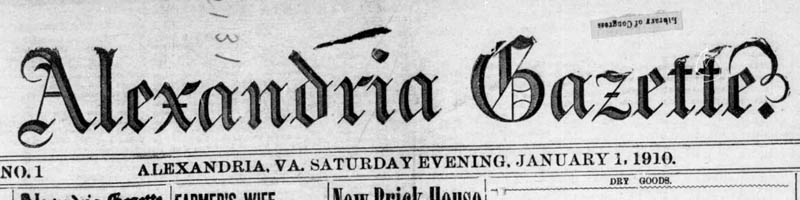
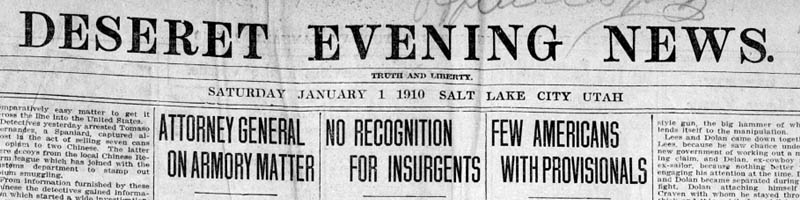
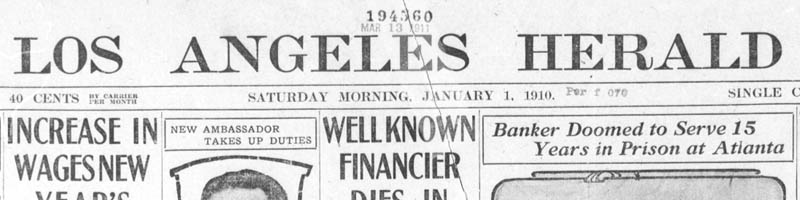
For the year 2010, the Chronicling America historic newspaper collection has a nearly complete collection of 11 American daily newspapers that were published exactly 100 years ago. Click on the masthead to view the newspaper’s 1910 publication calendar:


1910 Publication Calendar of the Alexandria Gazette (Alexandria, Virginia)
Scan of the masthead of the Alexandria Gazette


1910 Publication Calendar of the Deseret Evening News (Salt Lake City, Utah)
Scan of the masthead of the Deseret Evening News


1910 Publication Calendar of the Los Angeles Herald (Los Angeles, California)
Scan of the masthead of the Los Angeles Herald


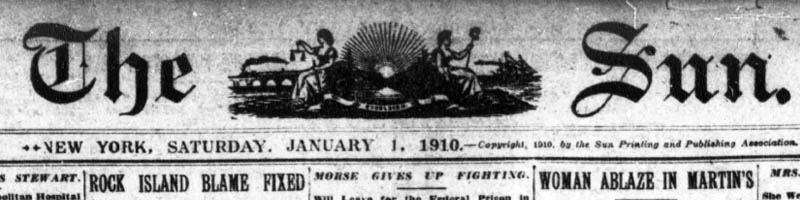
1910 Publication Calendar of the New York Sun (New York City, New York)
Scan of the masthead of the New York Sun


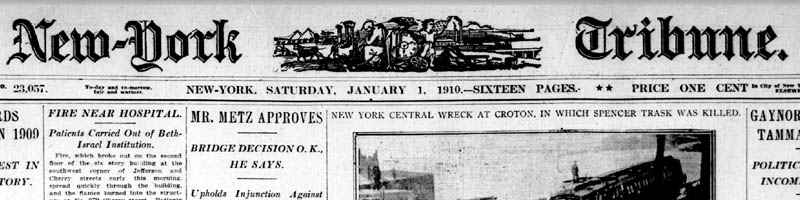
1910 Publication Calendar of the New York Tribune (New York City, New York)
Scan of the masthead of the New York Tribune


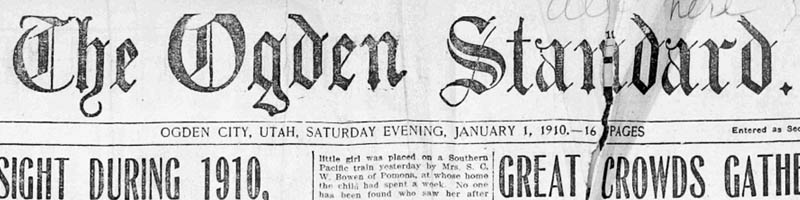
1910 Publication Calendar of the Ogden Standard (Ogden, Utah)
Scan of the masthead of the Ogden Standard


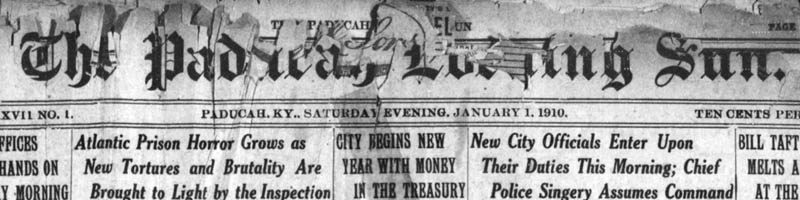
1910 Publication Calendar of the Paducah Evening Sun (Paducah, Kentucky)
Scan of the masthead of the Paducah Evening Sun


1910 Publication Calendar of the Palestine Daily Herald (Palestine, Texas)
Scan of the masthead of the Palestine Daily Herald


1910 Publication Calendar of the San Francisco Call (San Francisco, California)
Scan of the masthead of the San Francisco Call


1910 Publication Calendar of the Washington Herald (Washington, DC)
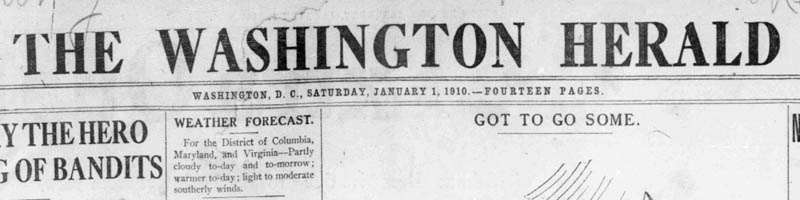
Scan of the masthead of the Washington Herald


1910 Publication Calendar of the Washington Times (Washington, DC)
Scan of the masthead of the Washington Times


Curious about what happened on your birthday 100 years ago? Try clicking on the day after your birthday :-)


The 1910 Publication Calendar of the Washington Times from the Chronicling America Newspaper Collection [100 Year Old News]
|| 1/12/2010 || 2:14 pm || 1 Comment Rendered || ||

Scan of the newspaper masthead

Text & content from the Chronicling America newspaper collection website

The Morning Times was founded on March 18, 1894, by union printers. Financial difficulties, however, soon forced the printers to sell to Charles G. Conn, a Democratic congressman from Indiana. In August 1895 the Washington Evening Times was added, and the two editions sold as a combined subscription. The evening edition soon became dominant, substantially surpassing the morning paper’s circulation. Late the following year, Conn sold both editions to Stilson Hutchins who had sold his interest in the Washington Post a few years earlier. In 1901 Frank A. Munsey, who was known for his consolidation practices and as a destroyer of the dailies, purchased the paper and ran it from the Munsey Building, which he had built on E Street in the northwest quadrant of the city. Munsey ceased printing the morning edition on November 29, 1902, and his evening and Sunday editions became known, simply, as the Washington Times. William Randolph Hearst gained control of the Times in 1917 and five years later merged it with the Washington Herald.


1910 Newspapers

January, 1910
S M T W T F S
            1
2 3 4 5 6 7 8
9 10 11 12 13 14 15
16 17 18 19 20 21 22
23 24 25 26 27 28 29
30 31          
February, 1910
S M T W T F S
    1 2 3 4 5
6 7 8 9 10 11 12
13 14 15 16 17 18 19
20 21 22 23 24 25 26
27 28          
             
March, 1910
S M T W T F S
    1 2 3 4 5
6 7 8 9 10 11 12
13 14 15 16 17 18 19
20 21 22 23 24 25 26
27 28 29 30 31    
             
April, 1910
S M T W T F S
          1 2
3 4 5 6 7 8 9
10 11 12 13 14 15 16
17 18 19 20 21 22 23
24 25 26 27 28 29 30
             
May, 1910
S M T W T F S
1 2 3 4 5 6 7
8 9 10 11 12 13 14
15 16 17 18 19 20 21
22 23 24 25 26 27 28
29 30 31        
             
June, 1910
S M T W T F S
      1 2 3 4
5 6 7 8 9 10 11
12 13 14 15 16 17 18
19 20 21 22 23 24 25
26 27 28 29 30    
             
July, 1910
S M T W T F S
          1 2
3 4 5 6 7 8 9
10 11 12 13 14 15 16
17 18 19 20 21 22 23
24 25 26 27 28 29 30
31            
August, 1910
S M T W T F S
  1 2 3 4 5 6
7 8 9 10 11 12 13
14 15 16 17 18 19 20
21 22 23 24 25 26 27
28 29 30 31      
             
September, 1910
S M T W T F S
        1 2 3
4 5 6 7 8 9 10
11 12 13 14 15 16 17
18 19 20 21 22 23 24
25 26 27 28 29 30  
             
October, 1910
S M T W T F S
            1
2 3 4 5 6 7 8
9 10 11 12 13 14 15
16 17 18 19 20 21 22
23 24 25 26 27 28 29
30 31          
November, 1910
S M T W T F S
    1 2 3 4 5
6 7 8 9 10 11 12
13 14 15 16 17 18 19
20 21 22 23 24 25 26
27 28 29 30      
             
December, 1910
S M T W T F S
        1 2 3
4 5 6 7 8 9 10
11 12 13 14 15 16 17
18 19 20 21 22 23 24
25 26 27 28 29 30 31
             

+ 1910 Publication Calendar of the Alexandria Gazette
+ 1910 Publication Calendar of the Deseret Evening News
+ 1910 Publication Calendar of the Los Angeles Herald
+ 1910 Publication Calendar of the New York Sun
+ 1910 Publication Calendar of the New York Tribune
+ 1910 Publication Calendar of the Ogden Standard
+ 1910 Publication Calendar of the Paducah evening sun
+ 1910 Publication Calendar of the Palestine Daily Herald
+ 1910 Publication Calendar of the San Francisco Call
+ 1910 Publication Calendar of the Washington Herald
+ 1910 Publication Calendar of the Washington Times


The Daily Render By
A Digital Scrapbook for the Past, Present, and Future.

©2004-2023 Nikolas R. Schiller - Colonist of the District of Columbia - Privacy Policy - Fair Use - RSS - Contact


::LAST 51 POSTS::

Fair Use


59 queries. 0.981 seconds.
Powered by WordPress

Photo by Charlie McCormick
Nikolas Schiller is a second-class American citizen living in America's last colony, Washington, DC. This blog is my on-line repository of what I have created or found on-line since May of 2004. If you have any questions or comments, please contact:

If you would like to use content found here, please consult my Fair Use page.

::THE QUILT PROJECTION::

Square
Square

Diamond
diamond

Hexagon
hexagon

Octagon
octagon

Dodecagon
Dodecagon

Beyond
beyond

::OTHER PROJECTIONS::

The Lenz Project
Lenz

Mandala Project
Mandala

The Star Series


Abstract Series
abstract

Memory Series
Memory

Mother Earth Series
Mother Earth

Misc Renderings
Misc

::POPULAR MAPS::

- The Los Angeles Interchanges Series
- The Lost Series
- Terra Fermi
- Antique Map Mashups
- Google StreetView I.E.D.
- LOLmaps
- The Inaugural Map
- The Shanghai Map
- Ball of Destruction
- The Lenz Project - Maps at the Library of Congress
- Winner of the Everywhere Man Award

::MONTHLY ARCHIVES::


::LOCATIONS & CATEGORIES::

  • 2004 Elections (2)
  • 2008 Elections (35)
  • 2014 Elections (4)
  • 2016 Elections (2)
  • ACLU (3)
  • Activism (287)
  • Adbusters (13)
  • Advertisements (33)
  • aerial photography (19)
  • Analysis (31)
  • Animals (30)
  • animated gif (7)
  • Animation (25)
  • Antique (104)
  • Apple (1)
  • Arabic (17)
  • Architectural Archeology (9)
  • Artomatic (25)
  • Astronomy (15)
  • Astrophotography (9)
  • Audio (2)
  • Awards (3)
  • Backpacking (2)
  • banner graphics (5)
  • Beat Google to the Map (56)
  • bicycle (23)
  • Birds-Eye View (5)
  • Blaeu (10)
  • Book Covers (7)
  • Bridge (10)
  • Building (15)
  • calendar (28)
  • calligraphy (6)
  • Capital (61)
  • Cars (18)
  • Cartography (74)
  • Cartoon (9)
  • Celestial (31)
  • Censorship (32)
  • Chinese (7)
  • Chronicling America (34)
  • Classroom (5)
  • Clothing (12)
  • Commentary (76)
  • Commissioned (27)
  • Credit Cards (3)
  • Crime (12)
  • Cyrillic Alphabet (1)
  • DAILY LINKS (30)
  • Dance (2)
  • DC History (93)
  • Design (102)
  • Digital Scrap (5)
  • Election (11)
  • ESA (3)
  • Facebook (19)
  • Fantasy (3)
  • Fashion (23)
  • Fast Food (2)
  • FBI (7)
  • Flag (15)
  • flickr (4)
  • Found Map (56)
  • French (9)
  • Gallery (54)
  • Gardening (25)
  • General (256)
  • George Bush (12)
  • GIS (69)
  • GMO Labeling (4)
  • Google (31)
  • Google AdSense (4)
  • Google AdWords (3)
  • Google Earth (28)
  • Google Maps (47)
  • Google Reader (4)
  • Google Streetview (8)
  • GPS (7)
  • Graffiti (5)
  • Greek (4)
  • Green (72)
  • Green Party (18)
  • Healthcare (15)
  • Highway (35)
  • Hiking (2)
  • Hipster (2)
  • history (151)
  • Holidays (10)
  • House Party (2)
  • Hubble Telescope (2)
  • Humor (88)
  • In The News (88)
  • Insects (2)
  • Interactive (74)
  • Interiors (4)
  • IP Trace (28)
  • Latin (22)
  • Law (15)
  • Lecture (11)
  • Legislation (19)
  • Library (21)
  • Library of Congress (66)
  • Location (1,018)
  • LOLMaps (3)
  • Mass Transit (6)
  • Memorandum (2)
  • meta-data (32)
  • Mobile Phone Applications (1)
  • Movie (3)
  • MrSID (4)
  • MSN (5)
  • Museum (5)
  • Music (48)
  • MySpace (6)
  • NASA (10)
  • National Archives (3)
  • News (182)
  • Obituary (2)
  • Oil (4)
  • Ornithology (4)
  • orthophotography (4)
  • OSCE (16)
  • Photography (134)
  • Poetry (18)
  • Portuguese (1)
  • postmodern (8)
  • QR code (9)
  • QTVR (4)
  • Radio (3)
  • Renderings (675)
  • RSS (3)
  • Seasons (12)
  • Sold (40)
  • Spanish (7)
  • Speech (5)
  • Sports (1)
  • Stadium (40)
  • statehood (94)
  • Statistics (2)
  • Stellarium (4)
  • Stereogram (1)
  • Street (21)
  • Street Art (10)
  • Submissions (5)
  • Tattoo (2)
  • Testimony (2)
  • time-lapse (19)
  • Torture (3)
  • Transportation (6)
  • TV (23)
  • Twitter (5)
  • University (41)
  • Update (24)
  • Vegetarianism (2)
  • Video (49)
  • Vimeo (18)
  • visualization (36)
  • Washington Critic (2)
  • Weather (19)
  • Web Crawler (9)
  • Wikipedia (14)
  • Wordpress (4)
  • Wordpress Upgrade (2)
  • World Wind (3)
  • Yahoo (6)
  • YouTube (113)
  • Zodiac (23)


  • thank you,
    come again!