The Daily Render

by

A Digital Scrapbook for the Past, Present, and Future

| FRONT PAGE | GEOSPATIAL ART | DC HISTORY / TIMELINE | NEWS | COLONIST | FOUND MAPS | FRACTALS |
| PHOTOGRAPHY | ANTIQUE | DESIGN | VIDEO | | CONTACT |

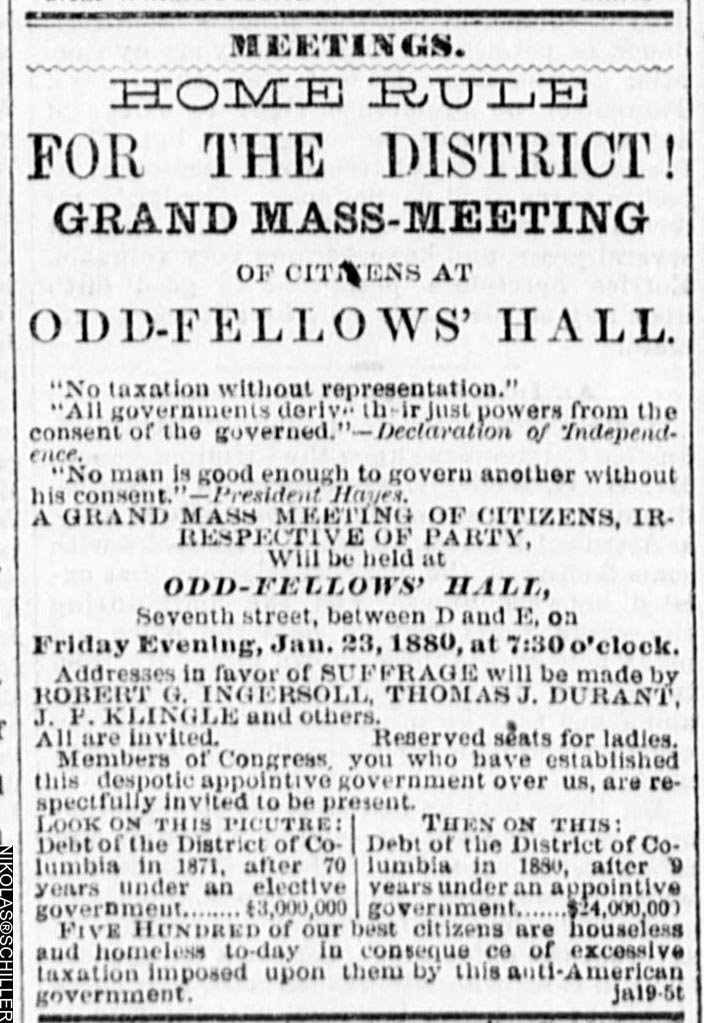
HOME RULE FOR THE DISTRICT! GRAND MASS-MEETING OF CITIZENS AT ODD-FELLOWS’ HALL [The Washington Times, 1/20/1880]
|| 11/1/2009 || 1:21 pm || Comments Off on HOME RULE FOR THE DISTRICT! GRAND MASS-MEETING OF CITIZENS AT ODD-FELLOWS’ HALL [The Washington Times, 1/20/1880] || ||

Scan of a Suffrage Meeting notice from the National Republican Newspaper from 1880

HOME RULE FOR THE DISTRICT!

GRAND MASS-MEETING OF CITIZENS AT ODD-FELLOWS’ HALL

“No taxation without representation.”
“All governments derive their just powers from the consent of the governed” – Declaration of Independence
“No man is good enough to govern another without his consent” – President Hayes

A GRAND MASS MEETING OF CITIZENS, IRRESPECTIVE OF PARTY
Will be held at
ODD-FELLOWS’ HALL
Seventh street, between D and E, on
Friday Evening, Jan.23, 1880, at 7:30 o’clock.

Addresses in favor of SUFFRAGE will be made by ROBERT G. INGERSOLL, THOMAS J. DURANT, J.F. KLINGLE and others.

All invited. Reserved seats for ladies. Members of Congress, you who have established this despotic appointive government over us, are respectfully invited to be present.

LOOK ON THIS PICTURE:
Debt of the District of Columbia in 1871, after 70 years under an elected government…….. $3,000,000
THEN ON THIS:
Debt of the District of Columbia in 1880, after 9 years under an appointive government……… $24,000,000

FIVE HUNDRED of our best citizens are houseless and homeless to-day in consequence of excessive taxation imposed upon them by this anti-American government.


This advertisement was obtained from the Library of Congress’ Chronicling America collection and was originally published on January 20th, 1880 in Washington, DC. It is being republished here in order to continue my advocacy for full representation for the American citizens of the District of Columbia.


WANT 20,000 SIGNERS – The Washington Post, November 16th, 1894
|| 10/20/2009 || 4:01 pm || Comments Off on WANT 20,000 SIGNERS – The Washington Post, November 16th, 1894 || ||

WANT 20,000 SIGNERS


A Monster Petition to Be Circulated in the District.

DISTRICT SUFFRAGISTS ORGANIZE

Congress to Be Asked to Authorize a Special Election to Allow People to Say Whether They Wish the Present System of Municipal Government Continued– A Constitution Adopted and Speeches Made– Labor Unions Taking a Hand.


The Washington Post, November 16th, 1894.

Another organization of those in the District of Columbia who want to be full-fledged citizens with the right to vote and to have a voice in the management of local affairs was formed this evening. The plan of campaign differs in some particulars from that of the labor organizations instituted some weeks ago, but in other respects it is the same. Steps were taken for the circulation of a monster petition and an effort will be made to secure for it 20,000 signatures. This will ask Congress to allow a special election in the District to determine whether the citizens desire to maintain the present form of government.

The of the organization is “The District Suffrage Petition Association.” It grew out of the meeting of citizens which was held a week ago last evening at the John Wesley Church on Connecticut Avenue, between L and M streets. The meeting last evening was at the same place and the temporary organization of a week ago was made permanent. Robert Reyburn, M.D. presided, and was made the president. He is strongly in favor of the movement and spoke earnestly for it.

The Constitution Adopted

Here is the constitution which was adopted:

The object for which this association is founded is the securing of a representative form of government for the citizens of the District of Columbia. All citizens of the District of Columbia who believe in the principles of free government are invited to join, and aid in the movement, by forming branches or auxiliary associations.

The officers of the association shall be a president, two vice presidents, a secretary, and a treasurer. The president shall be a member, by virtue of his office, of all committees. The president and all other officers of the association shall perform all the duties usually appertaining to such offices in other organizations. An executive committee shall be elected by the members of the association (or appointed by the president), to devise such means as in their judgment will further the objects for which the association was founded. They will be called upon for a report upon the progress they have made, at every meeting of the association.

The order of business at the meetings shall be reading of minutes, report of the treasurer, report of the executive committee, and other committees, unfinished business, new business, adjournment.

Regular meetings of the association will be held on the third Tuesday of each month and can be called at any time on the written request of three members to the president, or, in his absence, to the vice president.

The meeting was called to order at 7:30 o’clock. A good number of the persons who had assembled were colored people, many of whom are well known in the District. There were in the neighborhood of a hundred present, of whom three or four were women. Lawyer James H. Smith, who was subsequently elected permanent secretary, took down the minutes of the proceedings. There were brief addresses by Dr. Reyburn, who said he had always felt humiliated that he should have lived so many years in the District without the rights of a citizen which those in the States enjoy. He did not feel contented that his son should be reared without the education in public affairs which an enjoyment of the franchise imposes. Dr. Reyburn also stated briefly the transactions of the previous meeting. Mr. Smith spoke after him urging the necessity of suffrage for the District. Then the constitution was adopted and the election of officers proceeded with. Besides the president and secretary already named W. Calvin Chase, the editor of the Bee, was chosen first vice president; Gustav Augustine, second vice president; E.M. Hewlett corresponding secretary; Mr. Smith having been designated as recording secretary, and Walter Callahan, treasurer.

A Petition Proposed

Dr. Reyburn advanced the idea of circulating petitions, a number of copies of which he had caused to be printed. It was agreed that these should be carried about the friends of the cause and those present added their names. Dr. Reyburn said he proposed to have copies of these petitions in public places throughout the city, where signers could be secured. He believed this would be an effective method of expressing local opinion about suffrage to Congress. The petition reads as follows:

To the Honorable Senate and House of Representatives of the United States: We, the undersigned citizens and permanent residents of the District of Columbia, believe the present form of government existing in the District (by Commissioners) to be in direct violation of all the principles on which this republic was founded.

Moreover, we also believe that a large majority of the citizens and permanent residents of the District of Columbia are in favor of a change in this District from the present form to one in harmony with the principles of free government.

We respectfully urge and request, therefore, that a law be passed directing that a special election be held (as soon as practicable) by the citizens of the District of Columbia, to decide the question whether the citizens of this District desire to maintain the present form of government by Commissioners or to return to a representative form of government.

The next meeting will be held at this church next Thursday evening. A vote was taken also that the state monthly meetings should be held the third Thursday evening of each month, and the hour was fixed at 8 o’clock. Mr. Augustine said he had visited the hall of Typographical Temple, where a meeting of the labor organization interested in the suffrage movement was advertised to be held. He said that no one was in attendance. Milford Spohn, the president of that organization, was in the audience, and Dr. Reyburn called upon him to speak.

Co-operation of Labor Unions

Mr. Spohn replied with moderation and outlined the work which the labor men had undertaken to do. A delegate of the Knights of Labor from Washington to the convention in session this week at New Orleans had been instructed to bring the matter to the attention of the body with the request that labor organizations all over the country should ask their representatives in Congress to grant the citizens of the District the right to vote. This was done because of the opinion that Congressmen would respect a petition much more when there a vote behind it. A similar request was to be made before the international convention of the unions of the Federation of Labor. He added that able editorials had been written by the newspapers of the District against local government. The chief objection which these contained was that the government now paid half of the taxes, and that this would involve an undesirable complication. He thought it was not manly to sell one’s birthright for fifty cents on the dollar, and declared that only those in the jails, insane asylums, and the District of Columbia were denied the full right of citizenship in the United States.

At the close of his speech Mr. Augustine spoke dramatically of local affairs, expressing his opinion that an investigation would reveal corruption in police circles far beyond that lately exposed in New York. an enthusiast then said that a reporter for a morning newspaper was unable to attend the meeting and he was making a motion that the secretary be authorized to make out a full report and sent it to the office, but was compelled to sit down by a chorus of laughter, in midst of which the meeting voted to adjourn.


This newspaper article was transcribed from a scan of the original newspaper article. The document was obtained from the Washington Post archives and is in the public domain. It is being republished here in order to continue my advocacy for full representation for the American citizens of the District of Columbia.


PRESIDENT OPPOSED TO SUFFRAGE IN DISTRICT – The Washington Post, May 9th, 1909
|| 10/4/2009 || 9:40 am || 1 Comment Rendered || ||

PRESIDENT OPPOSED TO SUFFRAGE IN DISTRICT


Mr. Taft, in Speech at Dinner,
Favors One-Man Rule.


ANSWERS JUSTICE STAFFORD


Jurist Had Made an Eloquent Plea for Votes for Citizens of Washington– Executive Defends Wisdom of Early Statesmen in Denying Right of Ballot to Capital City– Declares That People Here Are Envied by Those of Other Municipalities.


With great vigor and with that clear insight into the ultimate meaning of the Constitution of the United States which has made him reckoned one of the foremost constitutional lawyers of the country, President Taft defended last night that provision of the Constitution which places the District of Columbia under the Federal government. He declared unequivocally that the whole people of the United States should have in its charge the government of the District, through its representatives in Congress, and that the people of the District must bow to the wisdom of the forefathers who declared in favor of this plan of government for the National Capital. The President stands, therefore, absolutely opposed to granting to the people of the District the right of suffrage.

President Taft made it equally clear that he is inclined to favor a single head for the District government as opposed to the triumvirate form of government which now exists here. He said, indeed, that he has not yet made up his mind just what changes in the form of government for the District he will recommend to Congress next fall. But he declared, in discussing the merits of the single head and the triumvirate, that he was convinced the single head was preferable where the functions of that head were merely executive. If legislative functions were attached to the head of a government, he said, the triumvirate was the better. Inasmuch as the head of the District government is merely executive, without legislative functions, the inference is clear that the President favors “one-man” rule for the District.

The President’s speech was delivered at the banquet tendered him in the New Willard ballroom by the business men of Washington. It was a dramatic finale of what resolved itself into a joint debate between the President of the United States and Justice Stafford, of the Supreme Court of the District. Justice Stafford, in an eloquent speech brought forth round after round of applause and made the blood tingle in the veins of every Washingtonian who heard him, pleaded for a voice in the national government for the people of the District. He pleaded that the 350,000 people of the District be not cut off forever from their birthright of freedom and no taxation without representation.

He asked the people be allowed to elect a senator and two representatives, who should have equal rights with other members of Congress. The people, he declared, are becoming slothful, unmindful of their duties, under the present system, but he predicted that there would come a day when, a million strong, the people of the District would not remain quiescent under the present scheme of government.

When President Taft arose to make the reply to Justice Stafford, who, as spokesman for the people, had voiced his idea of the greatest need of the District, there was the keenest interest evinced in his reply. The several hundred prominent men of affairs of the District were not kept in doubt long. The President, without a moment’s hesitation, launched into a vigorous defense of the Constitution, so far as it relates to the government of the District. He laughed at the argument of Justice Stafford, that the people of Washington were slaves, and declared that they were the envied of the peoples of all other cities of the Union.

Nevertheless, it appears that the President and Justice Stafford did not join issues directly in their debate. For Justice Stafford argued, not for suffrage in municipal government of the country and for a voice in those separate interests which directly concern the people here. The President, on the other hand argued that the framers of the Constitution had precluded all idea of the District of Columbia being governed directly by the people of the District.

List of Guests

Those who sat at the raised table at the west of the room were:

John Joy Edson, chairman of the joint committee; President Taft, Vice President Sherman, J.H. Small, president of the Board of Trade; W.F. Gude, president of the Chamber of Commerce; Speaker Cannon, Postmaster General Hitchcock, Theodore W. Noyes, Charles -J. Bell, Representative J. Van Vechten Olcott, Secretary of Commerce and Labor Nagel, Arthur C. Moses, Scott C. Bone, Representative Samuel W. Smith, Representative Vreeland, James F. Oyster, Allen D. Albert, j.r., Representative Philip Campbell, Commissioner Macfarland, Edward McLean, Representative George A. Pearre, Commissioner West, Charles C. Glover, Representative A. S. Burleson, Commissioner Judson, Clarence F. Norment, D.J. Callahan, Representative Edward L. Taylor, A. Lisner.


…secondary list was not transcribed…


This newspaper article was transcribed from a scan of the original newspaper article. The document was obtained from the Washington Post archives and is in the public domain. It is being republished here in order to continue my advocacy for full representation for the American citizens of the District of Columbia.


Prof. Gregory Favors It – The Washington Post, July 10th, 1883
|| 10/3/2009 || 12:37 pm || Comments Off on Prof. Gregory Favors It – The Washington Post, July 10th, 1883 || ||

Prof. Gregory Favors It.

The Washington Post, July 10th, 1883

“Yes, I thoroughly believe in suffrage in the District,” said Professor James G. Gregory, of Howard university, to a Post reporter, in answer to the question if he favored the present agitation for giving the citizens votes. “Yes, I am in favor of it,” he repeated. “I think the people would be much more contented if they had suffrage. You can see how the people are anxious to have some part in their own government by the interest they take in the choice of the school trustees. Why, there are sometimes more than a half dozen candidates in a single district and any number of delegations going to the commissioners in favor of this or that man. This one matter serves as a sort of outlet for their political feelings.”

“What do you think is the reason for opposition to suffrage?”

“I think that one reason why many oppose giving the citizens suffrage is that they are afraid of the colored vote. They think the colored man is top ignorant to have anything to do with the District affairs. Now, this is a great mistake. Within the past seven or eight years a great change has taken place. The colored people have been greatly influenced by those of their race who have received an education. In some families, perhaps, where the parents have no had the opportunities of books, their children have, and the influence of those children on the home is very marked. Many have been admitted to the public schools and the night schools. Then many of the colored people have become educated by business. In many cases they have prospered and have become property owners. Oh, no, it is a mistake to say that there is any danger from their ignorance in giving them the franchise.”

“Do you believe in universal suffrage?”

“No, I do not say that suffrage should be without limit. Perhaps it would be well to have some property and educational qualification. That is a very broad question. I believe suffrage should be granted , because of the value it would prove the citizens as a political school. We send out children to school to be educated to become citizens, but there is another education– a political education– that the citizens should receive. As it is now very few of the citizens have much of an idea about the Government. They do not discuss the actions of the commissioners as they discuss in other cities municipal affairs. We pay our taxes and that is the end of it. We do not think. Everything is done by the commissioners merely making suggestions and asking for appropriations. This is not the way to become citizens. How do they do in other cities? Why, they meet, discuss affairs, and vote upon their intelligent and deliberate opinions. Suffrage would educate the people in government, in the finance ad in the duties of citizenship.”

“Do you think the District affairs would be managed as economically under popular government?” inquired the reporter. “Was not the opposite found to be the case when there was suffrage?”

“I think that the state of affairs was more the result of circumstances than the system. Before the war nothing had been done for the city. When I came to Washington it was a mudhole. After the war improvements were projected on a large scale, and what it required many years to do in other cities was done here in a short time. Perhaps Governor Shepherd went rather too fast, but you can see what has been accomplished. There are many who object to giving the poor man the ballot because they are afraid property-holders will suffer. Now, the poor man is interested in having property protected. If he has no property, he hope to acquire some, and this will keep him from making any laws injurious to property rights. I lived in Cleveland for some years, where some of the richest men in the country live, and I never saw anything to cause any alarm.”

“Do you think the citizens would take any more interest in the government, or feel any responsibility in its right management if they could vote?”

“Certainly, they would feel that they had something at stake. Then look at the injustice of the thing– to deprive a man of his highest right as a citizen. If we lived in a State of Territory we would have a vote. Why should we be refused it here?”

“Is not Congress given full control over the District?” the reporter asked.

“Certainly; but I do not believe that power implies a right to take away the citizen’s vote. There is not another city in the Union where the same thing is done.”

“What would be your plan for the government of the District?”

“Well, I believe in having three commissioners as now, and if Congress insisted on the right of representation in return for paying half the District expenses, would give to the President the appointment of the engineer commissioner. The other two should be chosen by the people. I believe something of the kind will soon come, too, for the people generally are favoring it.”


This newspaper article was transcribed from a scan of the original newspaper article. The document was obtained from the Washington Post archives and is in the public domain. It is being republished here in order to continue my advocacy for full representation for the American citizens of the District of Columbia.


Suffrage in the District – The Washington Post, January 24, 1880
|| 10/2/2009 || 8:52 pm || Comments Off on Suffrage in the District – The Washington Post, January 24, 1880 || ||

Suffrage in the District

The Washington Post, January 24, 1880

We cannot understand how any man who believes in the fundamental principles of republican government can seriously contend for the continued denial of suffrage to the inhabitants of the District of Columbia.

If it be true that governments derive their just power only from the consent of the governed, what justice is there in ruling this great community– a population equal to that of the State of Nevada– by a system that does not ask consent, and which assumes the right to defy the wishes of the people?

If our fathers of the Revolution were justified in protesting, rebelling, and fighting against taxation without representation, if they were not criminals, rather than heroes, for going to war on such a question, if their memories should be revered and their example held up as worthy of imitation by their descendants, how can taxes be gathered, year after year, from the property-holders of this District, who have no more votes than the negro babies Central Africa, no representation than the mummies in the Smithsonian institution?

We can conceive of no circumstances under which a Democratic Congress can deny the right of suffrage and local self-government to a peaceful, law-abiding community without direct violation of the very essence of the Democratic creed. While it is true that the Constitution devolves on Congress the duty of providing a government for this District, while it is true that the people have no recourse but to accept such provision as Congress makes, it will not be contended by any sane man that Congress has a right to violate the spirit of the Constitution and set up the most detested features of despotic systems of government in the Capital of this Republic.

Here, if anywhere on the continent, we ought to be able to present to all the world a fair illustration of the practicability and advantages of Republican institutions. But we can’t do this in cities that are denied the ballot. And when we say that this great and intelligent community is incapable of self-government and not fit to be trusted with the ballot, we present a strong condemnation of the basis of our whole system; we direct encouragement to the opponents of free institutions.

It is said that suffrage has been abused here. Granted. There isn’t a doubt that it was shamefully abused. There is no question that great wrongs were perpetrated and that numerous evils prevailed under the system that was abolished in 1874. But where is the city, where is the State, in which suffrage has not been abused? Where is the community in which righteousness has always been voted up and iniquity always voted down? Where are the people who have made no mistakes in the selection of officers? Where, on this continent, shall we look for a town, city, county or State in which the ballot has always worked for the greatest good of the greatest number? If suffrage is to be denied to all who fail to use it always with wisdom and justice, let us call in a king and down with the ballot-box.

There is reason to believe that many of the evils of the past will not be repeated here when self-government is re-established. When corruption had its carnival here it was having an equally jolly time in many other places. That era is past. All over the country there has been great improvement in municipal management. Public plunderers have been brought to grief and better men have been put in authority. With the experience of the past as a warning and guide, the people of this District would avoid the reproaches and scandals which caused the last radical change in their government.

But because it is a right; because it is a republican, because it is democratic, because it is in accordance with the great principles on which this Republic stands because no Democrat can consistently deny it, we are compelled to favor the demand that the ballot be restored to this community.


This newspaper article was transcribed from a scan of the original newspaper article. The document was obtained from the Washington Post archives and is in the public domain. It is being republished here in order to continue my advocacy for full representation for the American citizens of the District of Columbia.


District Representation – The Washington Post, January 22, 1879
|| 10/1/2009 || 8:16 pm || Comments Off on District Representation – The Washington Post, January 22, 1879 || ||

District Representation

The Washington Post, January 22, 1879

With the exception of the Indian tribes, the only community within the territorial jurisdiction of the United States unrepresented in Congress is the District of Columbia.

Territories whose few inhabitants are scattered over a broad expanse like the masts of ships on the ocean, and which neither commerce nor manufactures, send their delegates to Congress to represent their interests, and procure for them such legislation as shall tend to develop their resources and afford encouragement and protection to their people the embryo state advances toward maturity.

States with half the population of this District have their representatives in the House, and have an equal voice in the Senate with the oldest, largest, richest, and most populous members of the family states.

It is only here, at the capital of a country whose government is based on suffrage, that suffrage is unknown.

Holding to the theory that governments derive their just powers only from the consent of the governed, and that the ballot is the proper mode of expressing that consent, our Government denies the ballot to the inhabitants of its capital city.

Believing and teaching that is should be no taxation without representation, and that such taxation is tyranny, our Government levies taxes on the property of this people, and if those taxes are not paid it sells the property under the red flag and the hammer of a Government auctioneer. Thousands of homes have thus been sold here during the last few years.

We cannot see how any man, whatever may have been the result of his observation here in times past, can hold to the Democratic creed, to the great underlying principles of free government, and oppose the representation of this District in the law-making department of our governmental mechanism.

And because out faith in true Democracy is a vital reality, and not a sham, we approve the proposition to have the District of Columbia represented in the House. We see no reason why this community should be an exception to the general rule- why all should have a voice in the Capitol and we be mute.

It may be urged that the horde of negroes who swarm here will be used to elect a delegate who will misrepresent our people. We do not believe it. Intelligence and social influence, if rightly employed, will so direct public opinion that the election will be a fair expression of the wishes of our people.

As the delegate will not vote, and as his influence will depend on his being in accord with the dominant party in Congress, there will be no temptation to resort to any of those schemes and tricks that brought reproach upon popular suffrage here some years ago.

But whatever may be the fears of the timid and doubtful, we see no way in which an honest believer in Democracy can deny representation to this community. The taxpayer has a right to be heard. A delegate can speak for him. Consistency demands that this proposition should not fail for want of the support of Democrats in Congress.


This newspaper article was transcribed from a scan of the original newspaper article. The document was obtained from the Washington Post archives and is in the public domain. It is being republished here in order to continue my advocacy for full representation for the American citizens of the District of Columbia.


Text of the District of Columbia Organic Act of 1871
|| 1/30/2009 || 5:23 pm || Comments Off on Text of the District of Columbia Organic Act of 1871 || ||

The District of Columbia Organic Act of 1871 aka “An Act to provide a Government for the District of Columbia (41st Congress, 3d Sess., ch. 62, 16 Stat. 419, enacted 1871-02-21) is an Act of Congress, which revoked the individual charters of the City of Washington, the City of Georgetown, and the County of Washington and created a new city government for the entire District of Columbia. The legislation effectively merged what had been separate municipalities within the federal territory into a single entity. It is for this reason that the city, while legally named the District of Columbia, is still commonly known as Washington, D.C. However, this act was abolished in 1874, and while the name did not change, the territorial Governor was replaced with a three-member Board of Commissioners appointed by the President. This system existed until 1974 when the District of Columbia Home Rule Act allowed for District residents to elect their own mayor.

Below is the text of the bill:

Continue reading the bill:

+ MORE


Within Sight of the White House [Overlay of Hooker’s Division]
|| 12/9/2007 || 2:30 am || 1 Comment Rendered || ||

[image links to .kmz file]
Google Earth Screen Shot of the Antique Overlay

One of the maps I recently downloaded was from a newspaper clipping showing the area near the White House. With 50 Saloons and 109 Bawdy-Houses the map was drawn to highlight business owners who were paying Federal taxes but not DC taxes. Of importance is how nearly all but four of the business owners were female. Were they not paying taxes because they were disenfranchised? Women’s suffrage didn’t come for another 30 years with the passage of the 19th Amendment. By taking the map and importing it into Google Earth, I was able to arrange it so that the buildings line up with minimal distortion. It’s not a perfect map, but it is truly an interesting glimpse into downtown Washington, DC in the 1890’s.

Today most of the buildings are all gone. There are some exceptions, like City Hall (Central Powerhouse) and the Old Post Office, which is written as the “New Post Office” on the map. In the place of the 109 Bawdy-Houses and 50 Saloons was the creation of Federal Triangle. Ohio Ave- gone, DC’s entertainment center, gone as well. Later built, on the year of my birth, was Freedom Plaza which was designed to look like L’Enfant’s map no less. By adjusting the antique map’s transparency you can see a approximately 117 years of development. From brothel to federal, what a strange entity time is.

Transcription:

+ MORE


The Daily Render By
A Digital Scrapbook for the Past, Present, and Future.

©2004-2026 Nikolas R. Schiller - Former Colonist of the District of Columbia - Privacy Policy - Fair Use - RSS - Contact


::LAST 51 POSTS::

Fair Use


50 queries. 0.524 seconds.
Powered by WordPress

Photo by Charlie McCormick
Hello! Thanks for stopping by! My name is Nikolas Schiller. I am an American citizen currently living in New York City and working remotely to support structural change in Washington, DC.

This blog is my online repository of what I have created or found online since May of 2004. I've been on hiatus since 2018 but plan on contributing more content in the not so distant future.

If you have any questions or comments, please contact:

If you would like to use content found here, please consult my Fair Use page.

::THE QUILT PROJECTION::

Square
Square

Diamond
diamond

Hexagon
hexagon

Octagon
octagon

Dodecagon
Dodecagon

Beyond
beyond

::OTHER PROJECTIONS::

The Lenz Project
Lenz

Mandala Project
Mandala

The Star Series


Abstract Series
abstract

Memory Series
Memory

Mother Earth Series
Mother Earth

Misc Renderings
Misc

::POPULAR MAPS::

- The Los Angeles Interchanges Series
- The Lost Series
- Terra Fermi
- Antique Map Mashups
- Google StreetView I.E.D.
- LOLmaps
- The Inaugural Map
- The Shanghai Map
- Ball of Destruction
- The Lenz Project - Maps at the Library of Congress
- Winner of the Everywhere Man Award

::MONTHLY ARCHIVES::


@NikolasSchiller

::LOCATIONS & CATEGORIES::

  • 2004 Elections (2)
  • 2008 Elections (35)
  • 2014 Elections (4)
  • 2016 Elections (2)
  • ACLU (3)
  • Activism (287)
  • Adbusters (13)
  • Advertisements (33)
  • aerial photography (19)
  • Analysis (31)
  • Animals (30)
  • animated gif (7)
  • Animation (25)
  • Antique (104)
  • Apple (1)
  • Arabic (17)
  • Architectural Archeology (9)
  • Artomatic (25)
  • Astronomy (15)
  • Astrophotography (9)
  • Audio (2)
  • Awards (3)
  • Backpacking (2)
  • banner graphics (5)
  • Beat Google to the Map (56)
  • bicycle (23)
  • Birds-Eye View (5)
  • Blaeu (10)
  • Book Covers (7)
  • Bridge (10)
  • Building (15)
  • calendar (28)
  • calligraphy (6)
  • Capital (61)
  • Cars (18)
  • Cartography (74)
  • Cartoon (9)
  • Celestial (31)
  • Censorship (32)
  • Chinese (7)
  • Chronicling America (34)
  • Classroom (5)
  • Clothing (12)
  • Commentary (76)
  • Commissioned (27)
  • Credit Cards (3)
  • Crime (12)
  • Cyrillic Alphabet (1)
  • DAILY LINKS (30)
  • Dance (2)
  • DC History (93)
  • Design (102)
  • Digital Scrap (5)
  • Election (11)
  • ESA (3)
  • Facebook (19)
  • Fantasy (3)
  • Fashion (23)
  • Fast Food (2)
  • FBI (7)
  • Flag (15)
  • flickr (4)
  • Found Map (56)
  • French (9)
  • Gallery (54)
  • Gardening (25)
  • General (256)
  • George Bush (12)
  • GIS (69)
  • GMO Labeling (4)
  • Google (31)
  • Google AdSense (4)
  • Google AdWords (3)
  • Google Earth (28)
  • Google Maps (47)
  • Google Reader (4)
  • Google Streetview (8)
  • GPS (7)
  • Graffiti (5)
  • Greek (4)
  • Green (72)
  • Green Party (18)
  • Healthcare (15)
  • Highway (35)
  • Hiking (2)
  • Hipster (2)
  • history (151)
  • Holidays (10)
  • House Party (2)
  • Hubble Telescope (2)
  • Humor (88)
  • In The News (88)
  • Insects (2)
  • Interactive (74)
  • Interiors (4)
  • IP Trace (28)
  • Latin (22)
  • Law (15)
  • Lecture (11)
  • Legislation (19)
  • Library (21)
  • Library of Congress (66)
  • Location (1,018)
  • LOLMaps (3)
  • Mass Transit (6)
  • Memorandum (2)
  • meta-data (32)
  • Mobile Phone Applications (1)
  • Movie (3)
  • MrSID (4)
  • MSN (5)
  • Museum (5)
  • Music (48)
  • MySpace (6)
  • NASA (10)
  • National Archives (3)
  • News (182)
  • Obituary (2)
  • Oil (4)
  • Ornithology (4)
  • orthophotography (4)
  • OSCE (16)
  • Photography (134)
  • Poetry (18)
  • Portuguese (1)
  • postmodern (8)
  • QR code (9)
  • QTVR (4)
  • Radio (3)
  • Renderings (675)
  • RSS (3)
  • Seasons (12)
  • Sold (40)
  • Spanish (7)
  • Speech (5)
  • Sports (1)
  • Stadium (40)
  • statehood (94)
  • Statistics (2)
  • Stellarium (4)
  • Stereogram (1)
  • Street (21)
  • Street Art (10)
  • Submissions (5)
  • Tattoo (2)
  • Testimony (2)
  • time-lapse (19)
  • Torture (3)
  • Transportation (6)
  • TV (23)
  • Twitter (5)
  • University (41)
  • Update (24)
  • Vegetarianism (2)
  • Video (49)
  • Vimeo (18)
  • visualization (36)
  • Washington Critic (2)
  • Weather (19)
  • Web Crawler (9)
  • Wikipedia (14)
  • Wordpress (4)
  • Wordpress Upgrade (2)
  • World Wind (3)
  • Yahoo (6)
  • YouTube (113)
  • Zodiac (23)


  • thank you,
    come again!