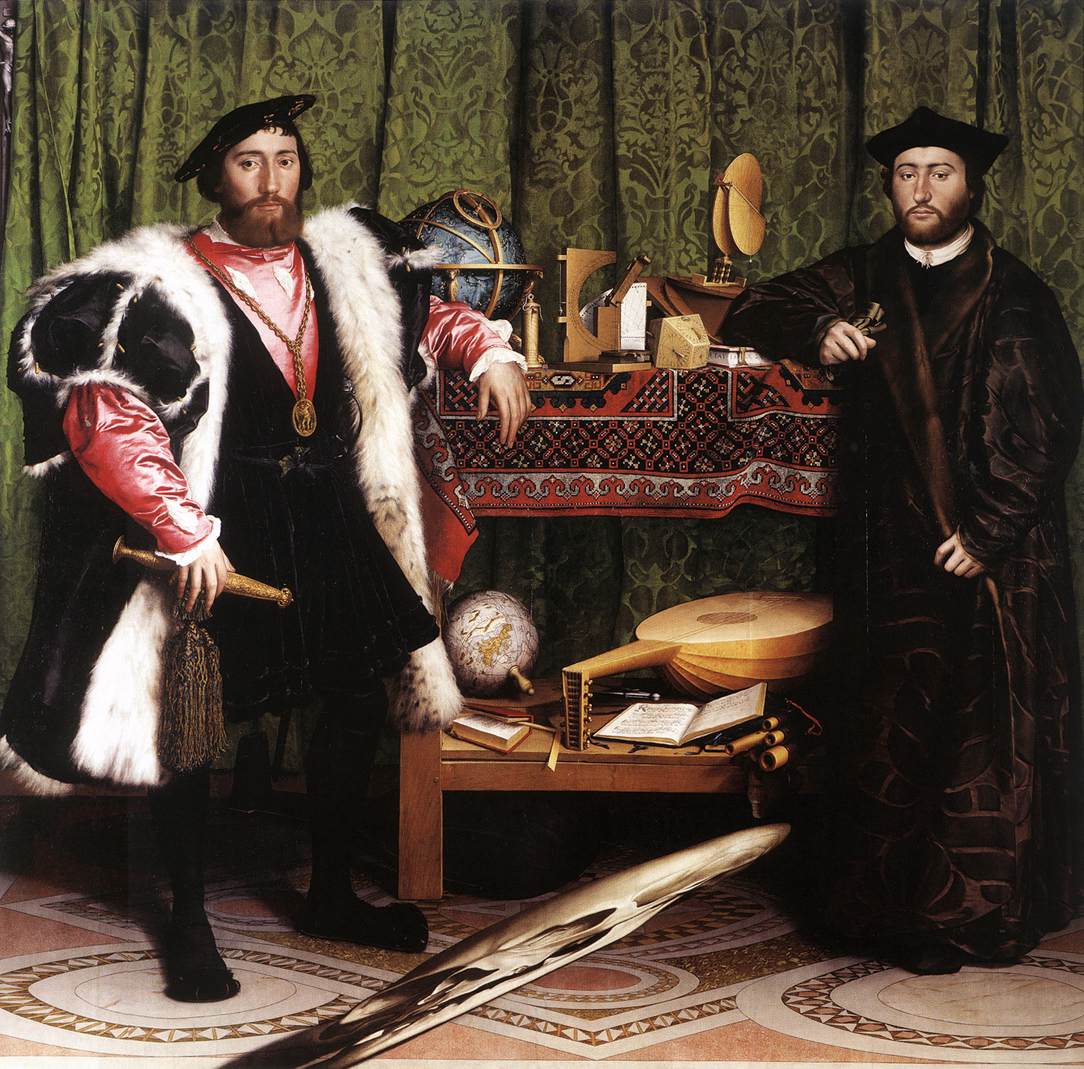
Upside down detail of the terrestrial globe in The Ambassadors by Hans Holbein, The Younger
The Ambassadors (1533) is a painting by Hans Holbein the Younger in the National Gallery in London. I remember first learning about it in my AP Art History class in High School. I was drawn to both the intricate nature of the painting’s near-photorealism and the anamorphic skull that obstructs the foreground. Today I was attempting to warp the skull to see it properly rendered and I realized that there was a nicely painted globe in the background. Well, actually, there is a lot more than just a globe in the background of this painting– there is also a beautiful celestial globe and numerous scientific instruments, but I will let you explore the painting on your own. Suffice it to say, this painting remains one of my favorites.

Image links to the KMZ file for Google Earth
The other day I was canvassing the Library of Congress’ Chronicling America newspaper collection and came across this advertisement that was published on May 27th, 1910 in the Washington Times. It shows development plans for Randle Highlands, a neighborhood in Southeast, Washington, DC. I was curious about the results of the newspaper ad. As in, how much has the map changed in the last 99 years? Surprisingly, not too much. Most of the land was developed to plan, except for one large chunk of the land that remains “undeveloped” to this day: Fort Dupont Park.
The National Park Service website says:
This particular fort had six sides, each 100 feet long, protected by a deep moat and trees felled side-by-side with branches pointing outward. It was named for Flag Officer Samuel F. du Pont, who commanded the naval victory at Port Royal, South Carolina, in November 1861.
Although its garrison and guns never saw battle, Fort Dupont served as a lifeline of freedom. Runaway slaves found safety here before moving on to join the growing community of “contrabands” in Washington. The barracks and guns are gone, but the fort’s earthworks can still be traced near the picnic area on Alabama Avenue.
In the 1930s, the National Capital Planning Commission acquired the old fort and surrounding land for recreation. An 18-hole golf course was constructed. As the city grew, golf gave way in 1970 to the sports complex along Ely Place that now includes tennis and basketball courts, athletic fields, and a softball diamond. An indoor ice rink offers skating all winter. Where once the Civil War fort looked out over farmlands, city dwellers now grow vegetables in community garden plots.
This advertisement was printed 20 years before the National Capital Planning Commission changed the future of this neighborhood. I wonder what it would be like today if it wasn’t a park? Umm, I mean golf course. I was able to line up the old map with the contemporary imagery and by adjusting the transparency in Google Earth you can see how much has been developed. Click here to download the KMZ file for Google Earth
Image links to Google Maps
Transcription below:

Last year I published Then & Now Birds-Eye Views of the Westminster Neighborhood in Washington, DC [1884 & 2005] and earlier today I came across some new maps of the street I’ve lived on for the last 5 years. This map comes from the 1921 edition of Baist’s real estate atlas of surveys of Washington, District of Columbia. It shows the neighborhood pretty much as it is today except for the neighborhood playground that currently sits where houses 193-196 used to be and some of the stables & garages people had constructed in their backyards have been removed.
Below is the citation from the Library of Congress entry:

I updated the Library of Congress‘ version of Joan Blaeu’s “A New and Accurate Map of the Entire World” (1662?) with NASA’s Blue Marble satellite images. Unlike the previous version, I decided to use a different satellite image for the eastern hemisphere so that the tip of Brazil does not overlap.
View the Interactive & Original version:

|| 6/18/2007 || 8:09 pm ||
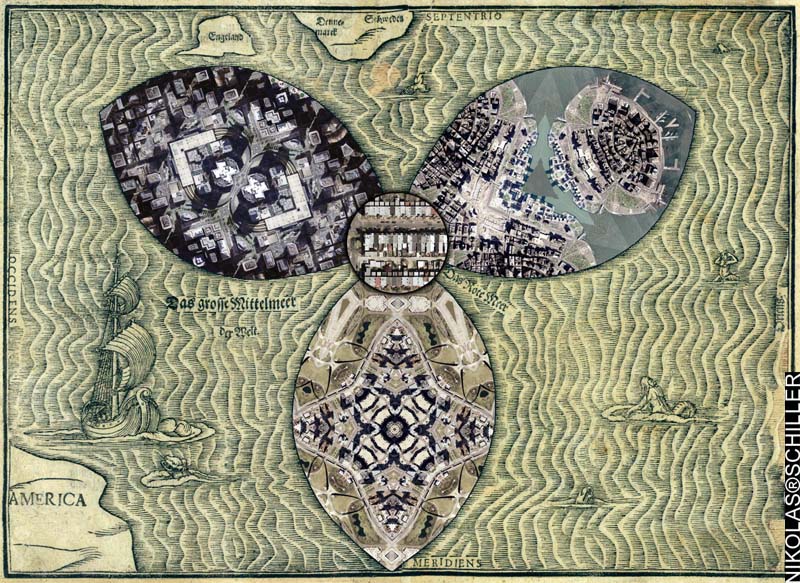
America as a Cloverleaf
View the original, interactive version, and legend:
This historic map mashup is courtesy of Heinrich Bunting (1545-1606) by way of the Yale University Map Library.
Originally the three cloverleaves were of Africa (South/Middle) , Europe (West/Left), and Asia (East/Right) and at the center was Jerusalem. You can read more about this map at the website Strange Maps.
My rendition is San Francisco’s Financial District (West/Left), the Saint Louis Arch (South), and Lower Manhattan (East/Right) and at the center is the rowhouse in Washington, DC where I reside at.

Worked on this “New Map” nearly all Memorial Day… took 12 hours to complete!
It’s a 269 year enrichment, errr, a cartographic memorial? Continue reading: