Last night I celebrated Nowruz, the Persian New Year, with some of my close friends for the second year in a row. Like the ancient peoples written in our history books, I am a fan of all celebrations that bring people together, and Nowruz has been bringing people together for over 15,000 years– making it one of mankind’s oldest celebrations.
The previous year I was given the sabzeh, or green wheat sprouts in a small dish, which represents rebirth. This year I saw my first traditional Haft-Seen display (pictured). Each element in the display has a specific meaning for the next year.
Via Wikipedia, some of the Haft-Seen items are:
* sabzeh – wheat, barley or lentil sprouts growing in a dish – symbolizing rebirth
* samanu – a sweet pudding made from wheat germ – symbolizing affluence
* senjed – the dried fruit of the oleaster tree – symbolizing love
* sÄ«r – garlic – symbolizing medicine
* sÄ«b – apples – symbolizing beauty and health
* somaq – sumac berries – symbolizing (the color of) sunrise
* serkeh – vinegar – symbolizing age and patienceOther items on the table may include:
* Sonbol – Hyacinth (flower)
* Sekkeh – Coins – representative of wealth
* traditional Iranian pastries such as baghlava, toot, naan-nokhodchi
* dried nuts, berries and raisins (Aajeel)
* lit candles (enlightenment and happiness)
* a mirror (symbolizing cleanness and honesty)
* decorated eggs, sometimes one for each member of the family (fertility)
* a bowl of water with goldfish (life within life, and the sign of Pisces which the sun is leaving)
* a bowl of water with an orange in it (the earth floating in space)
* rosewater, believed to have magical cleansing powers
* the national colours, for a patriotic touch
* a holy book (e.g., the Qur’an, Avesta, Bible, Torah, or Kitáb-i-Aqdas) and/or a poetry book (almost always either the Shahnama or the Divan of Hafez)

We stayed up to 1:48am to celebrate start of year 1387 (Anno Persico) and shortly after the new day began I poured rose water on my hands, rubbed it on my face, and looked into a small mirror. I am told its a ceremonial way of putting the year behind you— and what a great year 1386 was for me! I expect 1387 to be filled with intrigue, excitement, and fun.
I’d like to take a brief moment to expound on how amazing the Persian Calendar is. Technically, it is one of the few astronomical solar calendars that are still used today. Interestingly, it is more precise than the Gregorian calendars that have been in used in Europe (and America) since 1582. Each month is not based on the arbitrary division of months as we have today, rather each month was determined by the transit of the sun into the corresponding zodiac region.
By 1079 (C.E.), the Jalali Calendar, a precursor to the modern Persian Calendar, had the solar year calculated to seven decimal places (365.2421986) and in today’s Gregorian Calendar the days in a year is calculated to only six decimal places (365.242190). Also, since the astronomical observations and predictions used in Jalali Calendar were based on a yearly review of the astronomical ephemeris, the calendar never required a leap years nor were seasons ever off by more than a day. All in all, I am very impressed with their calendar and how its changed over the years to include other cultural influences.
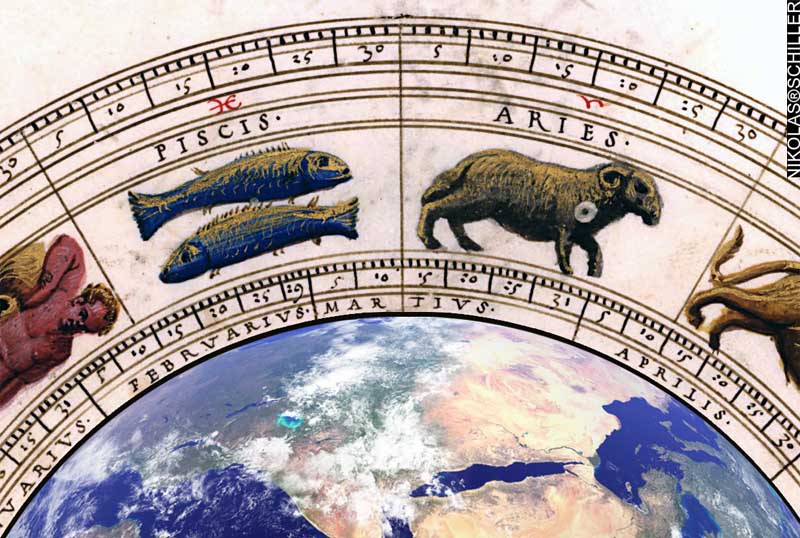
Last year’s research on the zodiac found in Battista Agnese’s portolan from 1544 shows that even as far back as 400+ years ago New Years was celebrated in the spring. I’ve spent quite a bit of time looking at this zodiac and found one important indicator of New Years.
There is only one point on the double concentric circle where there is a line that bisects both the astrological calendar and the Gregorian calendar. This line falls around March 10th (see below), however I have been unable to find out why that specific date was chosen for this specific calendar. I am still trying to reconcile this anomaly, but hope to have a definitive answer sometime in the not-so-distant future.

 Last Friday I removed the electronic Berlin Wall from my website and for the first time in 4 years I’ve released the contents of my website to search engines. Yesterday Google had crawled about 20 pages; half of which were already linking to my website from external sources. Today after last the check, Google has now cataloged about 320 of the 1500+ pages that were submitted with my website’s sitemap. I look forward to looking at the IP logs to see how Google’s robots do their crawling and the latency that exists between crawling and appearing in a search result. From my initial observations everything take at least 24 hours between the crawling and the content’s appearance within a search result. By the end of today, I bet there will be 750 pages indexed….
 .
.



The National Gruntledness Index
|| 3/21/2008 || 10:48 am || Comments Off on The National Gruntledness Index || ||
This map of the United States is Careerbuilder’s “definitive measure of career happiness.” While I think the map’s concept is cute, the means in which the colors are displayed make the map more comical than helpful. My screen grab above is a static picture but on the website the map is slightly animated which creates these bands of ‘gruntledness’ that are impossible (look at West Virginia’s colored band uniting with Ohio). Yet if you ignore this aspect, the point of the map becomes evident; it’s simply a promotional tool to bring people to Career Builder’s website. Maybe it’s time I start looking for a 9 to 5 job– it’s been about two years since I’ve been in an office.
Related Found Maps:
+ MORE